
Close Menu
    Facebook X (Twitter) Instagram
    SciTechDaily
    • Biology
    • Chemistry
    • Earth
    • Health
    • Physics
    • Science
    • Space
    • Technology
    Facebook X (Twitter) Pinterest YouTube RSS
    SciTechDaily
    Home»Chemistry»Electrocatalyst Breakthrough for Efficient H2O2 Production and Biomass Upgrading
    Chemistry

    Electrocatalyst Breakthrough for Efficient H2O2 Production and Biomass Upgrading

    By Hefei Institutes of Physical Science, Chinese Academy of SciencesDecember 21, 2023No Comments3 Mins Read
    Facebook Twitter Pinterest Telegram LinkedIn WhatsApp Email Reddit
    Share
    Facebook Twitter LinkedIn Pinterest Telegram Email Reddit
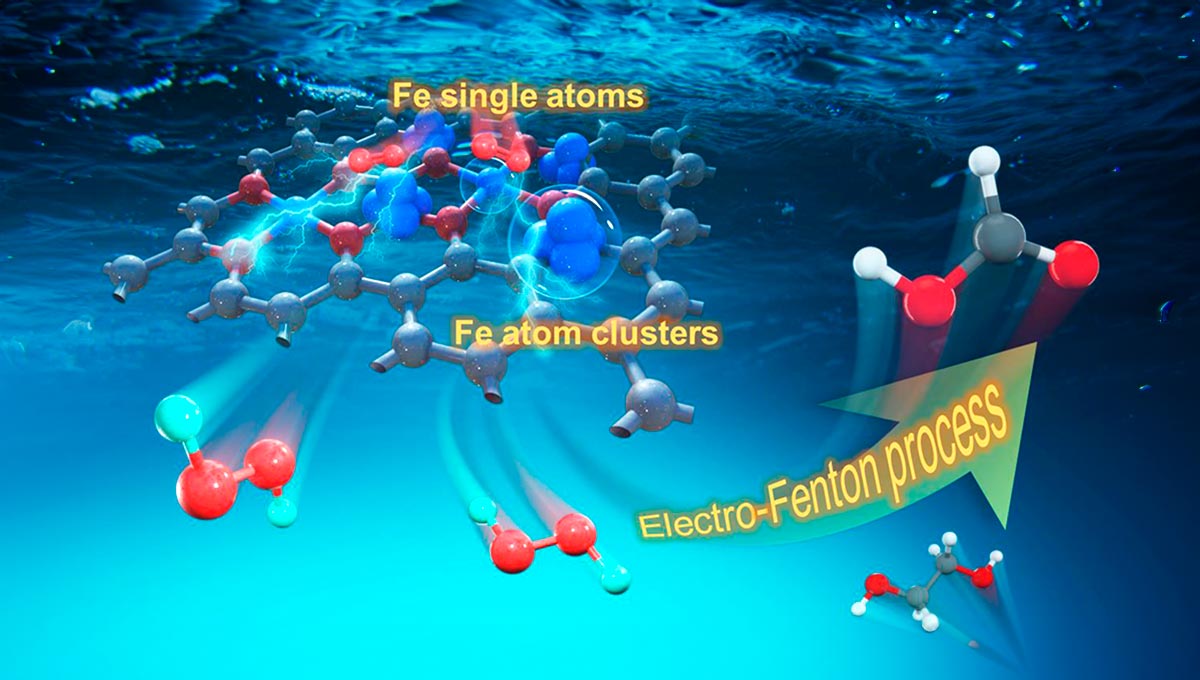
    New Approach Developed for Electrocatalytic H2O2 Production and Biomass Upgrading
    New Approach Developed for Electrocatalytic H2O2 Production and Biomass Upgrading. Credit: Hui Xu

    Chinese scientists have created a new electrocatalyst with oxygen-coordinated Fe atoms, significantly improving H2O2 production and biomass upgrading. This catalyst marks a significant step in sustainable chemical synthesis.

    Scientists from Hefei Institutes of Physical Science (HFIPS) of Chinese Academy of Sciences (CAS) have synthesized an oxygen-coordinated Fe single atoms and atom clusters catalyst, manifesting superior electrocatalytic performance toward H2O2 production and biomass upgrading.

    The Significance of H2O2 and Electrocatalysis

    Hydrogen peroxide (H2O2) is a widely used chemical with applications in diverse fields such as environment, energy, and healthcare. While traditionally manufactured through energy-intensive processes, electrocatalytic synthesis offers a greener and more efficient method using water and oxygen. However, this approach requires advanced electrocatalysts for high yield and selective H2O2 production, and further attention is needed for utilizing the generated H2O2, particularly in electrochemical organic oxidation processes. This presents significant potential for value-added applications beyond environmental remediation.
    New Approach Developed for Electrocatalytic H2O2 Production and Biomass Upgrading
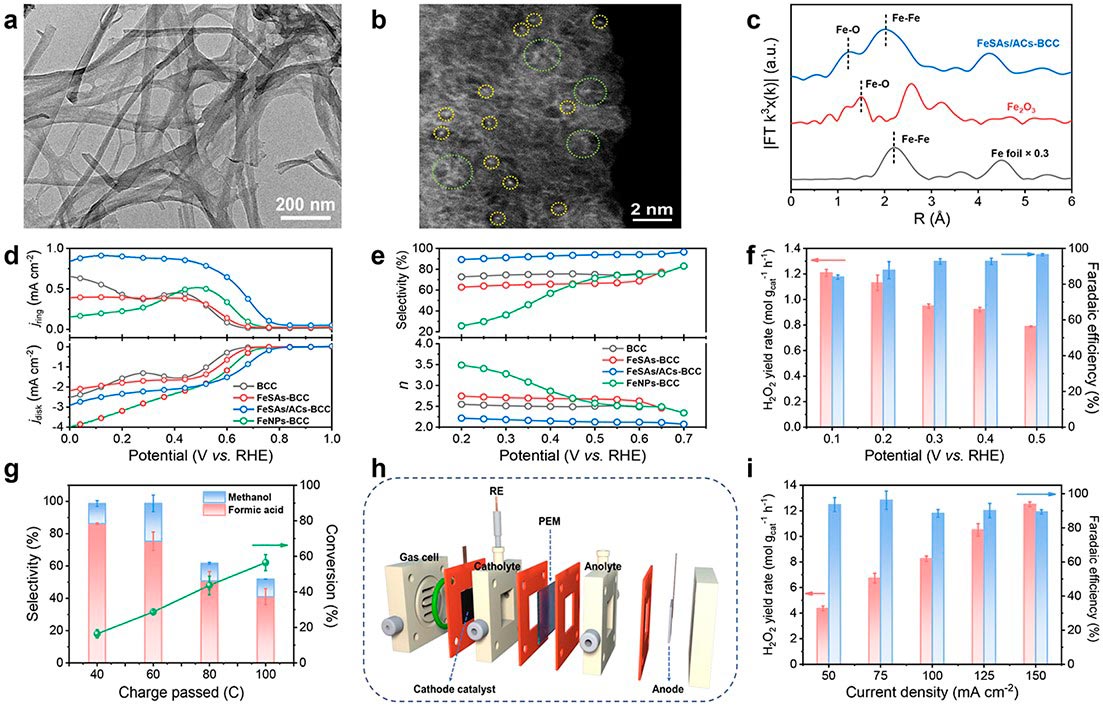
    Characterizations, electrochemical H2O2 synthesis performance and coupled electro-Fenton process of FeSAs/ACs-BCC. Credit: Hui Xu

    Innovative Catalyst Development Process

    In this study, the scientists utilized bacterial cellulose as the adsorption regulator and carbon source in combination with a multi-step approach involving wet-chemistry impregnation, pyrolysis, and acid-etching processes to create a catalyst termed FeSAs/ACs-BCC, consisting of oxygen-coordinated Fe single atoms and atom clusters. The presence of both Fe single atoms and clusters was confirmed using advanced imaging techniques such as aberration-corrected scanning transmission electron microscopy. Also, the atomic structure of Fe was determined using X-ray fine structure absorption spectroscopy and X-ray photoelectron spectroscopy.

    Exceptional Performance in Electrocatalysis

    This catalyst demonstrated outstanding electrocatalytic performance and selectivity for the 2-electron oxygen reduction reaction (2e– ORR) under alkaline conditions. Further H-cell experiments confirmed the accumulation of H2O2 in the electrolyte.

    Innovations in Biomass Upgrading

    Researchers successfully coupled the in situ generated H2O2 with the electro-Fenton process using ethylene glycol as the reactant and acidified 0.1M Na2SO4 as the electrolyte. This led to a high rate of ethylene glycol conversion and high selectivity for formic acid, showing that the electro-Fenton process has the potential to improve biomass-derived feedstocks through oxidative upgrading.

    Aside from that, they developed a three-phase flow cell based on the gas diffusion electrode to further enhance the H2O2 yield.

    Insights from Density Functional Theory

    Density functional theory analyses indicated that the actual catalytically active sites in the 2e– ORR process were the Fe clusters, and the electronic interaction between Fe single atoms and Fe clusters could significantly enhance the electrocatalytic performance toward 2e– ORR.

    Implications for Future Catalyst Design

    This study is instrumental in the design and development of atomic-level electrocatalysts. These catalysts are essential for high-efficiency 2e– ORR to H2O2 and biomass upgrading.

    Reference: “Atomically Dispersed Iron Regulating Electronic Structure of Iron Atom Clusters for Electrocatalytic H2O2 Production and Biomass Upgrading” by Hui Xu, Shengbo Zhang, Xinyuan Zhang, Min Xu, Miaomiao Han, Li Rong Zheng, Yunxia Zhang, Guozhong Wang, Haimin Zhang and Huijun Zhao, 9 November 2023, Angewandte Chemie International Edition.
    DOI: 10.1002/anie.202314414

    Never miss a breakthrough: Join the SciTechDaily newsletter.
    Follow us on Google and Google News.

    Catalysts Chinese Academy of Sciences Energy
    Share. Facebook Twitter Pinterest LinkedIn Email Reddit

    Related Articles

    Breakthrough Catalyst Turns CO2 Into Fuel With Incredible Efficiency

    The New King of Propylene? Cobalt Catalyst Outperforms Precious Metals

    Revolutionizing H2O2 Production: Ultrathin Nanosheets Show Immense Promise

    Eco-Friendly Breakthrough: Single Atom Catalyst Transforms CO2 Into Ethanol

    Efficient New Catalytic Approach Directly Converts Raw Biomass Into Natural Gas With Low Carbon Footprint

    Catalytic Hydrogenation of CO2 to Methanol: Low Temperature and High Efficiency

    Gasification Goes Green: Low-Temp Photocatalyst Slashes Carbon Footprint for Syngas

    Solving a Riddle That Would Provide the World With Entirely Clean, Renewable Energy

    Stanford Researchers Discover a New Route to Carbon-Neutral Fuels From Carbon Dioxide

    Leave A Reply Cancel Reply

    • Facebook
    • Twitter
    • Pinterest
    • YouTube

    Don't Miss a Discovery

    Subscribe for the Latest in Science & Tech!

    Trending News

    The Universe Is Expanding Too Fast and Scientists Can’t Explain Why

    “Like Liquid Metal”: Scientists Create Strange Shape-Shifting Material

    Early Warning Signals of Esophageal Cancer May Be Hiding in Plain Sight

    Common Blood Pressure Drug Shows Surprising Power Against Deadly Antibiotic-Resistant Superbug

    Scientists Uncover Dangerous Connection Between Serotonin and Heart Valve Disease

    Scientists Discover a “Protector” Protein That Could Help Reverse Hair Loss

    Bone-Strengthening Discovery Could Reverse Osteoporosis

    Scientists Uncover Hidden Trigger Behind Stem Cell Aging

    Follow SciTechDaily
    • Facebook
    • Twitter
    • YouTube
    • Pinterest
    • Newsletter
    • RSS
    SciTech News
    • Biology News
    • Chemistry News
    • Earth News
    • Health News
    • Physics News
    • Science News
    • Space News
    • Technology News
    Recent Posts
    • A Common Diabetes Drug May Hold the Key to Stopping HIV From Coming Back
    • Ancient “Syphilis-Like” Disease in Vietnam Challenges Key Scientific Assumptions
    • Drinking Alcohol To Cope in Your 20s Could Damage Your Brain for Life
    • Scientists Crack Alfalfa’s Chromosome Mystery After Decades of Debate
    • Ancient Ant-Plant Alliance Collapses As Predatory Wasps Move In
    Copyright © 1998 - 2026 SciTechDaily. All Rights Reserved.
    • Science News
    • About
    • Contact
    • Editorial Board
    • Privacy Policy
    • Terms of Use

    Type above and press Enter to search. Press Esc to cancel.