
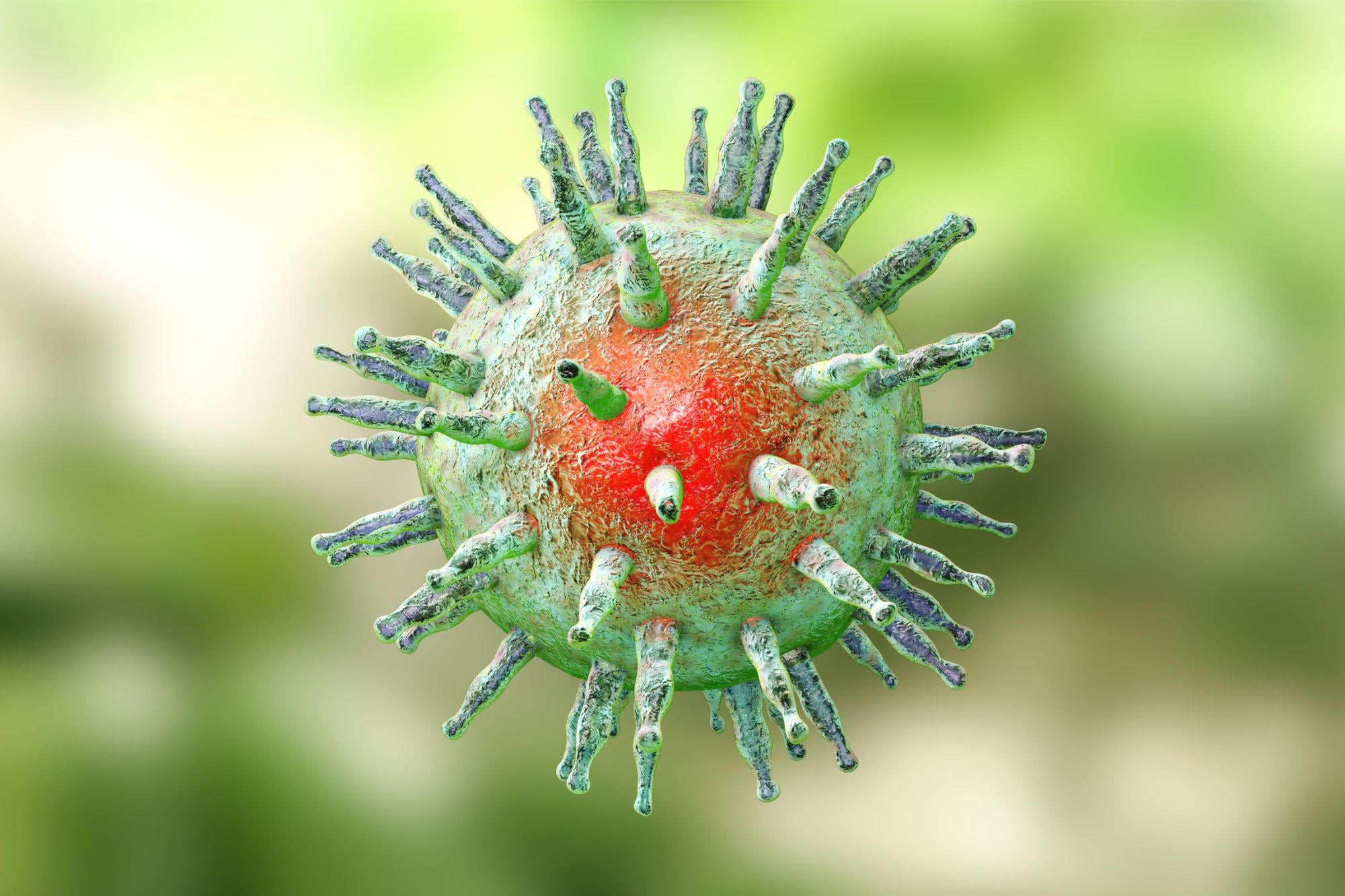
Scientists have taken a significant step toward neutralizing Epstein-Barr virus.
Scientists at Fred Hutch Cancer Center have reported an important advance in the effort to stop Epstein Barr virus (EBV), a virus believed to infect about 95% of people worldwide. EBV has been linked to several cancers, neurodegenerative disorders, and other long term health conditions.
To tackle the virus, researchers used mice engineered with human antibody genes. This approach allowed them to generate fully human monoclonal antibodies designed to block two critical viral surface proteins. These proteins normally help EBV attach to and enter human immune cells. The findings, published in Cell Reports Medicine, highlight one antibody in particular that protected mice with human immune systems from infection when they were exposed to EBV.
“Finding human antibodies that block Epstein Barr virus from infecting our immune cells has been particularly challenging because, unlike other viruses, EBV finds a way to bind to nearly every one of our B cells,” explained Andrew McGuire, PhD, a biochemist and cellular biologist in the Vaccine and Infectious Disease Division at Fred Hutch. “We decided to use new technologies to try to fill this knowledge gap and we ended up taking a critical step toward blocking one of the world’s most common viruses.”
A new scientific approach yields answers to a puzzling challenge
One of the central obstacles in this research was identifying human monoclonal antibodies that could stop EBV without provoking an anti drug immune response. Such reactions are common when patients receive antibodies originally produced in other animals.
The team concentrated on two viral proteins. The first, gp350, enables EBV to latch onto receptors on human cells. The second, gp42, plays a key role in allowing the virus to fuse with and enter those cells. By using a specialized mouse model containing human antibody genes, the scientists generated two monoclonal antibodies targeting gp350 and eight targeting gp42.
“Not only did we identify important antibodies against Epstein Barr virus, but we also validated an innovative a new approach for discovering protective antibodies against other pathogens,” noted Crystal Chhan, a pathobiology PhD student in the McGuire Lab. “As an early-career scientist, it was an exciting finding and has helped me appreciate how science often leads to unexpected discoveries.”
Additional studies conducted with support from Fred Hutch’s Antibody Tech Core identified specific weak points on the virus that may guide future vaccine design. In laboratory tests, one antibody directed at gp42 completely prevented EBV infection in mice with human immune systems. An antibody against gp350 offered partial protection.
Hope for patients at the highest risk of Epstein Barr virus
Each year, more than 128,000 people in the U.S. receive solid organ or bone marrow transplants. These patients must take medications that suppress their immune systems to prevent rejection. Currently, there are no targeted treatments that reliably prevent EBV infection or reactivation during this vulnerable period.
Uncontrolled EBV infection after transplantation can lead to post-transplant lymphoproliferative disorders (PTLD), an aggressive and sometimes life-threatening lymphoma. PTLD most often develops when EBV spreads unchecked in patients whose immune defenses are weakened.
“Post-transplant lymphoproliferative disorders (PTLD), most of which are EBV-associated lymphomas, are a frequent cause of morbidity and mortality after organ transplantation,” noted Rachel Bender Ignacio, MD, MPH, an associate professor and infectious disease physician at Fred Hutch and University of Washington School of Medicine. “Preventing EBV viremia has strong potential to reduce the incidence of PTLD and limit the need to reduce immunosuppression, thereby helping preserve graft function while improving overall patient outcomes. Effective prevention of EBV viremia remains a significant unmet need in transplant medicine.”
Transplant recipients can acquire EBV if donor organs or cells carry dormant virus. Patients who were previously infected may also experience viral reactivation when immunosuppressive drugs weaken immune control. Children undergoing transplants may face especially high risk because many have not yet been exposed to EBV and therefore lack natural immunity.
The next mile
The researchers are working toward a therapy that would involve infusing these monoclonal antibodies into high risk patients. The goal is to block EBV infection or reactivation and reduce the likelihood of PTLD.
Fred Hutch has filed for intellectual property protection covering the antibodies identified in the study. McGuire and Chhan are collaborating with academic partners and an industry collaborator to move the potential therapy forward. If development continues successfully, the treatment would first undergo safety testing in healthy adult volunteers before advancing to clinical trials in transplant recipients and other immunocompromised patients.
“There’s momentum to advance our discovery to a therapy that would make a huge difference for patients undergoing transplant,” said McGuire. “After many years of searching for a viable way to protect against Epstein Barr virus, this is a significant stride for the scientific community and the people at the highest risk of complications from this virus.”
Reference: “Transgenic mouse-derived human monoclonal antibodies targeting EBV gp350 and gp42 provide basis for therapeutic development” by Crystal B. Chhan, Kevin Lang, Amelia R. Davis, Yu-Hsin Wan, Nicholas T. Aldridge, Gargi Kher, Samuel C. Scharffenberger, Samantha R. Hardy, Roman Iureniev, Natalia V. Giltiay, Kristina R. Edwards, Stefan Radtke, Hans-Peter Kiem, Marie Pancera and Andrew T. McGuire, 17 February 2026, Cell Reports Medicine.
DOI: 10.1016/j.xcrm.2026.102618
Funding: National Institute of Allergy and Infectious Diseases, National Cancer Institute, Fred Hutchinson Cancer Research Center
Never miss a breakthrough: Join the SciTechDaily newsletter.
Follow us on Google and Google News.
7 Comments
why do you call it “Fred Hutch” everywhere in the article when the name is “Fred Hutchinson”?
This is a very common abbreviation among those who are familiar with Fred Hutchinson
Show me the virus! Send me a scientific paper from any source explaining step by step how to isolate and purify a “virus ” . Further more explain how your isolet is the cause of symptoms of sickness in humans and animals alike.
Autoimmune Disorrder are manly
From stress. Eptstien Barr virus.
It’s not the Blood type. It’s food that we eat and how we take care of your body on the inside.there are vitamins that we can take if are body is not make the. Any longer.
Like if someone has a virus from
flowers they can take Claritin it drys up your in sides mucus manbrai. Cancer IVIG treatment
Organ or bone marrow cell cept perdazon,meditation.
Donate platelets. Blood because if you have you red and white and the oxygen in your blood is choking your red cells. They need to get treatment .your red cell turn white. Would like to know more about this EBV virus you can dry up Take Vitamins C ,B12,D,E,K and Iron
Immune Disorder, Virus
It all in the blood system Ana tinter if it is a positive or negative and you find that out you will have a cure for the Immune system and for the viruses also. Stem cells it all in the blood cells and they must match each other.
Autoimmune Disorrder are manly
From stress. Eptstien Barr virus.
It’s not the Blood type. It’s food that we eat and how we take care of your body on the inside.there are vitamins that we can take if are body is not make the. Any longer.
Like if someone has a virus from
flowers they can take Claritin it drys up your in sides mucus manbrai. Cancer IVIG treatment
Organ or bone marrow cell cept perdazon,meditation.
Donate platelets. Blood because if you have you red and white and the oxygen in your blood is choking your red cells. They need to get treatment .your red cell turn white. Would like to know more about this EBV virus you can dry up Take Vitamins C ,B12,D,E,K and Iron
Immune Disorder, Virus
It all in the blood system Ana tinter if it is a positive or negative and you find that out you will have a cure for the Immune system and for the viruses also. Stem cells it all in the blood cells and they must match each other.
This is huge news
I personally believe that the herpesviruses are the reason we all age and die. Our immune system is constantly having to keep them in check. Eventually they just wear us out. If they could find a vaccine that could irradicate all of them, we could almost be immortal