
Close Menu
    Facebook X (Twitter) Instagram
    SciTechDaily
    • Biology
    • Chemistry
    • Earth
    • Health
    • Physics
    • Science
    • Space
    • Technology
    Facebook X (Twitter) Pinterest YouTube RSS
    SciTechDaily
    Home»Technology»Carbon Microthreads Could Link Machines & Human Brains
    Technology

    Carbon Microthreads Could Link Machines & Human Brains

    By SciTechDailyNovember 15, 2012No Comments2 Mins Read
    Facebook Twitter Pinterest Telegram LinkedIn WhatsApp Email Reddit
    Share
    Facebook Twitter LinkedIn Pinterest Telegram Email Reddit
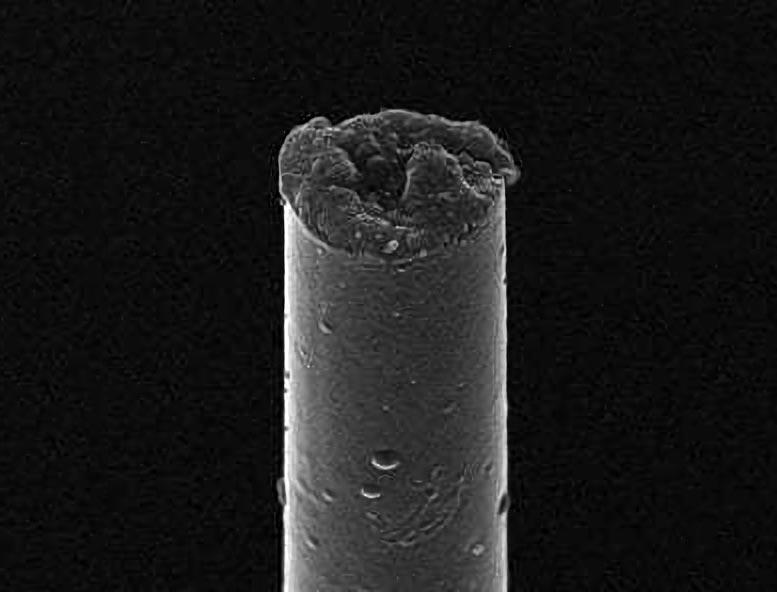
    Carbon Fiber Electrode
    An electrode made from a carbon fiber thread is 7 micrometers wide. Credit: MIT

    In order to link human brains to computers, the interface needs to be delicate enough not to damage nerve tissue, but resilient enough to last for decades.

    The scientists published their findings in the journal Nature Materials. Scientists have come up with a stealthy neural interface made from a single carbon fiber and coated with chemicals to make it resistant to proteins in the brain.

    This new microthread electrode is designed to pick up signals from a single neuron as it fires and is only 7 micrometers in diameter. This is the thinnest electrode that has ever been developed, and is about 100 times as thin as conventional metal electrodes used to study animal brains.

    Researchers need long-lasting electrodes so that they can improve brain-machine interfaces. These systems, which are currently in preliminary studies, allow paralyzed people to control robotic limbs or a computer mouse. Using electrodes to record the firing of individual brain cells, scientists have learned to decode these signals as representing the movement of a rat’s whiskers or a quadriplegic’s effort to move his arms.

    It could prove difficult to insert such a fine, flexible electrode into brain tissue and to secure them. But the researchers believed the small fibers are “a good thing, because they seem to be ‘ignored’ by the brain.” Conventional electrodes stop recording after a couple of years once scar tissue builds up around them. They researchers also coated its tip with a polymer that helps it pick up electrical signals.

    Reference: “Ultrasmall implantable composite microelectrodes with bioactive surfaces for chronic neural interfaces” by Takashi D. Yoshida Kozai, Nicholas B. Langhals, Paras R. Patel, Xiaopei Deng, Huanan Zhang, Karen L. Smith, Joerg Lahann, Nicholas A. Kotov and Daryl R. Kipke, 11 November 2012, Nature Materials.
    DOI: 10.1038/nmat3468

    Never miss a breakthrough: Join the SciTechDaily newsletter.
    Follow us on Google and Google News.

    Carbon Materials Science Microthreads Neuroscience
    Share. Facebook Twitter Pinterest LinkedIn Email Reddit

    Related Articles

    Revolutionary “Massless” Battery Technology Could Extend EV Range by 70%

    Nanowire Network at the “Edge of Chaos” Opens Pathway to Artificial Intelligence Discoveries

    New Non-Invasive MRI Technology Detects Alzheimer’s Disease Early

    3D Self-Assembling Polymer Materials Could Lead to New Microchips

    LCLS Low-Energy Test Just Shy of the 284-Electronvolt Carbon Edge

    BrainGate Neural Interface System Allows People with Paralysis to Control Robotic Arms

    Robot Outperforms Humans in Neuroscience Procedure

    Elastomeric “Soft” Robots Running on Pneumatic Actuators

    Researchers Develop World’s Lightest Material

    Leave A Reply Cancel Reply

    • Facebook
    • Twitter
    • Pinterest
    • YouTube

    Don't Miss a Discovery

    Subscribe for the Latest in Science & Tech!

    Trending News

    What Causes Chronic Pain? Scientists Identify Key Culprit in the Brain

    Semaglutide Shows Surprising Mental Health Benefits in Massive 100,000-Person Study

    This Liquid Snapped Instead of Flowing and Scientists Were Shocked

    Breakthrough Alzheimer’s Drug Rewires the Brain Instead of Just Clearing Plaques

    Scientists Discover Hidden “Footprint of Death” That Could Transform How We Fight Disease

    A Simple Nose Swab Could Detect Alzheimer’s Years Before Symptoms Appear

    Scientists Just Rewrote the Timeline of Complex Life on Earth

    Teenager’s Fossil Find Leads to Discovery of Shark Teeth in 5 Million-Year-Old Whale Skull

    Follow SciTechDaily
    • Facebook
    • Twitter
    • YouTube
    • Pinterest
    • Newsletter
    • RSS
    SciTech News
    • Biology News
    • Chemistry News
    • Earth News
    • Health News
    • Physics News
    • Science News
    • Space News
    • Technology News
    Recent Posts
    • Even “Failed” Diets May Deliver Long-Term Health Gains, Study Finds
    • Childhood Junk Food May Rewire the Brain for Life
    • NIH Scientists Discover Powerful New Opioid That Relieves Pain Without Dangerous Side Effects
    • Breakthrough Study Reveals Why Damaged Nerves Struggle To Heal
    • 20-Year Study Reveals Cholera’s Surprising Weakness
    Copyright © 1998 - 2026 SciTechDaily. All Rights Reserved.
    • Science News
    • About
    • Contact
    • Editorial Board
    • Privacy Policy
    • Terms of Use

    Type above and press Enter to search. Press Esc to cancel.