
Close Menu
    Facebook X (Twitter) Instagram
    SciTechDaily
    • Biology
    • Chemistry
    • Earth
    • Health
    • Physics
    • Science
    • Space
    • Technology
    Facebook X (Twitter) Pinterest YouTube RSS
    SciTechDaily
    Home»Space»Chandra Reveals Feedback from Supermassive Black Holes
    Space

    Chandra Reveals Feedback from Supermassive Black Holes

    By Harvard-Smithsonian Center For AstrophysicsMay 2, 20191 Comment2 Mins Read
    Facebook Twitter Pinterest Telegram LinkedIn WhatsApp Email Reddit
    Share
    Facebook Twitter LinkedIn Pinterest Telegram Email Reddit
    Feedback from Supermassive Black Holes
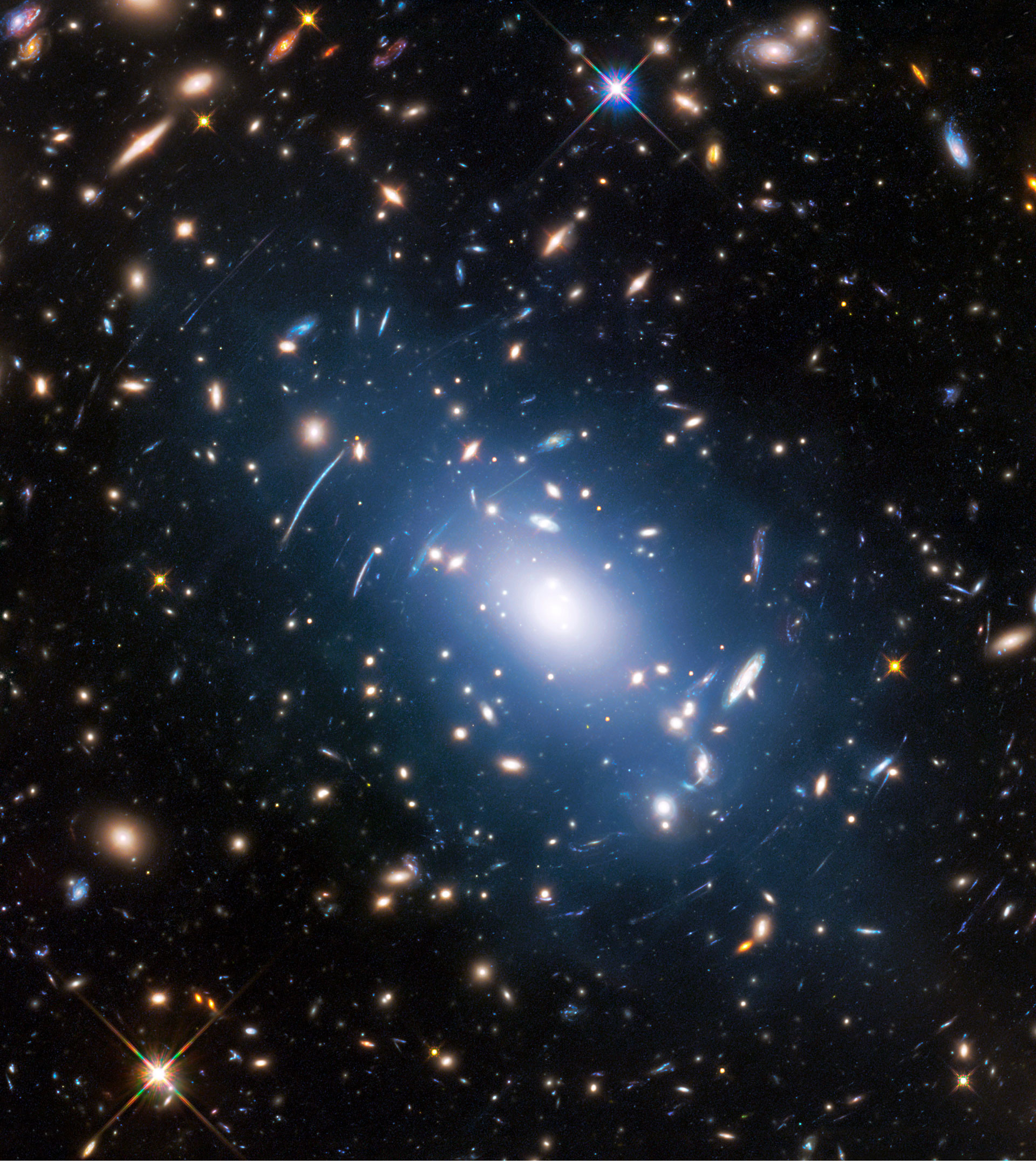
    A Hubble image of the galaxy cluster Abell S1063. Astronomers using the Chandra X-ray Observatory to study the cluster 3C88 have found that activity around the supermassive black hole has powered jets that heat the intracluster gas, and that these jets have recently changed their orientation. Credit: NASA, ESA, and M. Montes (University of New South Wales)

    X-ray observations have found copious amounts of very hot gas in galaxy clusters, and in the central regions more than was expected. While supernovae and shock excitation will heat the gas, it should cool off and flow back onto the galaxies, yet this is not observed. Astronomers have suggested that some other source continues to heat the gas, and a prime candidate is feedback from the supermassive black holes that make up active galactic nuclei (AGN). X-ray observations have indeed found evidence for disturbed gas that could be caused by AGN jets that generate hot bubbles as they push outward. How the energy from the AGN outburst actually heats the gas is, however, poorly understood.

    Harvard-Smithsonian Center For Astrophysics (CfA) astronomers Paul Nulsen and Bill Forman and their colleagues used very sensitive Chandra observations, together with radio images from the new Giant Metrewave Radio Telescope near Pune, India and the Very Large Array in New Mexico, to study an AGN outburst in the local group of galaxies called 3C 88. They were able to detect shocks pumping energy into a hot cavity equivalent to over a billion suns shining for a billion years, the largest amount of such activity known at the center of a cluster. Moreover, the observed AGN jets are not aligned with the shape of the hot cavity. This new result reconfirms that powerful AGN with jets can indeed keep the X-ray gas hot and slow its flow back onto the galaxy cluster. The scientists also argue that in this case the AGN jets have apparently reoriented relatively recently, perhaps in just the past few tens of millions of years.

    Reference: “AGN Feedback in Galaxy Group 3C 88: Cavities, Shock, and Jet Reorientation” by Wenhao Liu, Ming Sun, Paul Nulsen, Tracy Clarke, Craig Sarazin, William Forman, Massimo Gaspari, Simona Giacintucci, Dharam Vir Lal and Tim Edge, 24 January 2019, Monthly Notices of the Royal Astronomical Society.
    DOI: 10.1093/mnras/stz229

    Never miss a breakthrough: Join the SciTechDaily newsletter.
    Follow us on Google and Google News.

    Black Hole Chandra X-ray Observatory Harvard-Smithsonian Center for Astrophysics
    Share. Facebook Twitter Pinterest LinkedIn Email Reddit

    Related Articles

    Massive X-ray Jet – Extending for 160,000 Light-Years – Spied From Supermassive Black Hole in Early Universe

    The Recipe for Powerful Quasar Jets: Why Some Supermassive Black Holes Launch Powerful Beams

    Record-Breaking, Gargantuan Black Hole Eruption – Biggest Explosion Seen in the Universe

    Outbursts From Supermassive Black Hole Transform Exoplanets

    Chandra Identifies X-Ray Emission from the Nuclear Region of Arp 220

    Astronomers Discover a Cosmic Particle Accelerator in Abell 3411 and 3412

    NASA’s Chandra Views a Stellar Circle of Life, Cygnus X-3

    Link Between Accretion Mode and Environment in Radio-Loud Active Galaxies Revealed

    Black Hole Ejected from Home Galaxy, Moving at 3 Million MPH

    1 Comment

    1. Jose Principote on May 28, 2021 12:53 pm

      The observed AGN jets are in agreement with the Global Physics development of galaxies and dark energy
      https://molwick.com/en/astrophysics/r-galaxy-formation.gif
      https://molwick.com/en/astrophysics/045-dark-matter-rotation-galaxies.html

      Reply
    Leave A Reply Cancel Reply

    • Facebook
    • Twitter
    • Pinterest
    • YouTube

    Don't Miss a Discovery

    Subscribe for the Latest in Science & Tech!

    Trending News

    Breakthrough Bowel Cancer Trial Leaves Patients Cancer-Free for Nearly 3 Years

    Natural Compound Shows Powerful Potential Against Rheumatoid Arthritis

    100,000-Year-Old Neanderthal Fossils in Poland Reveal Unexpected Genetic Connections

    Simple “Gut Reset” May Prevent Weight Gain After Ozempic or Wegovy

    2.8 Days to Disaster: Scientists Warn Low Earth Orbit Could Suddenly Collapse

    Common Food Compound Shows Surprising Power Against Superbugs

    5 Simple Ways To Remember More and Forget Less

    The Atomic Gap That Could Cost the Semiconductor Industry Billions

    Follow SciTechDaily
    • Facebook
    • Twitter
    • YouTube
    • Pinterest
    • Newsletter
    • RSS
    SciTech News
    • Biology News
    • Chemistry News
    • Earth News
    • Health News
    • Physics News
    • Science News
    • Space News
    • Technology News
    Recent Posts
    • After 37 Years, the World’s Longest-Running Soil Warming Experiment Uncovers a Startling Climate Secret
    • NASA Satellite Captures First-Ever High-Res View of Massive Pacific Tsunami
    • ADHD Isn’t Just a Deficit: Study Reveals Powerful Hidden Strengths
    • Scientists Uncover “Astonishing” Hidden Property of Light
    • Scientists Discover Stem Cells That Could Regrow Teeth and Bone
    Copyright © 1998 - 2026 SciTechDaily. All Rights Reserved.
    • Science News
    • About
    • Contact
    • Editorial Board
    • Privacy Policy
    • Terms of Use

    Type above and press Enter to search. Press Esc to cancel.