
CHARA Array Will Add a Seventh Telescope To Triple Its Resolution
Plans are underway to add a seventh movable telescope to Georgia State University’s Center for High Angular Resolution Astronomy— known as the CHARA Array—that would increase the resolution, or the ability to see small objects, by a factor of three.
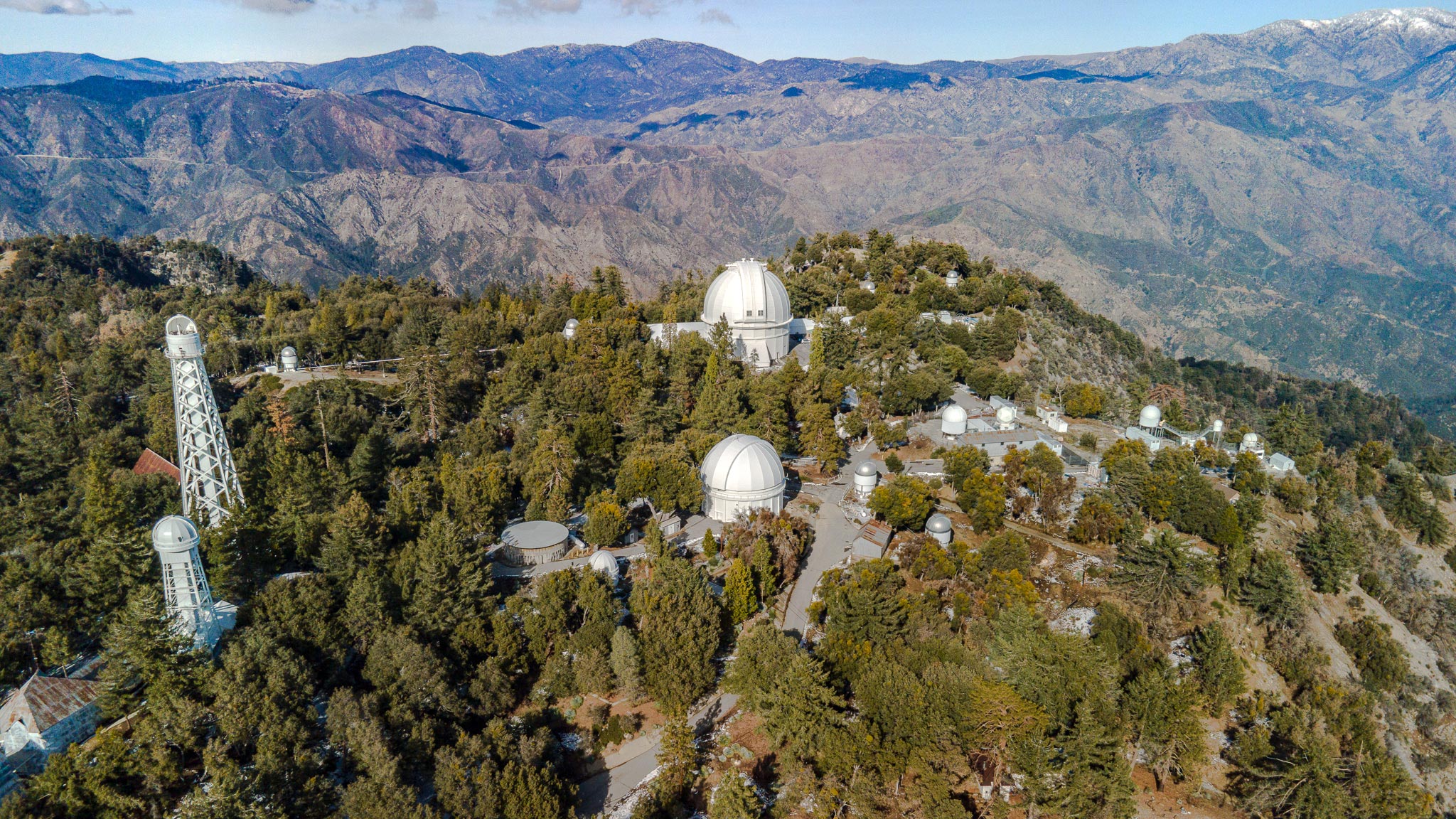
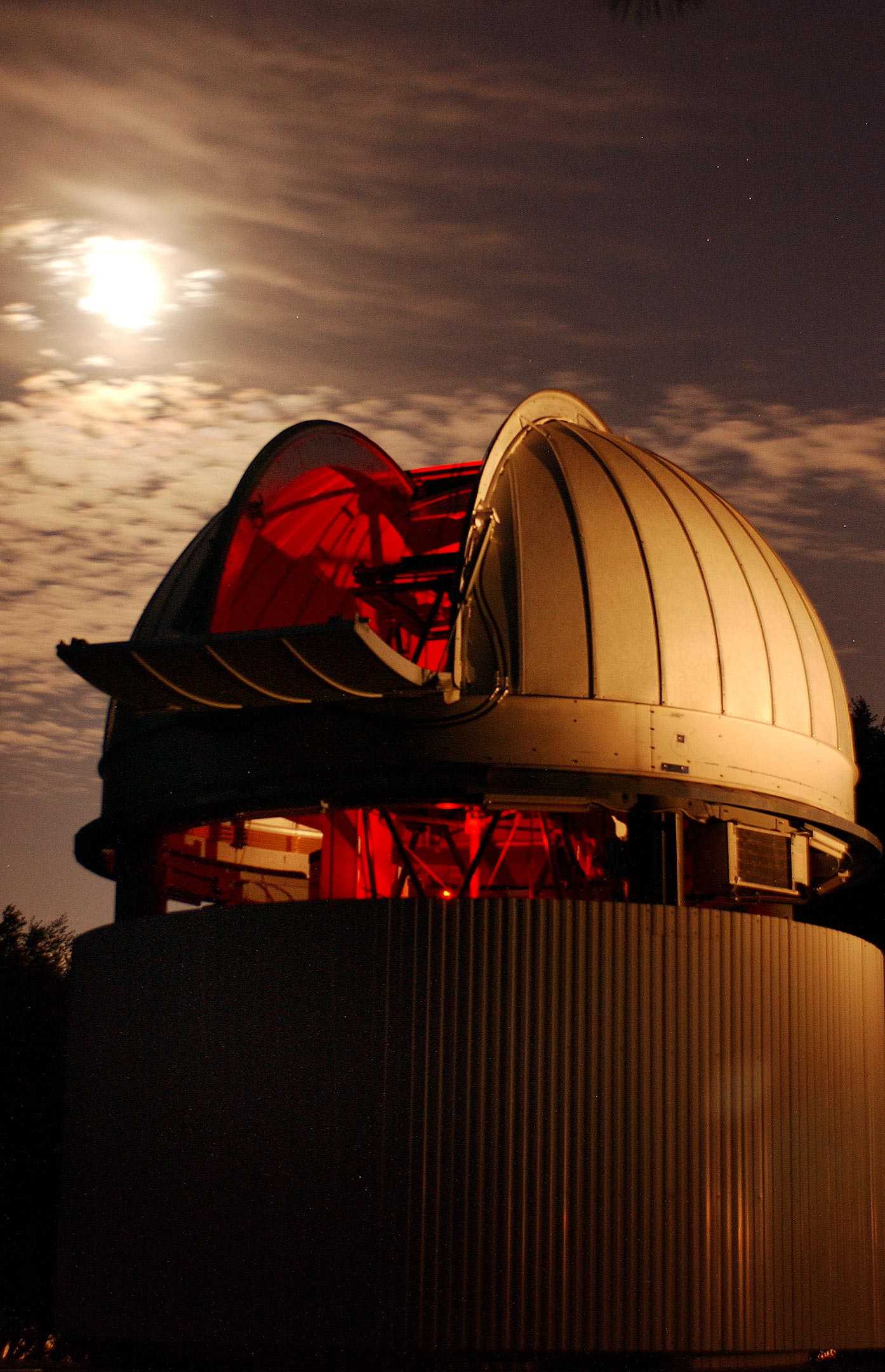
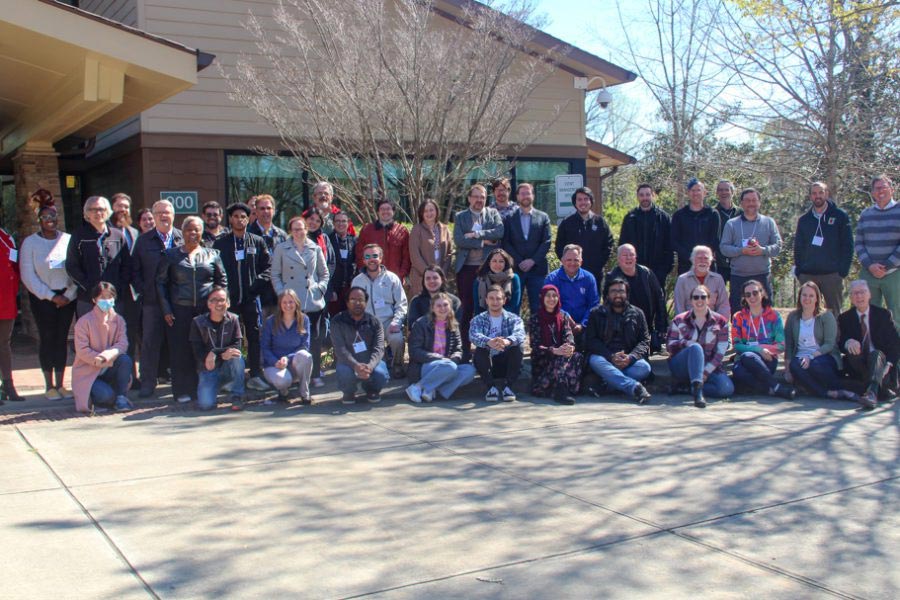
Located at Mount Wilson Observatory in Southern California and operated by Georgia State, the new telescope will be connected using fiber optics to transport the starlight, a technique that will serve as a pathfinder for future expansion of the Array. The update comes after a group of international scientists gathered in Atlanta to take part in the 2023 CHARA Science Meeting to share the latest developments in high-resolution astronomical imaging using the CHARA Array.
“Adding a seventh moveable telescope to the Array represents a great leap forward in stellar astronomy,” says Doug Gies, Regents’ Professor of Physics and Astronomy and director of the center. “Collaboration is truly fundamental for an undertaking like the CHARA Array. With scientists all over the world using our telescopes, this annual gathering is an important forum for us to share our latest discoveries.”
The Power and Potential of the CHARA Array
The CHARA Array combines the light from six optical telescopes spread across the mountaintop to image stars with a spatial resolution equivalent to a single telescope 331 meters (over 1000 ft) in diameter. The visible and infrared observatory offers astronomers the opportunity to capture images of space with better resolution than any other telescope in the world.
More than 40 members of the CHARA Consortium, which represents 10 institutions around the world, took part in the annual review of the latest scientific and technical progress.
CHARA features a new suite of instruments built by partner institutions at the University of Michigan, University of Exeter, and Observatoire de la Côte d’Azur in France. This next generation of instrumentation provides unprecedented capabilities to image the surfaces of stars and their circumstellar environments at a variety of different wavelengths from the near-infrared to the visible part of the spectrum. Georgia State University is also building a new instrument that will increase the sensitivity of the CHARA Array to measure light 30 times fainter than possible now. This improvement will help astronomers probe the gas clouds swirling around supermassive black holes in very distant active galaxies.
With funding from the National Science Foundation (NSF), CHARA has expanded its user base over the last six years by offering open access time to the global community of astronomers through a competitive proposal process offered through the National Optical-Infrared Astronomy Research Laboratory. In addition to over 60 active observers at Georgia State University and partner institutions, the open-access program has received applications from over 350 visiting astronomers around the world.
“Expanding the user community brings new opportunities for innovative science projects that broaden the impact and productivity of the CHARA Array,’’ says Gail Schaefer, Director of the CHARA Array.
At the recent meeting, members presented some science highlights and findings from the CHARA Array.
- Georgia State graduate student Katherine Shepard presented results on a sample of evolved massive binary star systems surrounded by outflowing disks. The disks in these fascinating systems form as one star in the system grows in size as it evolves and material from that star is transferred to the companion. Some of the mass escapes into a disk that surrounds the system. Katherine is using the CHARA Array to resolve the structure of these disks and search for interactions between the disk and the inner binary system.
- Noura Ibrahim, a graduate student from the University of Michigan, imaged the ring-like structure of a circumstellar disk around the young star V1295 Aquila. Two images taken one month apart show a bright spot in the ring that rotates between the two epochs. This variation could be caused by a stellar companion, an exoplanet in formation, or asymmetries in the density distribution.
- Visiting astronomer Willie Torres at the Harvard-Smithsonian Center for Astrophysics mapped the orbits in the Castor multiple star system. The system consists of Castor A and B that revolve around each other every 450 years, and each component in turn are short-period binary systems with periods of a few days. They are joined by a more distant component Castor C, which is also a binary. Torres used the CHARA Array to resolve the close, faint companions in Castor A and B for the first time. He combined these observations with historical observations spanning the past three centuries to map the orbits of the stars in the Castor system and measure their stellar masses with a precision better than 1%. The CHARA observations were also used to measure the radii of the two brightest stars to infer an age for the system of 290 million years.
- Rachael Roettenbacher, a Postdoctoral Associate from the University of Michigan, presented recent work on mapping starspots over a rotation cycle for the sun-like star Epsilon Eridani, which is orbited by an exoplanet. The starspot images, in combination with data from other telescopes, were used to develop a technique to distinguish between small changes in the stellar spectrum caused by starspots and those caused the orbiting planet. These techniques will improve the detection of planets around other stars.
The annual meeting was followed by a workshop on imaging and modeling of interferometric observations. Participants were given an overview of modeling and imaging software packages available to analyze data from stellar interferometers (arrays of telescopes that combine light together), and the workshop included interactive hands-on sessions where participants used the software tools to analyze data. Participants also brought their own data for review in order to get the most from observations made with the CHARA Array.
Never miss a breakthrough: Join the SciTechDaily newsletter.
Follow us on Google and Google News.