
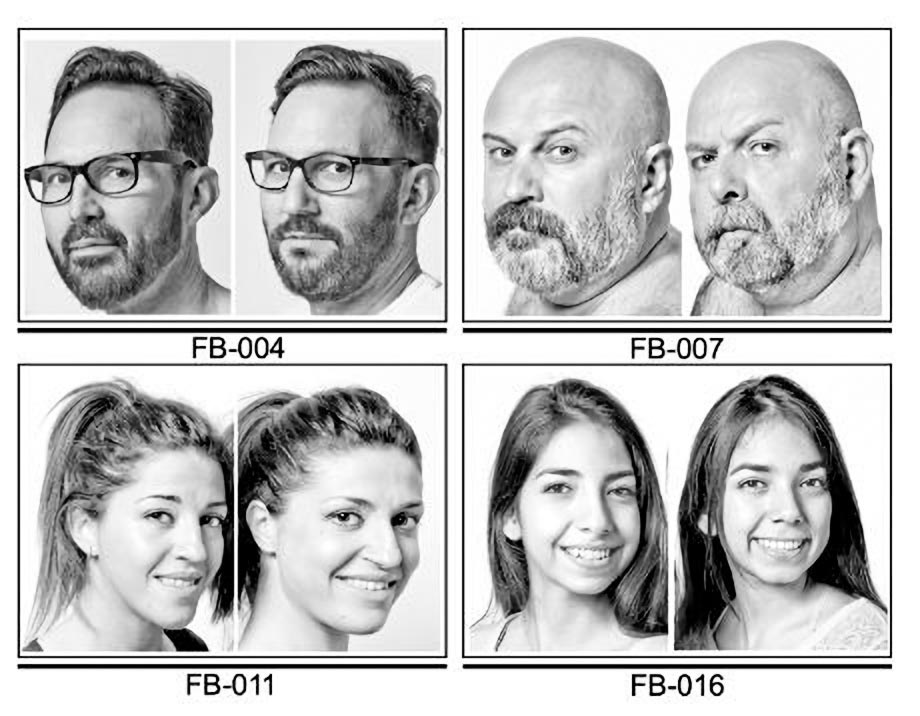
A study on unrelated lookalikes found shared genetic variants that explain facial similarity, offering potential applications in forensics and genetic diagnosis.
A collection of photos of genetically unrelated lookalikes, along with DNA analysis, has revealed that strong facial similarity is linked with shared genetic variants. The work will be published today (August 23rd) in the journal Cell Reports.
“Our study provides a rare insight into human likeness by showing that people with extreme lookalike faces share common genotypes, whereas they are discordant at the epigenome and microbiome levels,” says senior author Manel Estellerof the Josep Carreras Leukaemia Research Institute in Barcelona, Spain. “Genomics clusters them together, and the rest sets them apart.”
The number of people identified online as doubles or virtual twins who are genetically unrelated has increased with the expansion of the World Wide Web and the possibility of exchanging pictures of humans across the planet. In the new study, Esteller and his research team set out to characterize, on a molecular level, random human beings that objectively share facial features.
To do this, they recruited human doubles from the photographic work of François Brunelle. He is a Canadian artist who has been obtaining worldwide pictures of lookalikes since 1999. They obtained headshot pictures of 32 lookalike couples. The scientists determined an objective measure of likeness for the pairs using three different facial recognition algorithms.
DNA Analysis Reveals Shared Genotypes
Additionally, the participants completed a comprehensive biometric and lifestyle questionnaire and provided saliva DNA for multiomics analysis. “This unique set of samples has allowed us to study how genomics, epigenomics, and microbiomics can contribute to human resemblance,” Esteller says.
Overall, the results revealed that these individuals share similar genotypes, but differ in their DNA methylation and microbiome landscapes. Half of the lookalike pairs were clustered together by all three algorithms. Genetic analysis revealed that 9 of these 16 pairs clustered together, based on 19,277 common single-nucleotide polymorphisms.
Physical and Behavioral Correlations
Furthermore, physical traits such as weight and height, as well as behavioral traits such as smoking and education, were correlated in lookalike pairs. Taken together, the findings suggest that shared genetic variation not only relates to similar physical appearance, but may also influence common habits and behavior.
“We provided a unique insight into the molecular characteristics that potentially influence the construction of the human face,” Esteller says. “We suggest that these same determinants correlate with both physical and behavioral attributes that constitute human beings.”
There were a few study limitations. These include the small sample size, the use of 2D black-and-white images, and the predominance of European participants. Despite these caveats, the findings may provide a molecular basis for future applications in various fields such as biomedicine, evolution, and forensics.
“These results will have future implications in forensic medicine—reconstructing the criminal’s face from DNA—and in genetic diagnosis—the photo of the patient’s face will already give you clues as to which genome he or she has,” Esteller says. “Through collaborative efforts, the ultimate challenge would be to predict the human face structure based on the individual’s multiomics landscape.”
Reference: “Look-alike humans identified by facial recognition algorithms show genetic similarities” by Ricky S. Joshi, Maria Rigau, Carlos A. García-Prieto, Manuel Castro de Moura, David Piñeyro, Sebastian Moran, Veronica Davalos, Pablo Carrión, Manuel Ferrando-Bernal, Iñigo Olalde, Carles Lalueza-Fox, Arcadi Navarro, Carles Fernández-Tena, Decky Aspandi, Federico M. Sukno, Xavier Binefa, Alfonso Valencia and Manel Esteller, 23 August 2022, Cell Reports.
DOI: 10.1016/j.celrep.2022.111257
This work was funded by the governments of Catalonia and Spain, as well as the Cellex Foundation. Declarations of interest can be found in the paper.
Never miss a breakthrough: Join the SciTechDaily newsletter.
Follow us on Google and Google News.