

Theoretical physicists help expand the search for new particle — ‘axions’ — that could help answer one of the most puzzling questions in physics.
One of the most high-profile mysteries in physics today is what scientists refer to as the “Strong CP Problem.” Stemming from the puzzling phenomenon that neutrons do not interact with electric fields despite being made up of quarks—smaller, fundamental particles that carry electric charges—the Strong CP Problem puts into question the Standard Model of physics, or the set of theories scientists have been using to explain the laws of nature for years.
A team led by University of Minnesota Twin Cities theoretical physicists has discovered a new way to search for axions, hypothetical particles that could help solve this mystery. Working in collaboration with experimental researchers at the Fermilab National Accelerator Laboratory, the physicists’ new strategy opens up previously unexplored opportunities to detect axions in particle collider experiments.
The researchers’ paper is published and featured as the Editor’s suggestion in Physical Review Letters, a peer-reviewed scientific journal published by the American Physical Society.
“As particle physicists, we’re trying to develop our best understanding of nature,” said Zhen Liu, co-author of the paper and an assistant professor in the University of Minnesota School of Physics and Astronomy. “Scientists have been tremendously successful in the past century in finding elementary particles through established theoretical frameworks. So, it’s extremely puzzling why neutrons do not couple to electric fields because in our known theory, we would expect them to. If we do discover the axion, it will be a great advance in our fundamental understanding of the structure of nature.”
One of the primary means for studying subatomic particles, and potentially discovering new ones, is collider experiments. Essentially, scientists force beams of particles to collide—and when they hit each other, the energy they produce creates other particles that pass through a detector, allowing researchers to analyze their properties.
Innovative Axion Search Using Muon Decays
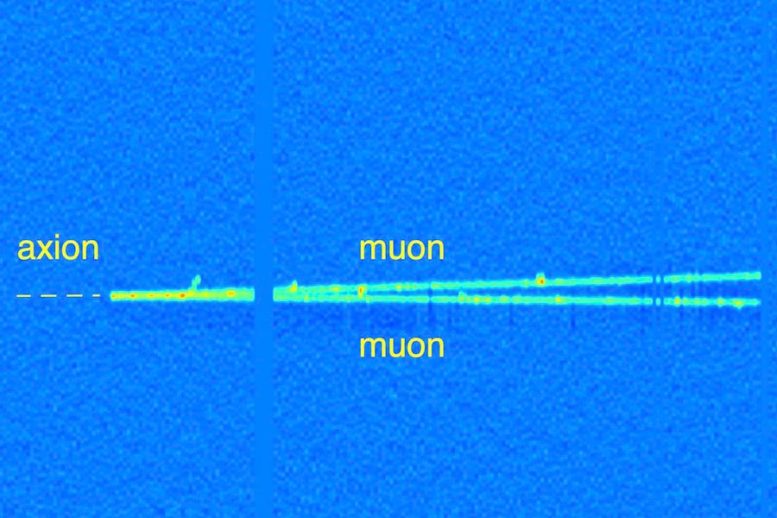
Liu and his team’s proposed method involves measuring the “decay” product—or what happens when an unstable heavy particle transforms into multiple lighter particles—of the hypothetical axion into two muons, known particles that are essentially the heavier version of the electron. By working backward from the muon tracks in the detector to reconstruct such decays, the researchers believe they have a chance to locate the axion and prove its existence.
“With this research, we’re expanding ways we can search for the axion particle,” said Raymond Co, co-author of the paper and a postdoctoral researcher in the University of Minnesota School of Physics and Astronomy and William Fine Theoretical Physics Institute. “People have never used axion decay into muons as a way to search for the axion particle in neutrino or collider experiments before. This research opens up new possibilities to pave the way for future endeavors in our field.”
Liu and Co, along with University of Minnesota physics and astronomy postdoctoral researcher Kun-Feng Lyu and University of California, Berkeley postdoctoral researcher Soubhik Kumar, are behind the theoretical part of the research. They’re a part of the ArgoNeuT collaboration, which brings together theorists and experimentalists from across the country to study particles through experiments at Fermilab.
In this paper, the University of Minnesota-led theoretical team worked with the experimental researchers to perform a search for axions using their new method and existing data from the ArgoNeuT experiment. The researchers plan to use the experimental results to further refine their theoretical calculations of the axion production rate in the future.
Reference: “First Constraints on Heavy QCD Axions with a Liquid Argon Time Projection Chamber Using the ArgoNeuT Experiment” by R. Acciarri, C. Adams, B. Baller, V. Basque, F. Cavanna, R. T. Co, R. S. Fitzpatrick, B. Fleming, P. Green, R. Harnik, K. J. Kelly, S. Kumar, K. Lang, I. Lepetic, Z. Liu, X. Luo, K. F. Lyu, O. Palamara, G. Scanavini, M. Soderberg, J. Spitz, A. M. Szelc, W. Wu and T. Yang (The ArgoNeuT Collaboration), 31 May 2023, Physical Review Letters.
DOI: 10.1103/PhysRevLett.130.221802
The research was funded by the U.S. Department of Energy’s Office of Science; the National Science Foundation; the United Kingdom Research and Innovation’s Science and Technology Facilities Council; and the UK’s Royal Society.
In addition to Liu, Co, Lyu, and Kumar, the team for this paper included researchers Roberto Acciarri, Bruce Baller, Vincent Basque, Flavio Cavanna, Roni Harnik, Ornella Palamara, Wanwei Wu, and Tingjun Yang (Fermi National Accelerator Laboratory); Corey Adams (Argonne National Laboratory); Rory Fitzpatrick and Joshua Spitz (University of Michigan); Bonnie Fleming and Giacomo Scanavini (Yale University); Patrick Green (University of Manchester, University of Oxford); Kevin Kelly (European Organization for Nuclear Research or CERN); Karol Lang (University of Texas at Austin); Ivan Lepetic (Rutgers University); Xiao Luo (University of California, Santa Barbara); Mitchell Soderberg (Syracuse University); and Andrzej Szelc (University of Edinburgh).
Never miss a breakthrough: Join the SciTechDaily newsletter.
Follow us on Google and Google News.
1 Comment
GGzhj