
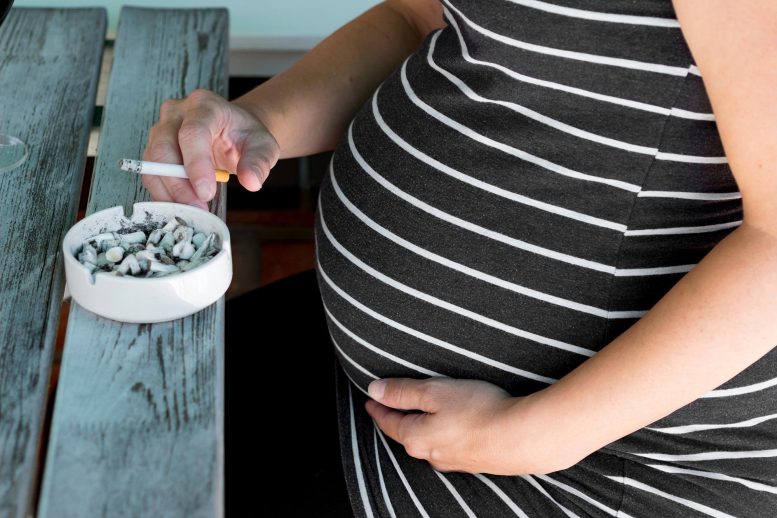
A newly published study found that on average children exposed to high levels of nicotine in utero scored 21 percent lower in areas such as reading speed, single-word identification, spelling, accuracy, real and non-word reading, and reading as compared to classmates born to non-smoking mothers.
Yale School of Medicine researchers have found that children born to mothers who smoked more than one pack per day during pregnancy struggled on tests designed to measure how accurately a child reads aloud and comprehends what they read.
The findings are published in the current issue of The Journal of Pediatrics.
Lead author Dr. Jeffrey Gruen, professor of pediatrics and genetics at Yale School of Medicine, and colleagues analyzed data from more than 5,000 children involved in the Avon Longitudinal Study of Parents and Children (ALSPAC), a large-scale study of 15,211 children from 1990-1992 at the University of Bristol in the United Kingdom.
Gruen and his team from Yale and Brock University in Canada, compared performance on seven specific tasks – reading speed, single-word identification, spelling, accuracy, real and non-word reading, and reading comprehension – with maternal cigarette smoking, after adjusting for socioeconomic status, mother-child interactions, and 14 other potential factors.
They found that on average, children exposed to high levels of nicotine in utero — defined as the minimum amount in one pack of cigarettes per day — scored 21 percent lower in these areas than classmates born to non-smoking mothers. The children were tested at age seven and again at age nine.
Among students who share similar backgrounds and education, a child of a smoking mother will, on average, be ranked seven places lower in a class of 31 in reading accuracy and comprehension ability.
“It’s not a little difference — it’s a big difference in accuracy and comprehension at a critical time when children are being assessed, and are getting a sense of what it means to be successful,” said Gruen, who also points out that the effects of smoking in pregnancy are especially pronounced in children with an underlying phonological (i.e., speech) deficit, suggesting an interaction between an environmental exposure (smoking) and a highly heritable trait (phonological ability).
“The interaction between nicotine exposure and phonology suggests a significant gene-by-environment interaction, making children with an underlying phonological deficit particularly vulnerable,” he said.
Reference: “Prenatal Exposure to Nicotine and Impaired Reading Performance” by Kelly Cho, PhD; Jan C. Frijters, PhD; Heping Zhang, PhD; Laura L. Miller, MSc and Jeffrey R. Gruen, MD, 5 November 2022, The Journal of Pediatrics.
DOI: 10.1016/j.jpeds.2012.09.041
Other authors on the study include Kelly Cho, Jan C. Frijters, Heping Zhang, and Laura L. Miller.
The study was funded by The UK Medical Research Council; the Wellcome Trust; the National Institutes of Health R01NS43530 (J.R.G.), R01DA016750 (H.Z.) and T32 MH014235 (K.C.); and the University of Bristol provided core support for ALSPAC.
Never miss a breakthrough: Join the SciTechDaily newsletter.
Follow us on Google and Google News.
3 Comments
as a child of the fifties, who’s mother and many others during the fifties smoked, i can attest to this problem with reading and word skills. i am high on the side of working with numbers and calculations, but reading and writing is still an issue in my fifties…. you might call it dyslexia, but i think many children of that era were damaged by the barrage of smoking, hell, the doctors would smoke in the exam room…… thank you phillip morris.
Well then, I must be a genius, my mother and dad smoked, (grand parents, grand uncles and aunts and uncles and aunts and cousins, and I still had a college freshman reading level at the age of 12. I also had problems with higher math, but these are typical problems of gifted/learning disabled that have nothing to do with smoking. I also tested at 137 IQ at that time as well. (Not that I’m all that and a bag of chips), but this study is skewed and not accurate.
My mom smoked like a chimney and I’m a genius at spelling. I think it has more to do with socioeconomic factors and a combination of unhealthy behaviors that are likely to affect fetus health in utero, which in turn mirror individuals with high levels of nicotine usage.