
Close Menu
    Facebook X (Twitter) Instagram
    SciTechDaily
    • Biology
    • Chemistry
    • Earth
    • Health
    • Physics
    • Science
    • Space
    • Technology
    Facebook X (Twitter) Pinterest YouTube RSS
    SciTechDaily
    Home»Science»Laboratory-Based Astrophysics Leads to Dedicated Discipline
    Science

    Laboratory-Based Astrophysics Leads to Dedicated Discipline

    By SciTechDailyNovember 21, 2012No Comments2 Mins Read
    Facebook Twitter Pinterest Telegram LinkedIn WhatsApp Email Reddit
    Share
    Facebook Twitter LinkedIn Pinterest Telegram Email Reddit
    tokamak-generates-solar-wind
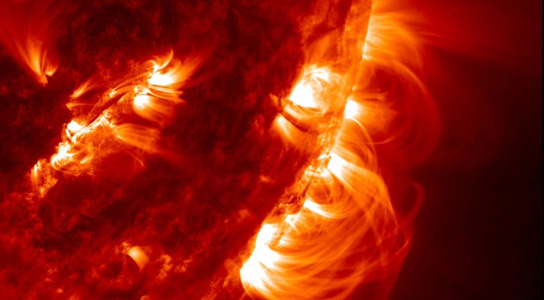
    A type of turbulence simulated in a lab experiment could help to explain why the Sun’s corona is so hot. Credit: SDO/NASA

    The gigantic orange magnets at MIT were originally built decades ago to confine hydrogen nuclei in the search for nuclear fusion. However, since 1998 plasma physicist Jan Egedal has been using them to simulate magnetic fields in the thin wind of charged particles emanating from Sol. Egedal hopes to figure out how the solar wind can transfer energy.

    These kinds of laboratory astrophysical experiments, in which efforts were made to mimic the behavior of space-borne plasmas and other phenomena, have had to rely on the apparatus of energy research or fundamental physics. Now, astrophysicists are trying to make the field a discipline in its own right, with its dedicated funding and equipment.

    In June, the American Astronomical Society (AAS) in Washington DC created its first new discipline in 30 years, dedicated to laboratory-based astrophysics. At the American Physical Society’s plasma-physics meeting last month in Providence, Rhode Island, there were an unprecedented number of lab-astrophysics sessions. Even some NASA scientists are saying that the agency should devote some funding from every space mission to lab astrophysics.

    Egedal is exploring questions posed by two solar wind missions, the ESA’s Cluster and NASA’s Wind. The work is attractive in times of tight budgets because the cost of most experiments tends to be hundreds of thousands of dollars instead of the hundreds of millions needed for space missions.

    Last month, the first lab measurement of astrophysical turbulence in which two magnetic waves collide to generate a third one, a phenomenon that has been used to explain why Sol’s corona is thousands of times hotter than its surface and how massive amounts of energy move between galaxies, was described. Using the Large Plasma Device, a 21-meter-long (69-foot-long) plasma generator at the University of California, Los Angeles, two Alfvén waves were generated and collided. The daughter wave was mapped and this confirmed the celestial mechanism. This experiment cost less than $100,000 to perform.

    Dedicated funding for lab astrophysics would be good news for Egedal, who is beginning to outgrow his current apparatus and wants to build a new one.

    Never miss a breakthrough: Join the SciTechDaily newsletter.
    Follow us on Google and Google News.

    AAS Astronomy Astrophysics Plasma Physics
    Share. Facebook Twitter Pinterest LinkedIn Email Reddit

    Related Articles

    Astronomers Believe There May Be a New Population of Circumbinary Planets

    New Exoplanet-Hunting Facility (NGTS) Achieves First Light

    New Supercomputer Simulations Could Improve Our Understanding of Dark Matter

    NASA Supercomputer Simulation Shows Neutron Stars Ripping Each Other Apart to Form a Black Hole

    CfA Astronomers Create First Realistic Virtual Universe

    Researchers Develop Model to Reconstruct Spatial Structure of Molecule Clouds

    Scientists Believe Humans Will One Day Colonize the Universe

    Supernova SN 2012fr Reveals Key Link in Comic Distance Ladder

    Large Globular Star Clusters Survive Collisions, Smaller Clusters Do Not

    Leave A Reply Cancel Reply

    • Facebook
    • Twitter
    • Pinterest
    • YouTube

    Don't Miss a Discovery

    Subscribe for the Latest in Science & Tech!

    Trending News

    AI Could Detect Early Signs of Alzheimer’s in Under a Minute – Far Before Traditional Tests

    What if Dark Matter Has Two Forms? Bold New Hypothesis Could Explain a Cosmic Mystery

    This Metal Melts in Your Hand – and Scientists Just Discovered Something Strange

    Beef vs. Chicken: Surprising Results From New Prediabetes Study

    Alzheimer’s Breakthrough: Scientists Discover Key Protein May Prevent Toxic Protein Clumps in the Brain

    Quantum Reality Gets Stranger: Physicists Put a Lump of Metal in Two Places at Once

    Scientists May Have Found the Key to Jupiter and Saturn’s Moon Mystery

    Scientists Uncover Brain Changes That Link Pain to Depression

    Follow SciTechDaily
    • Facebook
    • Twitter
    • YouTube
    • Pinterest
    • Newsletter
    • RSS
    SciTech News
    • Biology News
    • Chemistry News
    • Earth News
    • Health News
    • Physics News
    • Science News
    • Space News
    • Technology News
    Recent Posts
    • Popular Sweetener Linked to DNA Damage – “It’s Something You Should Not Be Eating”
    • Ancient “Rock” Microbes May Reveal How Complex Life Began
    • Hidden “Trade Winds” Inside Cells Could Explain Cancer Spread
    • Humans Owe Their Eyes to a Tiny One-Eyed “Cyclops”
    • Researchers Capture Quantum Interference in One of Nature’s Rarest Atoms
    Copyright © 1998 - 2026 SciTechDaily. All Rights Reserved.
    • Science News
    • About
    • Contact
    • Editorial Board
    • Privacy Policy
    • Terms of Use

    Type above and press Enter to search. Press Esc to cancel.