
Why Hotter Clocks Are More Accurate
A new experiment shows that the more energy consumed by a clock, the more accurate its timekeeping.
Clocks pervade every aspect of life, from the atomic clocks that underlie satellite navigation to the cellular clocks inside our bodies. All of them consume energy and release heat. A kitchen clock, for example, does this by using up its battery. Generally, the most accurate clocks require the most energy, which hints at a fundamental connection between energy consumption and accuracy. This is what an international team of scientists from Lancaster, Oxford, and Vienna set out to test.
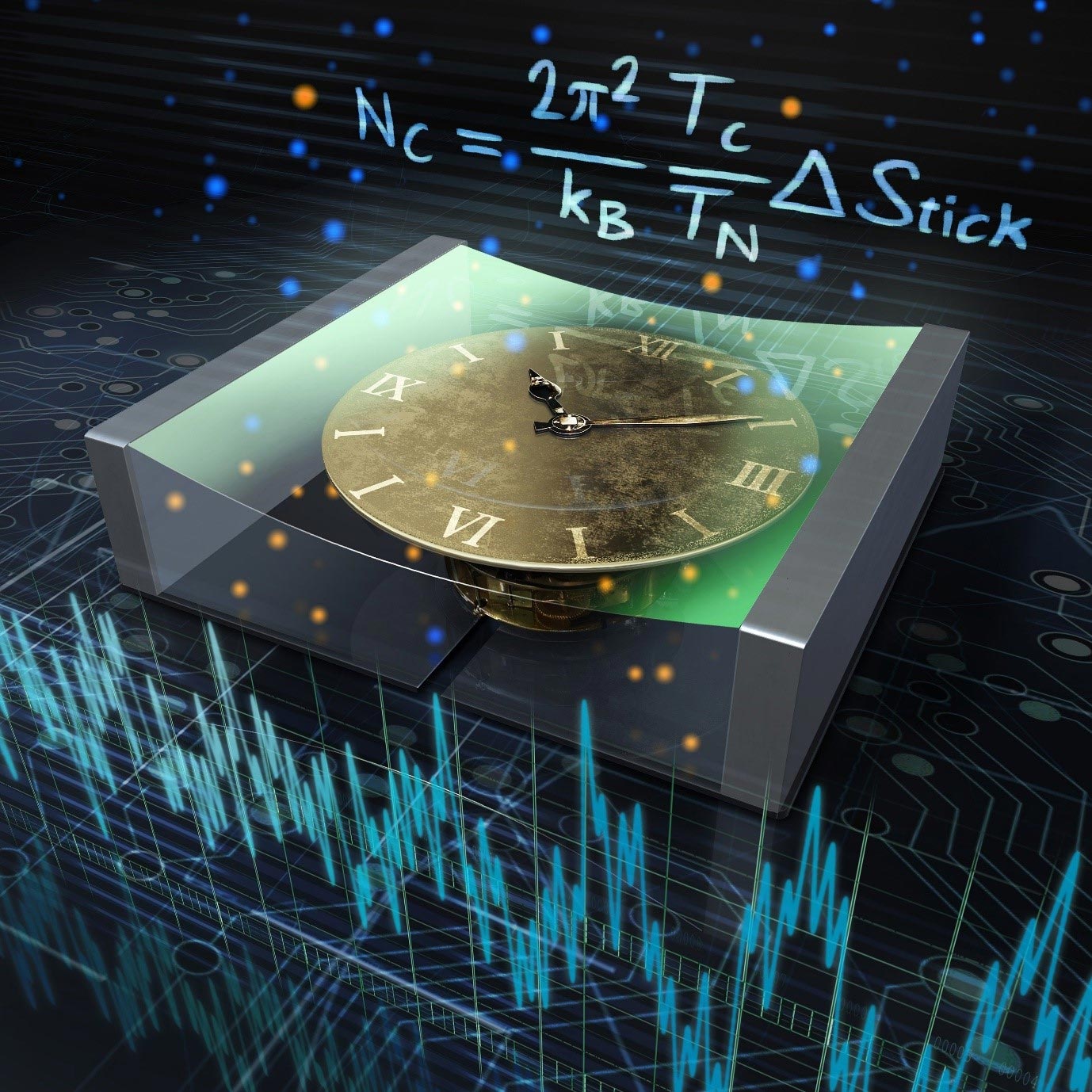
To do this, they built a particularly simple clock, consisting of a vibrating ultra-thin membrane, tens of nanometers thick and 1.5 millimeters long, incorporated into an electronic circuit. Each oscillation of the membrane generated one electrical tick. The ingenious aspect of this design is that it is powered simply by heating the membrane, while the complete flow of energy through the clock can be measured electrically.
Heat Directly Boosts Timekeeping Precision
The scientists found that the more heat they supplied, the more accurately the clock ran. In fact, the accuracy was directly proportional to the heat released. To make the clock twice as accurate, they needed to supply twice as much heat.
The experimental team consisted of Dr. Edward Laird at Lancaster University, Professor Marcus Huber at Atominstitut, TUWien, Dr. Paul Erker, and Dr. Yelena Guryanova at the Institute for Quantum Optics and Quantum Information (IQOQI), and Dr. Natalia Ares, Dr. Anna Pearson and Professor Andrew Briggs from Oxford.
Their study, published in Physical Review X, is the first time that a measurement has been made of the entropy — or heat loss — generated by a minimal clock.
Understanding the thermodynamic cost involved in timekeeping is a central step along the way in the development of future technologies, and understanding and testing thermodynamics as systems approach the quantum realm.
Timekeeping Mirrors Thermodynamic Machines
It also shows a similarity between the operation of a clock and a steam engine. With a steam engine there is fundamental constraint on how much heat we must supply to do a desired amount of work. This constraint is the famous Second Law of Thermodynamics which is central to modern engineering. What this experiment suggests is that clocks, like engines, are constrained by the Second Law, with their output being accurate ticks instead of mechanical work.
Dr. Edward Laird of Lancaster University said: “The subject of thermodynamics, which incorporates the most fundamental principles of nature, tells us that there are two types of machine that we cannot operate without releasing heat. One is the mechanical engine, which releases heat to do work, and the other is the computer memory, which releases heat when it rewrites itself. This experiment — in conjunction with other work — suggests that clocks are also limited by thermodynamics. It also poses an intriguing question: are all possible clocks limited in this way, or is it just a property of the ones we have studied?”
Interestingly, many everyday clocks have an efficiency that is close to what the scientists’ analysis predicts. For example, their formula predicts that a wristwatch whose accuracy per tick is one part in ten million must consume at least a microwatt of power. In fact, a basic wristwatch usually consumes only a few times this amount. The laws of thermodynamics, discovered in the nineteenth century, are still finding new applications today.
Reference: “Measuring the Thermodynamic Cost of Timekeeping” by A. N. Pearson, Y. Guryanova, P. Erker, E. A. Laird, G. A. D. Briggs, M. Huber and N. Ares, 6 May 2021, Physical Review X.
DOI: 10.1103/PhysRevX.11.021029
Never miss a breakthrough: Join the SciTechDaily newsletter.
Follow us on Google and Google News.
1 Comment
… if one can only talk about probability where the electron is, why not to talk about time probability, … new idea, it got my head spinning and spinning, but no answer…
… those lucky people who plant carrots and onions, and lettuce…