

Close Menu
    Facebook X (Twitter) Instagram
    SciTechDaily
    • Biology
    • Chemistry
    • Earth
    • Health
    • Physics
    • Science
    • Space
    • Technology
    Facebook X (Twitter) Pinterest YouTube RSS
    SciTechDaily
    Home»Physics»Energy Harvesting Goes Organic: Self-Assembled Peptides for Electricity Generation
    Physics

    Energy Harvesting Goes Organic: Self-Assembled Peptides for Electricity Generation

    By American Institute of PhysicsSeptember 15, 2020No Comments4 Mins Read
    Facebook Twitter Pinterest Telegram LinkedIn WhatsApp Email Reddit
    Share
    Facebook Twitter LinkedIn Pinterest Telegram Email Reddit
    Energy Molecule Concept
    Researchers are exploring peptide-based nanotubes for their potential use in electronic devices and energy harvesting applications.

    Self-assembled peptides, when aligned, show great promise for electricity generation.

    Nanogenerators capable of converting mechanical energy into electricity are typically made from metal oxides and lead-based perovskites. But these inorganic materials aren’t biocompatible, so the race is on to create natural biocompatible piezoelectric materials for energy harvesting, electronic sensing, and stimulating nerves and muscles.

    University College Dublin and University of Texas at Dallas researchers decided to explore peptide-based nanotubes, because they would be an appealing option for use within electronic devices and for energy harvesting applications.

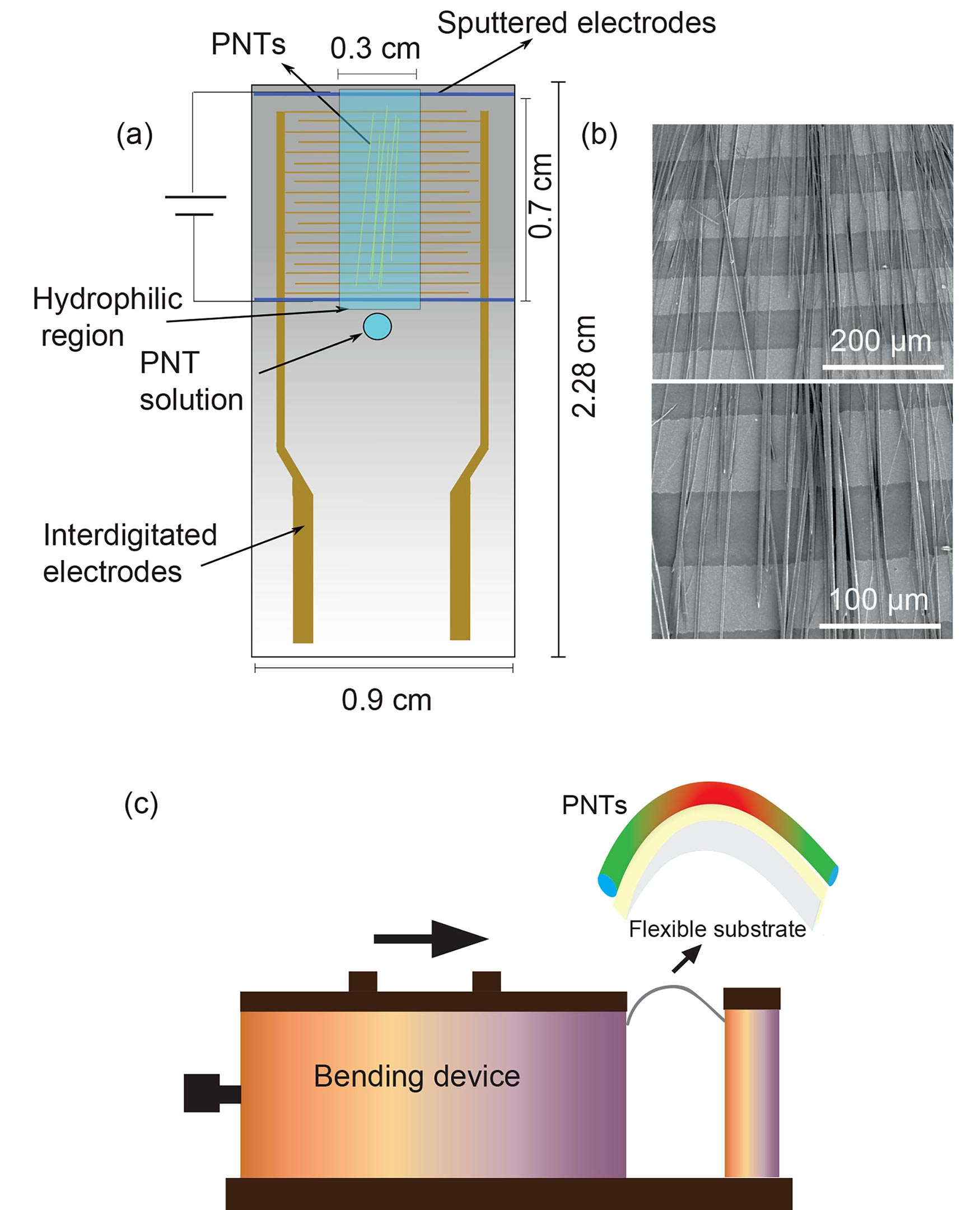
    In the Journal of Applied Physics, from AIP Publishing, the group reports using a combination of ultraviolet and ozone exposure to generate a wettability difference and an applied field to create horizontally aligned polarization of nanotubes on flexible substrates with interlocking electrodes.
    Peptide Based Nanotubes
    A group of researchers has explored peptide-based nanotubes and, in the Journal of Applied Physics, reports using a combination of ultraviolet and ozone exposure to generate a wettability difference and an applied field to create horizontally aligned polarization of nanotubes on flexible substrates with interlocking electrodes. The work will enable the use of organic materials more widely. This image shows optical (a-c) and lateral piezoresponse force microscopy (LPFM) phase images (d-f) of the peptide nanotubes on interlocking electrode substrates: (a, d) without alignment, (b, e) aligned using both electric field and UV/ozone, and (c, f) aligned PNTs with graphene oxide (GO) using both electric field and UV/ozone. Credit: Sawsan Almohammed

    “The piezoelectric properties of peptide-based materials make them particularly attractive for energy harvesting, because pressing or bending them generates an electric charge,” said Sawsan Almohammed, lead author and a postdoctoral researcher at University College Dublin.

    There’s also an increased demand for organic materials to replace inorganic materials, which tend to be toxic and difficult to make.

    “Peptide-based materials are organic, easy to make, and have strong chemical and physical stability,” she said.

    In the group’s approach, the physical alignment of nanotubes is achieved by patterning a wettability difference onto the surface of a flexible substrate. This creates a chemical force that pushes the peptide nanotube solution from the hydrophobic region, which repels water, with a high contact angle to the hydrophilic region, which attracts water, with a low contact angle.

    Not only did the researchers improve the alignment of the tubes, which is essential for energy harvesting applications, but they also improved the conductivity of the tubes by making composite structures with graphene oxide.

    “It’s well known that when two materials with different work functions come into contact with each other, an electric charge flows from low to high work function,” Almohammed said. “The main novelty of our work is that controlling the horizontal alignment of the nanotubes by electrical field and wettability-assisted self-assembly improved both the current and voltage output, and further enhancement was achieved by incorporating graphene oxide.”

    The group’s work will enable the use of organic materials, especially peptide-based ones, more widely within electronic devices, sensors, and energy harvesting applications, because two key limitations of peptide nanotubes — alignment and conductivity — have been improved.

    “We’re also exploring how charge transfer processes from bending and electric field applications can enhance Raman spectroscopy-based detection of molecules,” Almohammed said. “We hope these two efforts can be combined to create a self-energized biosensor with a wide range of applications, including biological and environmental monitoring, high-contrast imaging, and high-efficiency light-emitting diodes.”

    Reference: “Energy harvesting with peptide nanotube–graphene oxide flexible substrates prepared with electric field and wettability assisted self-assembly” by Sawsan Almohammed, Abi Thampi, Arwa Bazaid, Fengyuan Zhang, Salvador Moreno, Kevin Keogh, Majid Minary-Jolandan, James H. Rice and Brian J. Rodriguez, 15 September 2020, Journal of Applied Physics.
    DOI: 10.1063/5.0017899

    Never miss a breakthrough: Join the SciTechDaily newsletter.
    Follow us on Google and Google News.

    American Institute of Physics Electrical Engineering Energy Nanotechnology
    Share. Facebook Twitter Pinterest LinkedIn Email Reddit

    Related Articles

    Breathing Crystal Breakthrough Could Revolutionize Clean Energy

    Molecular Motion: Powering the Next Wave in Electricity Generation

    Manipulating Magnets at the Atomic Scale for Fast and Energy-Efficient Future Data Processing

    Improving Lithium-Ion Battery Performance, Cell Lifetime for Renewable Energy Applications

    Detection of Terahertz Electromagnetic Waves Could Revolutionize Electronics

    Nano Antennas for Data Transfer – Could Allow Processor Cores to Exchange Data at Speed of Light

    Physicists Optimize Nanosized Waveguides to Overcome Signal Loss in Magnonic Circuits

    New Spectroscopic Methods to Observe Energy Flow in the Nano Range

    Nanoscientists Develop Blueprint for Next-Generation Computing

    Leave A Reply Cancel Reply

    • Facebook
    • Twitter
    • Pinterest
    • YouTube

    Don't Miss a Discovery

    Subscribe for the Latest in Science & Tech!

    Trending News

    New Study Reveals Why Ozempic Works Better for Some People Than Others

    Climate Change Is Altering a Key Greenhouse Gas in a Way Scientists Didn’t Expect

    New Study Suggests Gravitational Waves May Have Created Dark Matter

    Scientists Discover Why the Brain Gets Stuck in Schizophrenia

    Scientists Engineer “Tumor-Eating” Bacteria That Devour Cancer From Within

    Even “Failed” Diets May Deliver Long-Term Health Gains, Study Finds

    NIH Scientists Discover Powerful New Opioid That Relieves Pain Without Dangerous Side Effects

    Collapsing Plasma May Hold the Key to Cosmic Magnetism

    Follow SciTechDaily
    • Facebook
    • Twitter
    • YouTube
    • Pinterest
    • Newsletter
    • RSS
    SciTech News
    • Biology News
    • Chemistry News
    • Earth News
    • Health News
    • Physics News
    • Science News
    • Space News
    • Technology News
    Recent Posts
    • The Surprising Reason You Might Want To Sleep Without a Pillow
    • Household Cats Could Hold the Secret to Fighting Breast Cancer
    • Scientists Say This Natural Hormone Reverses Obesity by Targeting the Brain
    • This 15,000-Year-Old Discovery Changes What We Know About Early Human Creativity
    • 35-Million-Year-Old Mystery: Strange Arachnid Discovered Preserved in Amber
    Copyright © 1998 - 2026 SciTechDaily. All Rights Reserved.
    • Science News
    • About
    • Contact
    • Editorial Board
    • Privacy Policy
    • Terms of Use

    Type above and press Enter to search. Press Esc to cancel.