

Close Menu
    Facebook X (Twitter) Instagram
    SciTechDaily
    • Biology
    • Chemistry
    • Earth
    • Health
    • Physics
    • Science
    • Space
    • Technology
    Facebook X (Twitter) Pinterest YouTube RSS
    SciTechDaily
    Home»Technology»Improving Lithium-Ion Battery Performance, Cell Lifetime for Renewable Energy Applications
    Technology

    Improving Lithium-Ion Battery Performance, Cell Lifetime for Renewable Energy Applications

    By American Institute of PhysicsNovember 28, 20201 Comment3 Mins Read
    Facebook Twitter Pinterest Telegram LinkedIn WhatsApp Email Reddit
    Share
    Facebook Twitter LinkedIn Pinterest Telegram Email Reddit
    Improved Battery Performance Concept
    In the Journal of Vacuum Science and Technology A, researchers investigate the origins of degradation in high energy density LIB cathode materials and develop strategies for mitigating those degradation mechanisms and improving LIB performance.

     Creating higher energy density lithium-ion batteries with graphene-coated nickel, cobalt, aluminum nanoparticle cathodes.

    Lithium-ion batteries (LIBs) that function as high-performance power sources for renewable applications, such as electric vehicles and consumer electronics, require electrodes that deliver high energy density without compromising cell lifetimes.

    In the Journal of Vacuum Science and Technology A, by AIP Publishing, researchers investigate the origins of degradation in high energy density LIB cathode materials and develop strategies for mitigating those degradation mechanisms and improving LIB performance.

    Their research could be valuable for many emerging applications, particularly electric vehicles and grid-level energy storage for renewable energy sources, such as wind and solar.

    “Most of the degradation mechanisms in LIBs occur at the electrode surfaces that are in contact with the electrolyte,” said author Mark Hersam. “We sought to understand the chemistry at these surfaces and then develop strategies for minimizing degradation.”

    Synthesized NCA
    Scanning electron microscopy images of as-synthesized NCA at different magnifications. Credit: Jin-Myoung Lim and Norman S. Luu, Northwestern University

    The researchers employed surface chemical characterization as a strategy for identifying and minimizing residual hydroxide and carbonate impurities from the synthesis of NCA (nickel, cobalt, aluminum) nanoparticles. They realized the LIB cathode surfaces first needed to be prepared by suitable annealing, a process by which the cathode nanoparticles are heated to remove surface impurities, and then locked into the desirable structures with an atomically thin graphene coating.

    The graphene-coated NCA nanoparticles, which were formulated into LIB cathodes, showed superlative electrochemical properties, including low impedance, high rate performance, high volumetric energy and power densities, and long cycling lifetimes. The graphene coating also acted as a barrier between the electrode surface and the electrolyte, which further improved cell lifetime.
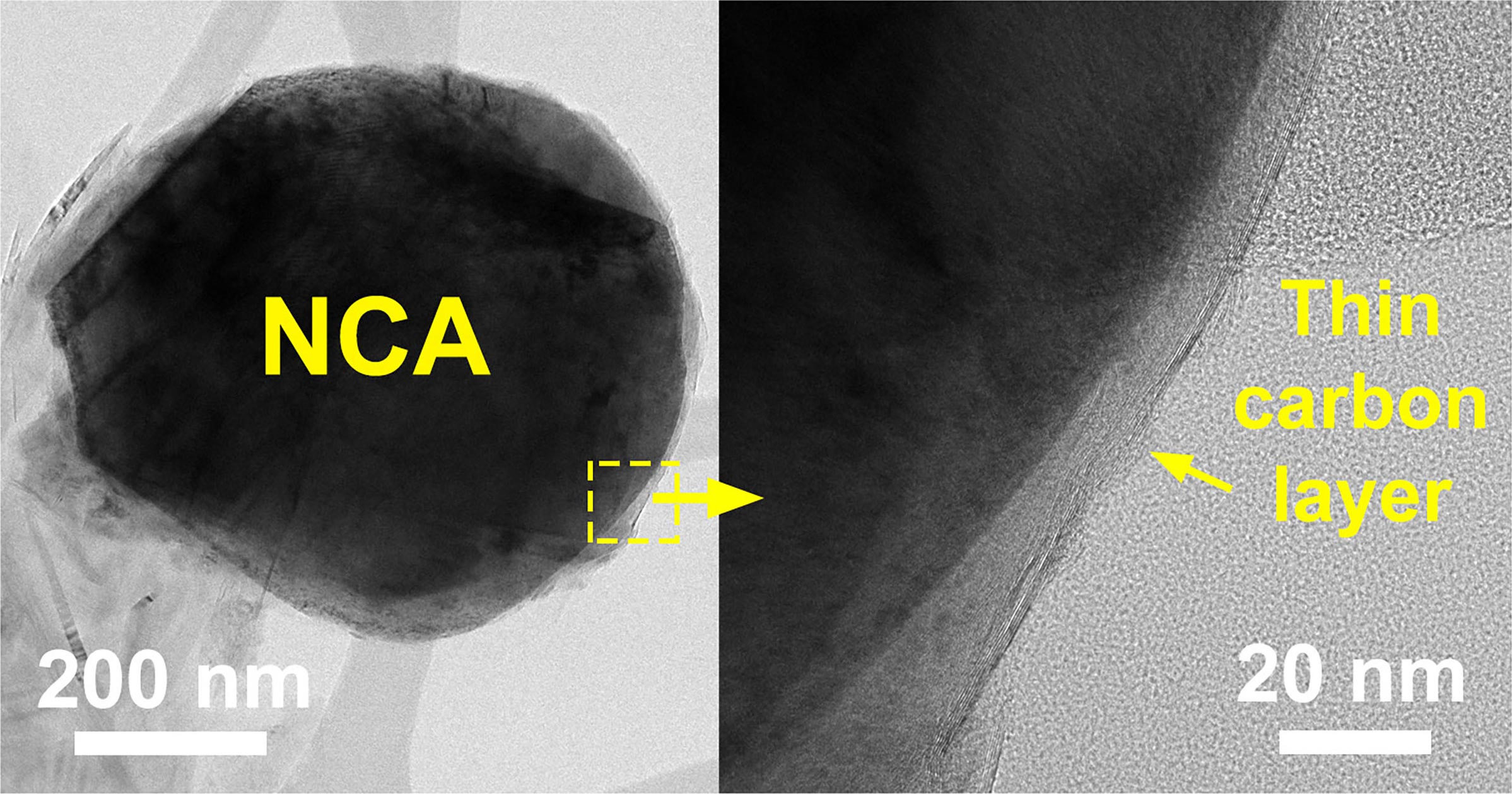
    Gr-R-nNCA Particles
    Transmission electron microscopy images showing the surface of the Gr-R-nNCA particles. Credit: Jin-Myoung Lim and Norman S. Luu, Northwestern University

    While the researchers had thought the graphene coating alone would be sufficient to improve performance, their results revealed the importance of pre-annealing the cathode materials in order to optimize their surface chemistry before the graphene coating was applied.

    While this work focused on nickel-rich LIB cathodes, the methodology could be generalized to other energy storage electrodes, such as sodium-ion or magnesium-ion batteries, that incorporate nanostructured materials possessing high surface area. Consequently, this work establishes a clear path forward for the realization of high-performance, nanoparticle-based energy storage devices.

    “Our approach can also be applied to improve the performance of anodes in LIBs and related energy storage technologies,” said Hersam. “Ultimately, you need to optimize both the anode and cathode to achieve the best possible battery performance.”

    Reference: “Enhancing nanostructured nickel-rich lithium-ion battery cathodes via surface stabilization” by Jin-Myoung Lim, Norman S. Luu, Kyu-Young Park, Mark T. Z. Tan, Sungkyu Kim, Julia R. Downing, Kai He, Vinayak P. Dravid and Mark C. Hersam, 24 November 2020, Journal of Vacuum Science & Technology A.
    DOI: 10. 10.1116/6.0000580

    Never miss a breakthrough: Join the SciTechDaily newsletter.
    Follow us on Google and Google News.

    American Institute of Physics Battery Technology Electrical Engineering Energy Nanotechnology
    Share. Facebook Twitter Pinterest LinkedIn Email Reddit

    Related Articles

    Researchers Watch Solid-State Batteries Charge and Discharge Using X-ray Tomography

    Supercapacitors Challenge Batteries: Powerful Graphene Hybrid Material for Highly Efficient Energy Storage

    Batteries Mimic Multilayer Geometry of Mammal Bones for Structural Stability

    Fast-Charging Super-Capacitor Technology Unveiled for Clean Energy Storage

    New Battery Can Self-Charge Without Losing Energy

    Next-Generation Energy Storage Breakthrough: Fast-Charging, Long-Running, Flexible

    Better Lithium-Ion Batteries Possible With Nanoscale Molecular View of Self-Assembling Structure

    New Aqueous Lithium-Ion Battery – Low Cost & Improved Safety

    Iron-Air Batteries Promise Higher Energy Density Than Lithium-Ion Batteries

    1 Comment

    1. Alice on February 27, 2021 4:44 am

      There are methods that allow you to revive the battery at home, I read about it here https://energylast.com/ . Recovery methods are suitable only for some types of breakdowns, but it is still worth trying to restore the battery of the uninterruptible power supply

      Reply
    Leave A Reply Cancel Reply

    • Facebook
    • Twitter
    • Pinterest
    • YouTube

    Don't Miss a Discovery

    Subscribe for the Latest in Science & Tech!

    Trending News

    Your Blood Pressure Reading Could Be Wrong Because of One Simple Mistake

    Astronomers Stunned by Ancient Galaxy With No Spin

    Physicists May Be on the Verge of Discovering “New Physics” at CERN

    Scientists Solve 320-Million-Year Mystery of Reptile Skin Armor

    Scientists Say This Daily Walking Habit May Be the Secret to Keeping Weight Off After Dieting

    New Therapy Rewires the Brain To Restore Joy in Depression Patients

    Giant Squid Detected off Western Australia in Stunning Deep-Sea Discovery

    Popular Sugar-Free Sweetener Linked to Liver Disease, Study Warns

    Follow SciTechDaily
    • Facebook
    • Twitter
    • YouTube
    • Pinterest
    • Newsletter
    • RSS
    SciTech News
    • Biology News
    • Chemistry News
    • Earth News
    • Health News
    • Physics News
    • Science News
    • Space News
    • Technology News
    Recent Posts
    • Scientists Stunned As Volcano Removes Methane From the Air
    • Scientists Discover Signs Africa May Be Splitting Apart Beneath Zambia
    • New Stroke Study Challenges Decades-Old Medical Beliefs
    • These Simple Plant Foods Are Linked to Lower Blood Pressure
    • Common Blood Pressure Drug Supercharges Cancer Treatment in Surprising New Study
    Copyright © 1998 - 2026 SciTechDaily. All Rights Reserved.
    • Science News
    • About
    • Contact
    • Editorial Board
    • Privacy Policy
    • Terms of Use

    Type above and press Enter to search. Press Esc to cancel.