
Close Menu
    Facebook X (Twitter) Instagram
    SciTechDaily
    • Biology
    • Chemistry
    • Earth
    • Health
    • Physics
    • Science
    • Space
    • Technology
    Facebook X (Twitter) Pinterest YouTube RSS
    SciTechDaily
    Home»Space»A Close Up View of the Primary Landing Site on Comet 67P
    Space

    A Close Up View of the Primary Landing Site on Comet 67P

    By DC Agle, Jet Propulsion LaboratoryOctober 16, 2014No Comments3 Mins Read
    Facebook Twitter Pinterest Telegram LinkedIn WhatsApp Email Reddit
    Share
    Facebook Twitter LinkedIn Pinterest Telegram Email Reddit
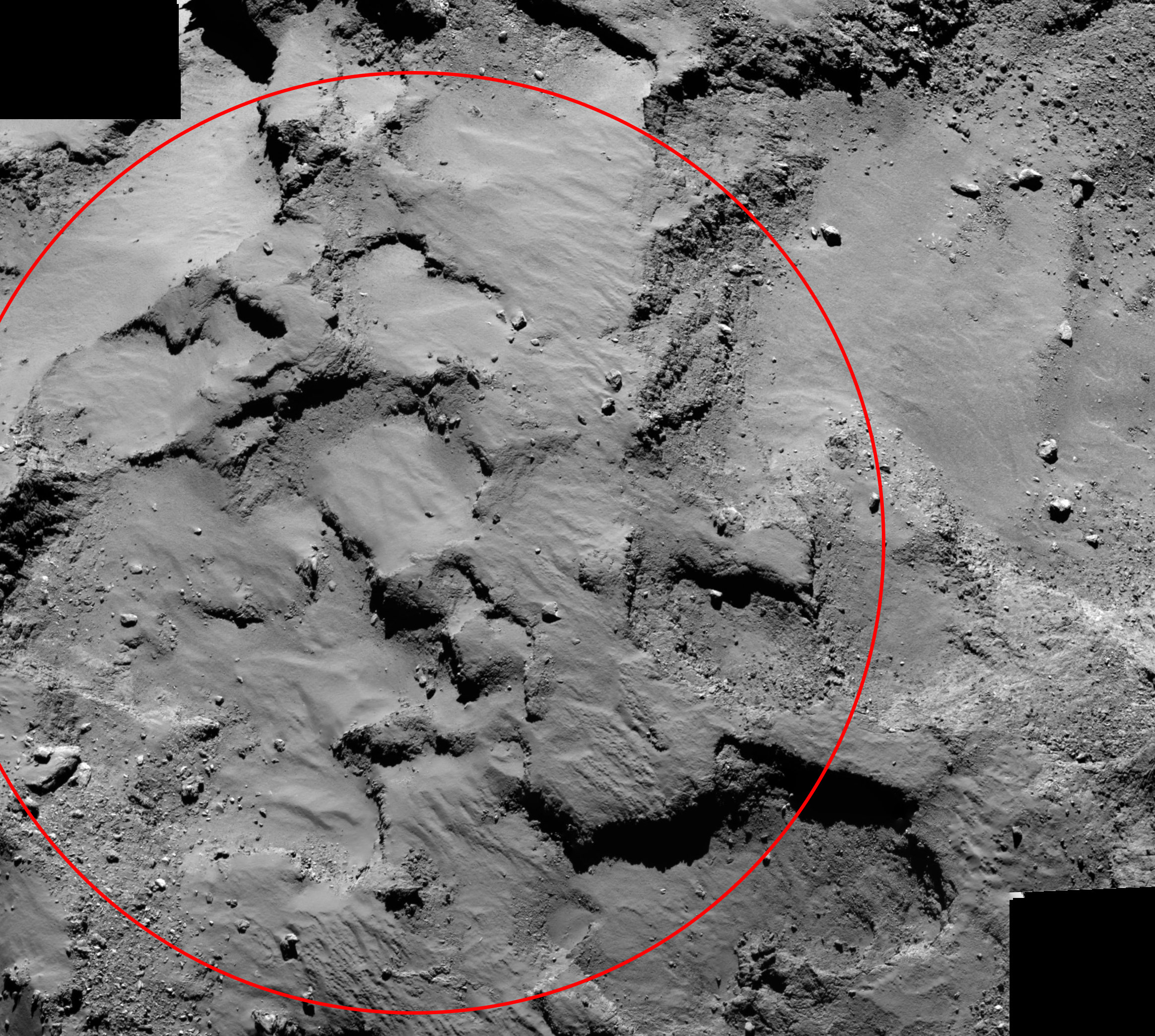
    Close Up of Rosetta Comet Landing Site
    An annotated mosaic from the Rosetta spacecraft shows “Site J,” the primary landing site on comet 67P/Churyumov–Gerasimenko for the mission’s Philae lander. Credit: ESA/Rosetta/MPS/UPD/LAM/IAA/SSO/INTA/UPM/DASP/IDA

    This mosaic from the European Space Agency’s Rosetta spacecraft shows a close up view of landing “Site J” – the primary landing site on comet 67P/Churyumov–Gerasimenko for the mission’s Philae lander.

    The mosaic comprises two images taken by Rosetta’s OSIRIS narrow-angle camera on September 14, 2014, from a distance of about 19 miles (30 kilometers). The image scale is 1.6 feet (0.5 meters) per pixel. The red ellipse is centered on the landing site and is approximately 1,600 feet (500 meters) in diameter.

    Site J is located on the smaller of the comet’s two lobes. On November 12, the Rosetta spacecraft will release Philae at 4:03 a.m. EST (10:03 a.m. Central European Time) (the time the signal is received on Earth). Touchdown of Philae on Site J is expected about seven hours later, at around 11 a.m. EST/5 p.m. CET (Earth Received Time).

    Launched in March 2004, Rosetta was reactivated in January 2014 after a record 957 days in hibernation. Composed of an orbiter and lander, Rosetta’s objectives since arriving at comet 67P/Churyumov-Gerasimenko earlier this month have been to study the celestial object up close in unprecedented detail, prepare for landing a probe on the comet’s nucleus in November, and following the landing, track the comet’s changes as it sweeps past the sun.

    Comets are time capsules containing primitive material left over from the epoch when the sun and its planets formed. Rosetta’s lander will obtain the first images taken from a comet’s surface and will provide a comprehensive analysis of the comet’s possible primordial composition by drilling into the surface. Rosetta also will be the first spacecraft to witness at close proximity how a comet changes as it is subjected to the increasing intensity of the sun’s radiation. Observations will help scientists learn more about the origin and evolution of our solar system and the role comets may have played in seeding Earth with water, and perhaps even life.

    Rosetta is a European Space Agency mission with contributions from its member states and NASA. Rosetta’s Philae lander is provided by a consortium led by the German Aerospace Center, Cologne; Max Planck Institute for Solar System Research, Gottingen; National Center of Space Studies of France (CNES), Paris; and the Italian Space Agency, Rome. NASA’s Jet Propulsion Laboratory in Pasadena, California, a division of the California Institute of Technology, manages the U.S. participation in the Rosetta mission for NASA’s Science Mission Directorate in Washington.

    Never miss a breakthrough: Join the SciTechDaily newsletter.
    Follow us on Google and Google News.

    Astronomy Comet Rosetta Spacecraft
    Share. Facebook Twitter Pinterest LinkedIn Email Reddit

    Related Articles

    Philae Lander Makes Soft Landing on Comet 67P

    Rosetta Spacecraft Picks Up a Mysterious “Song” From Comet 67P

    How to Land on a Comet Moving 40 Times Faster Than a Speeding Bullet

    Rosetta Image Reveals Increased Activity on Comet 67P

    Rosetta “Selfie” with Comet 67P/Churyumov–Gerasimenko in the Background

    Astronomers Choose Primary Landing Site for Rosetta’s Lander

    Rosetta Orbiter Delivers First Batch of Science Data

    ESA Identifies Five Candidate Landing Sites on Comet 67P

    New Rosetta Image of 67P/Churyumov-Gerasimenko

    Leave A Reply Cancel Reply

    • Facebook
    • Twitter
    • Pinterest
    • YouTube

    Don't Miss a Discovery

    Subscribe for the Latest in Science & Tech!

    Trending News

    Popular Sugar-Free Sweetener Linked to Liver Disease, Study Warns

    What Is Hantavirus? The Deadly Disease Raising Alarm Worldwide

    Scientists Just Discovered How the Universe Builds Monster Black Holes

    Scientists Unveil New Treatment Strategy That Could Outsmart Cancer

    A Simple Vitamin May Hold the Key to Treating Rare Genetic Diseases

    Scientists Think the Real Fountain of Youth May Be Hiding in Your Gut

    Ravens Don’t Follow Wolves, They Predict Them

    This Common Knee Surgery May Be Doing More Harm Than Good

    Follow SciTechDaily
    • Facebook
    • Twitter
    • YouTube
    • Pinterest
    • Newsletter
    • RSS
    SciTech News
    • Biology News
    • Chemistry News
    • Earth News
    • Health News
    • Physics News
    • Science News
    • Space News
    • Technology News
    Recent Posts
    • Popular Supplement Ingredient Linked to Shorter Lifespan in Men
    • Scientists May Have Found a Way To Repair Nerve Damage in Multiple Sclerosis
    • GLP-1 Weight Loss Linked To Dramatically Lower Risk of Sleep Apnea, Kidney Disease and More
    • Scientists Uncover the Surprising Source of Strange Clouds Near the Milky Way’s Supermassive Black Hole
    • This Dazzling Green Snake Was Hiding in Plain Sight for Decades
    Copyright © 1998 - 2026 SciTechDaily. All Rights Reserved.
    • Science News
    • About
    • Contact
    • Editorial Board
    • Privacy Policy
    • Terms of Use

    Type above and press Enter to search. Press Esc to cancel.