
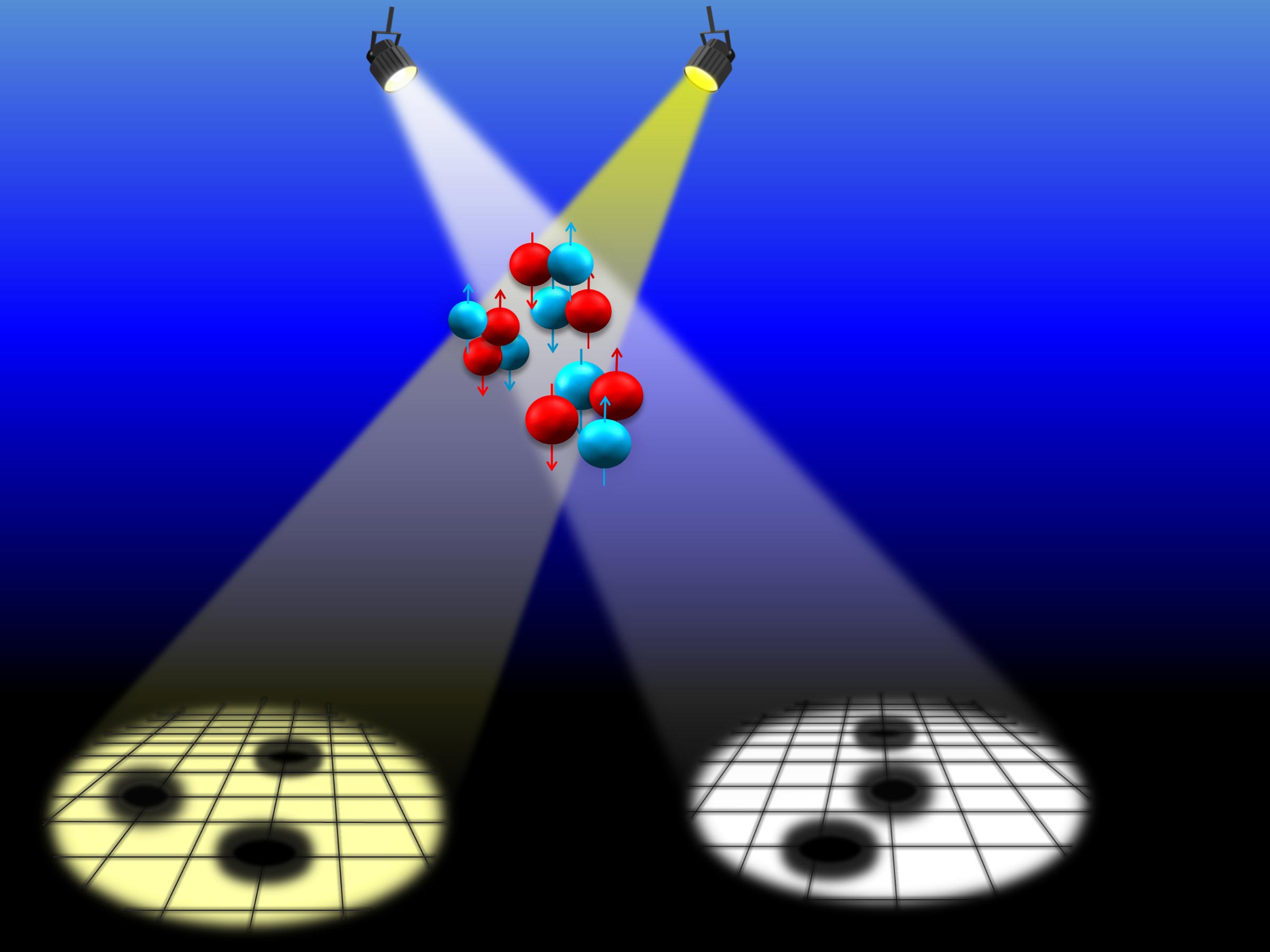
A groundbreaking study reveals the internal structure of a carbon atom’s nucleus, highlighting the importance of the Hoyle state and offering new insights into nuclear particle arrangements. This research paves the way for further discoveries in nuclear physics.
What does the inside of a carbon atom’s nucleus look like? A recent study by Forschungszentrum Jülich, Michigan State University, and the University of Bonn provides the first comprehensive answer to this question.
In the study, the researchers simulated all known energy states of the nucleus. These include the puzzling Hoyle state. If it did not exist, carbon and oxygen would only be present in the universe in tiny traces. Ultimately, we therefore also owe it our own existence. The study was published in the journal Nature Communications.
Composition and Dynamics of the Nucleus
The nucleus of a carbon atom normally consists of six protons and six neutrons. But how exactly are they arranged? And how does their configuration change when the nucleus is bombarded with high-energy radiation? For decades, science has been searching for answers to these questions. Not least because they could provide the key to a mystery that has long puzzled physicists: Why is there a significant amount of carbon in space at all — an atom without which there would be no life on Earth?
The Universe’s Elemental Evolution
After all, shortly after the Big Bang, there was only hydrogen and helium. The hydrogen nucleus consists of a single proton, that of helium of two protons and two neutrons. All heavier elements were only created many billions of years later by aging stars. In them, helium nuclei fused into carbon nuclei at immense pressure and extremely high temperatures. This requires three helium nuclei to fuse together.
“But it’s actually very unlikely for this to happen,” explains Prof. Dr. Ulf Meißner of the Helmholtz Institute of Radiation and Nuclear Physics at the University of Bonn and the Institute for Advanced Simulation at Forschungszentrum Jülich. The reason: The helium nuclei together have a much higher energy than a carbon nucleus.
However, this does not mean that they fuse particularly readily — on the contrary: It is as if three people wanted to jump onto a merry-go-round. But since they run much faster than the merry-go-round turns, they do not succeed.
The Hoyle State: A Key to Carbon Formation
As early as the 1950s, the British astronomer Fred Hoyle therefore postulated that the three helium nuclei first come together to form a kind of transition state. This “Hoyle state” has a very similar energy to the helium nuclei. To stay in the picture: It is a faster-spinning version of the merry-go-round, which the three passengers can therefore easily jump onto. When that happens, the carousel slows down to its normal speed.
“Only by taking a detour via the Hoyle state can stars create carbon at all in any appreciable quantity,” says Meißner, who is also a member of the Transdisciplinary Research Areas “Modeling” and “Matter” of the University of Bonn.
Advanced Simulation Techniques
About ten years ago, together with colleagues from the USA, Forschungszentrum Jülich, and Ruhr-Universität Bochum, he succeeded in simulating this Hoyle state for the first time.
“We already had an idea then of how the protons and neutrons of the carbon nucleus are arranged in this state,” he explains. “However, we were not able to prove with certainty that this assumption was true.”
With the help of an advanced method, the researchers have now succeeded. This is essentially based on confinement: In reality, the protons and neutrons — the nucleons — can be located anywhere in space. For their calculations, however, the team restricted this freedom: “We arranged our nuclear particles on the nodes of a three-dimensional lattice,” Meißner explains. “So we allowed them only certain strictly defined positions.”
Computing Time: Five Million Processor Hours
Thanks to this restriction, it was possible to calculate the motion of nucleons. Since nuclear particles affect each other differently depending on their distance from each other, this task is very complex. The researchers also ran their simulation several million times with slightly different starting conditions. This allowed them to see where the protons and neutrons were most likely to be.
“We performed these calculations for all known energy states of the carbon nucleus,” Meißner says. The calculations were performed on the JEWELS supercomputer at Forschungszentrum Jülich. They required a total of about five million processor hours, with many thousands of processors working simultaneously.
Revealing the Nucleus’ Structure
The results effectively provide images from the carbon nucleus. They prove that the nuclear particles do not exist independently of each other. “Instead, they are clustered into groups of two neutrons and two protons each,” the physicist explains. This means that the three helium nuclei can still be detected after they have fused to form the carbon nucleus. Depending on the energy state, they are present in different spatial formations — either arranged into an isosceles triangle or like a slightly bent arm, with the shoulder, elbow joint and wrist each occupied by a cluster.
Broader Implications for Nuclear Physics
The study not only allows researchers to better understand the physics of the carbon nucleus. Meißner: “The methods we have developed can easily be used to simulate other nuclei and will certainly lead to entirely new insights.”
Reference: “Emergent geometry and duality in the carbon nucleus” by Shihang Shen, Serdar Elhatisari, Timo A. Lähde, Dean Lee, Bing-Nan Lu and Ulf-G. Meißner, 15 May 2023, Nature Communications.
DOI: 10.1038/s41467-023-38391-y
Forschungszentrum Jülich, Michigan State University (USA), the China Academy of Engineering Physics and the University of Bonn were involved in the study. The work was made possible by funding from the German Research Foundation, the National Natural Science Foundation of China, the Chinese Academy of Sciences (CAS), the Volkswagen Foundation, the European Research Council (ERC), the U.S. Department of Energy, the Nuclear Computational Low-Energy Initiative (NUCLEI), and the Gauss Center for Supercomputing e.V.
Never miss a breakthrough: Join the SciTechDaily newsletter.
Follow us on Google and Google News.
4 Comments
What does the inside of a carbon atom’s nucleus look like?
It can be confirmed that the observable carbon nucleus is definitely not two-dimensional.
Low dimensional spacetime matter is the understructure of high-dimensional spacetime matter. Topological vortices are point defects in spacetime. Point defects do not only impact the thermodynamic properties, but are also central to kinetic processes. A standard model without point defects will be incomplete, and it cannot fundamentally explain where universal gravitation comes from.
Mathematics is the language used by physics to write about the universe. Physics must respect the scientificity of low dimensional spacetime mathematical models (such as topological vortices). Physics must accept the fact that scientific experiments are limited by nature. Respecting mathematics will make physics experiments more scientific, simple, and efficient.
Natural Communications is exactly the same as its parent journal. They firmly believe tha two objects (such as two sets of cobalt-60) rotating in opposite directions can form a mirror image of each other.
Is your article worth showing off when it published in such a journal? Such so-called academic journals they hardly know what scientific spirit is.
QM says all is made of waves; linear waves (photons) or waves fragments (neutrinos) that go in straight lines. Waves that spins around stay put (particles). Particles, as circular waves, get interlocked, a bit like the Olympic symbol, and connect to each other. Neutrons and protons rings get interlocked (“strong force”) and combine in the very specific ways allowed ring combinations …
How are protons and neutrons placed in the carbon nucleus of our body? In wood and …?
This research was only about The Hoyle State?