
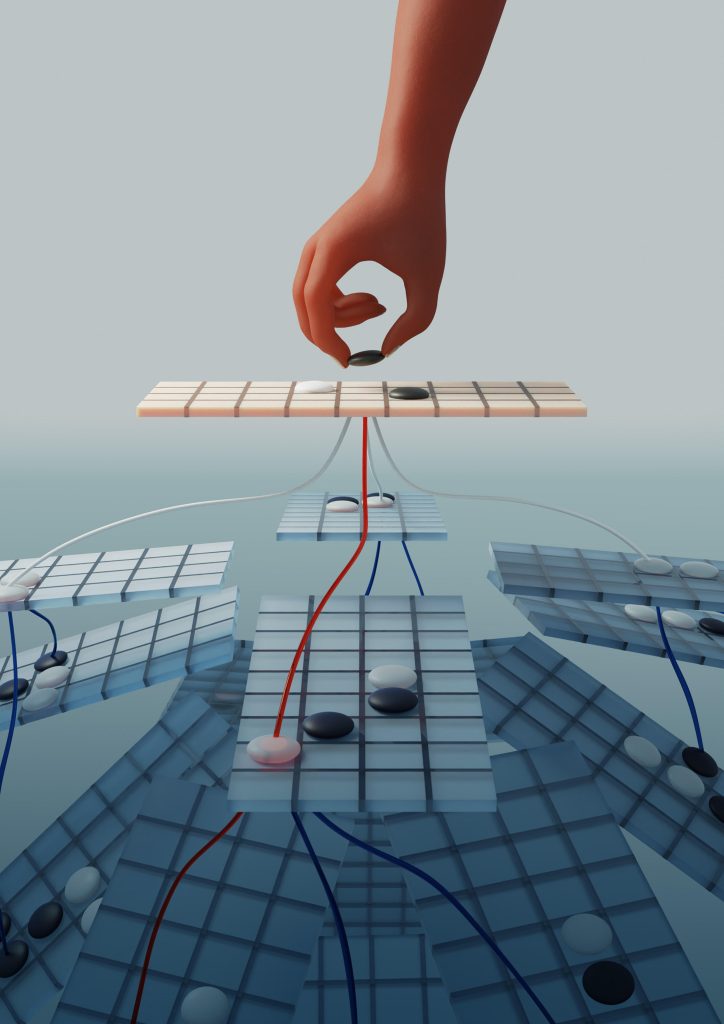
Artist’s impression of how people plan multiple steps ahead. Credit: Art by Jordan Lei.
A computational model developed by cognitive scientists illustrates how expertise can improve the depth of planning.
Chess grandmasters are frequently perceived as the pinnacle of forward thinking. However, is it possible for others to learn to think further ahead with a reasonable amount of practice?
To explore this, a group of cognitive scientists developed a computational model that reveals our ability to plan for future events. This research not only deepens our comprehension of the elements influencing decision-making, but it also demonstrates how we can improve our planning abilities with practice.
The research, conducted by scientists in New York University’s Center for Neural Science and reported in the journal Nature, centers on the role of “planning depth”—the number of steps that an individual thinks ahead—in decision-making.
“While artificial intelligence has made impressive progress in solving complex planning problems, much less is understood about the nature and depth of planning in people,” explains Wei Ji Ma, a professor of neuroscience and psychology at NYU and the paper’s senior author. “Our work adds to this body of knowledge by showing that even a relatively modest amount of practice can improve depth of planning.”
It’s been long established that a hallmark of human intelligence is the ability to plan multiple steps into the future. However, it’s less clear whether or not skilled decision-makers plan more steps ahead than do novices. This is because methods for measuring this aptitude (e.g., experiments involving board games) have notable shortcomings—in part, because they don’t reliably estimate planning depth.
Modeling the Human Decision Tree
The Nature paper’s authors had people play a relatively simple game—a more sophisticated version of tic-tac-toe—that still required players to plan deeply (i.e., multiple steps ahead). Then, to understand precisely what goes on in people’s minds as they are thinking of their next move in this game, the authors designed a computer model based on AI principles. The model allows them to describe and subsequently predict the moves that people make when faced with new situations in the game.
“In this computational model, players build a ‘decision tree’ in their heads the same way that you might plan for multiple possible scenarios for a complex travel itinerary,” Ma explains.
Here, their calculations showed that human behavior can be captured using a computational cognitive model based on a heuristic search algorithm—one that maps out a sequence of promising moves for both players.
To validate the model, the researchers conducted a series of behavioral experiments with human participants. Specifically, they tracked how players planned their moves under different scenarios while also testing their memory and their ability to learn from and reconstruct their game-playing experiences. In addition, the team conducted a Turing test experiment in which observers, who had played the game before, were asked to determine whether sequences of moves they witnessed were generated by the model or by human players. These observers were able to make the correct distinction only about half the time, suggesting that the model makes similar decisions that a human would make. Several of these experiments may be played online by going to Ma’s laboratory website.
Practice Makes Perfect: The Role of Experience in Planning
Overall, their results showed that better planning is driven by the ability to recognize patterns more accurately and in less time—outcomes that point to the benefits of practice and experience.
“It is known that cognitive abilities can improve in adulthood through practice,” observes Ma. “These findings show that even a relatively modest amount of practice can improve one’s depth of planning. This opens up new avenues of research. For example, we can use these methods to study the development of planning abilities in children, or test whether planning abilities can be retained in old age. Of course, it is also crucial that we connect planning in the laboratory to planning in real life.”
Reference: “Expertise increases planning depth in human gameplay” by Bas van Opheusden, Ionatan Kuperwajs, Gianni Galbiati, Zahy Bnaya, Yunqi Li and Wei Ji Ma, 31 May 2023, Nature.
DOI: 10.1038/s41586-023-06124-2
The study was funded by the National Science Foundation.
The paper’s other authors are: Bas van Opheusden, an NYU doctoral student at the time of the study and now a research scientist at Generally Intelligent; Ionatan Kuperwajs, an NYU doctoral student; Gianni Galbiati, an NYU researcher at the time of the study and now director of research and development at Vidrovr; Zahy Bnaya, a postdoctoral researcher at NYU’s Center for Neural Science; and Yunqi Li, an NYU researcher at the time of the study and now a doctoral student at Stanford University.
Never miss a breakthrough: Join the SciTechDaily newsletter.
Follow us on Google and Google News.