
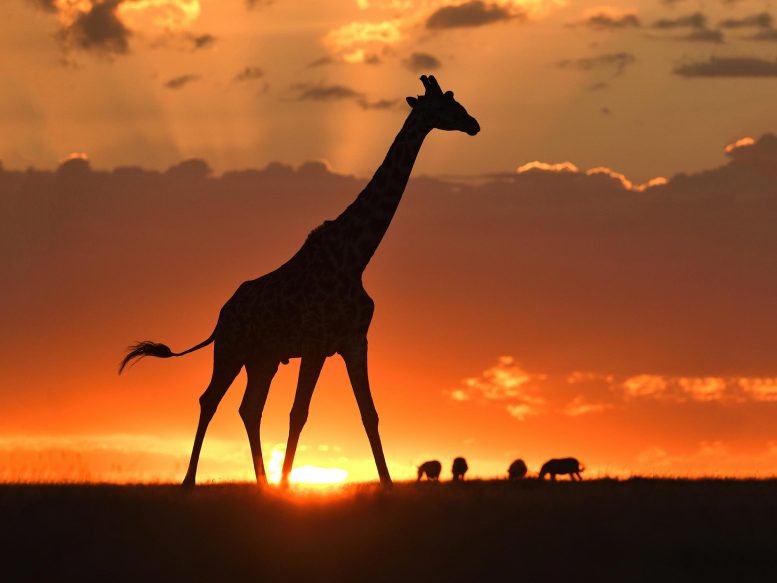
Giraffe populations separated by Great Rift Valley in eastern Africa are genetically distinct, suggesting that conservation efforts should be considered separately for each population.
Giraffes in eastern Africa may be even more endangered than previously thought. A new study led by researchers at Penn State reveals that populations of Masai giraffes separated geographically by the Great Rift Valley have not interbred — or exchanged genetic material — in more than a thousand years, and in some cases hundreds of thousands of years. The researchers recommend that the two populations be considered separately for conservation purposes, with separate but coordinated conservation efforts to manage each population.
Populations of giraffes have declined rapidly in the last thirty years, with fewer than 100,000 individuals remaining worldwide. Numbers of Masai giraffes, a species found in Tanzania and southern Kenya that are considered endangered by the International Union for Conservation of Nature (IUCN) have declined by about 50% in this period due to illegal hunting and other human activities that encroach on their habitat, with only about 35,000 individuals remaining.
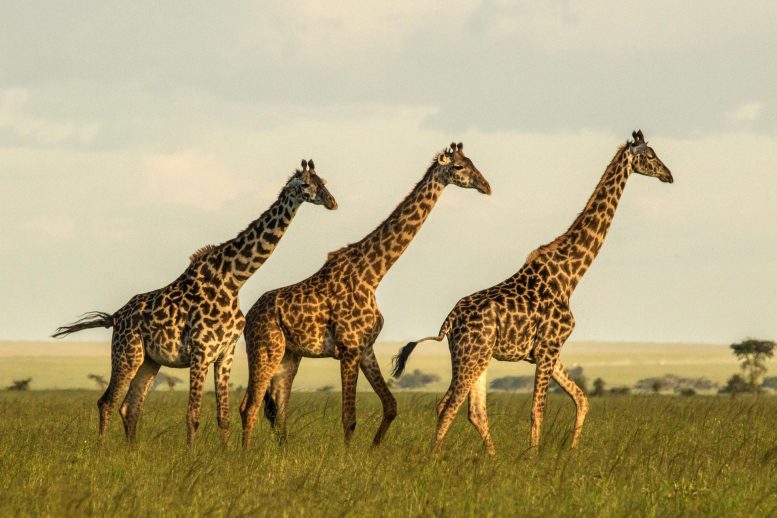
Impact of the Great Rift Valley on Genetic Isolation
“The habitat of Masai giraffes is highly fragmented, in part due to the rapid expansion of the human population in east Africa in the last 30 years and the consequent loss of wildlife habitats,” said Douglas Cavener, Dorothy Foehr Huck and J. Lloyd Huck Distinguished Chair in Evolutionary Genetics and professor of biology at Penn State and leader of the research team. “Additionally, the Great Rift Valley cuts down through East Africa, and the steep slopes of its escarpments are formidable barriers to wildlife migration. We looked at the genomes of 100 Masai giraffes to determine if populations on either side of the rift have crossed over to breed with each other in the recent past, which has important implications for conservation.”
According to the researchers, giraffes are notoriously bad climbers. Using high-resolution satellite data, they found only two locations where the angle of the rift’s slopes was shallow enough for giraffes to potentially climb over, but there are no reports of them actually doing so. To better understand the historical exchange of genetic information, the researchers used a combination of whole genome sequencing of the nuclear genome, which includes genetic information passed on from both parents, as well the mitochondrial genome, which includes information passed on only from the maternal line. They present their results in a paper appearing today (June 12) in the journal Ecology and Evolution.
“Interbreeding among different populations results in the exchange of genetic information—often called gene flow—and is generally considered to be beneficial because it can improve overall genetic diversity and help buffer small populations against disease and other threats,” said Lan Wu-Cavener, assistant research professor of biology and a member of the research team. “To understand potential gene flow across the rift, we sequenced the more than 2 billion base pairs that make up entire nuclear genome as well as the more than 16,000 base pairs that make up the entire mitochondrial genome. This complex data presented a variety of computational and data storage challenges for our small team, but using the entire genome instead of a small portion allowed us to definitively investigate the extent of gene flow among these populations.”
The researchers identified several blocks of genes within the mitochondrial genome that are typically inherited together — which researchers call haplotypes — across the two populations and conducted a network analysis based on patterns of similarity across those haplotypes. They found that giraffes on the east side of the rift had no overlapping haplotypes with giraffes on the west side of the rift, which suggests that females have not migrated across the rift to breed in the past 250,000-300,000 years.
“Female-mediated gene flow between the two populations has not occurred in hundreds of thousands of years, or probably ever,” said Cavener. “This raised a new question that we hadn’t anticipated about the origin of these populations. We originally thought that one population was founded and then some individuals crossed over to the other side of the rift to establish the second population. But we now think that the two populations were founded independently more than 200,000 years ago.”
Analysis of the nuclear genome suggests that gene flow through the movement of males may have occurred as recently as a thousand years ago. The researchers plan to take samples from additional animals from both populations to better understand when and why this gene flow might have stopped.
Conservation Implications of Genetic Distinctiveness
“Taken together, these results suggest that populations of giraffes on each side of the rift are genetically distinct, with each population having less genetic diversity than if they were one, larger interconnected population,” said Cavener. “There are very little prospects of giraffes crossing over the rift on their own, and translocation is highly impractical with giraffes. This suggests that Masai giraffes are more endangered than we previously thought, and that conservation efforts for each population should be considered in an independent but coordinated fashion. We hope that the Tanzanian and Kenyan governments will increase the protection of Masai giraffes and their habitats, especially given the recent increase in giraffe poaching in the area.”
The researchers also found alarmingly high indicators of inbreeding — a process that decreases genetic diversity and overall fitness of the population — on both the east and west side of the rift. The researchers plan to continue to study populations of Masai giraffes on both sides of the rift, including those that are particularly isolated, to better understand any danger faced due to inbreeding. They also plan to investigate how giraffes move between groups on the east side of the rift, where the habitat is particularly fragmented, to better understand how to prioritize conservation efforts to maintain connectivity between them.
“We would also like to use genetics to clarify parental and sibling relationships in Masai giraffes,” said Cavener. “There’s a lot we don’t know about how giraffes mate, for example do only a few males successfully breed in a local population over many years or do several males breed in that population? These questions are critically important to estimating the actual breeding population of the populations and will continue to guide our efforts to protect and conserve these majestic and charismatic animals.”
Reference: “Genetic evidence of population subdivision among Masai giraffes separated by the Gregory Rift Valley in Tanzania” by George G. Lohay, Derek E. Lee, Lan Wu-Cavener, David L. Pearce, Xiaoyi Hou, Monica L. Bond and Douglas R. Cavener, 12 June 2023, Ecology and Evolution.
DOI: 10.1002/ECE3.10160
In addition to Cavener and Wu-Cavener, the research team at Penn State includes first author George Lohay, postdoctoral scholar who collected the biological samples from wild giraffe in Tanzania; Associate Research Professor of Biology Derek Lee and academic affiliate in biology Monica Bond, whose work over the past decade on the Masai giraffe populations in this study were essential for the project design and interpretation of the results; undergraduate student David Pearce; and graduate student Xiaoyi Hou, This work was supported by the Penn State Department of Biology, the Eberly College of Science, and the Huck Institutes of the Life Sciences as well as the Wild Nature Institute.
Never miss a breakthrough: Join the SciTechDaily newsletter.
Follow us on Google and Google News.