
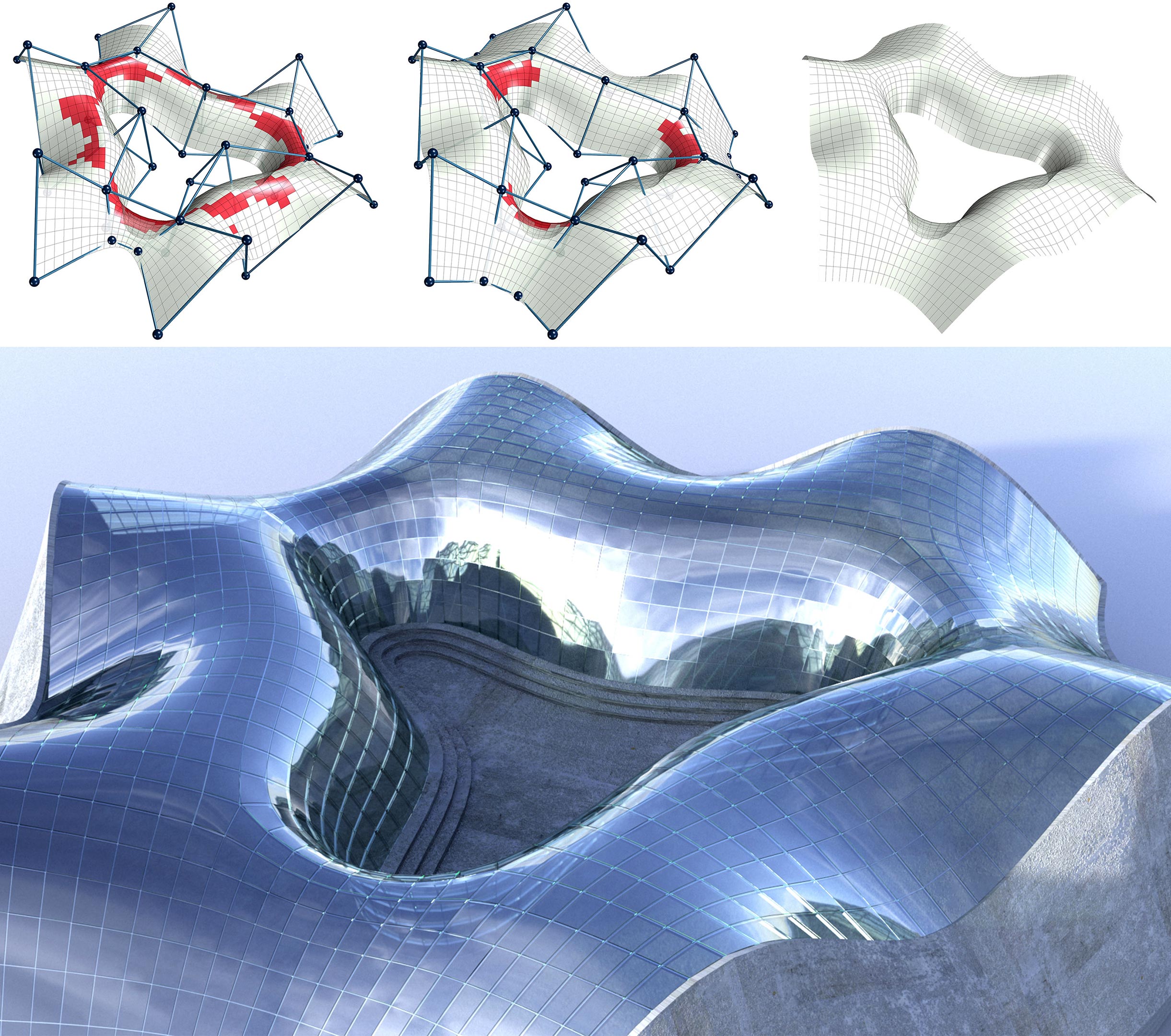
Curved glass façades can be stunningly beautiful, but traditional construction methods are extremely expensive. Panes are usually made with “hot bending,” where glass is heated and formed using a mold or specialized machines, an energy-intensive process that generates excess waste in the form of individual molds. Cold-bent glass is a cheaper alternative in which flat panes of glass are bent and fixed to frames at the construction site. However, given the fragility of the material, coming up with a form that is both aesthetically pleasing and manufacturable is extremely challenging. Now, an interactive, data-driven design tool allows architects to do just that.
Created by a team of scientists from IST Austria, TU Wien, UJRC, and KAUST, the software allows users to interactively manipulate a façade design and receive immediate feedback on the fabricability and aesthetics of the panelization — a very convenient way for navigating various realizations of the designer’s intentions. The software is based on a deep neural network trained on special physical simulations to predict glass panel shapes and fabricability. In addition to allowing users to interactively adapt an intended design, it can automatically optimize a given design, and can be easily integrated into an architect’s usual workflow. The software and research results were presented at SIGGRAPH Asia 2020.
Hot-bent and cold-bent glass
Hot-bent glass has been in use since the 19th century, though it was not until the 1990s that it became generally available. Still, the process remains prohibitively expensive and the logistics of transporting bent glass are complicated. An alternative, cold-bent glass, was developed around ten years ago. It was cheap to make, easy to transport, and the geometric and visual quality were better than hot-bent glass. The technique also allowed architects to make use of special types of glass and accurately estimate the deformation stress on the panels.
The issue was that designing cold-bent glass façades represents an enormous computational problem. Ruslan Guseinov, IST Austria postdoc and co-first author, explains: “While it is possible to calculate when an individual panel will break, or provide a safety margin for additional loads, working with the full façade — which often comprises thousands of panels — is simply too complex for the conventional designer tools.” Moreover, using a computer with traditional computational methods to obtain stresses and shapes each time a change was made would take too long to be usable.
Enabling a new technology
Thus, the team’s goal was to create software that would allow a (non-expert) user to interactively edit a surface while receiving real-time information on the bent shape and the associated stresses for each individual panel. They decided on a data-driven approach: the team ran more than a million simulations to build a database of possible curved glass shapes, represented in a computer-aided design (CAD) format conventional in architecture. Then, a deep neural network (DNN) was trained on this data. This DNN precisely predicts one or two possible glass panel shapes for a given quadrangular boundary frame; these can then be used in a façade sketched by an architect.
That the DNN predicted several shapes was “one of the most surprising aspects of the DNN,” adds Konstantinos Gavriil, co-first author and researcher at TU Wien. “We knew that a given boundary does not uniquely define the panel, but we didn’t anticipate that the DNN would be able to find multiple solutions, even though it had never seen two alternative panels for a single boundary.” From the set of solutions, the program selects the pane geometry that best fits the façade design, taking into account characteristics such as smoothness of frames and reflections.
The user can then adapt their model to reduce stress and otherwise improve the overall appearance. If this proves too difficult, the user can automatically optimize the design at any time, which gives a “best fit” solution that significantly reduces the number of infeasible panels. In the end, either all panels can be safely constructed, or the user can choose to hot bend a few of them. Once the user is satisfied with the form, the program exports the flat panel shapes and frame geometries necessary for the construction of the façade.
Accuracy and efficiency
To test the accuracy of the simulations, the team manufactured frames and glass panels, including panels under extremely high stress. In the worst case, they observed miniscule deviation from the predicted shapes (less than panel thickness), and all panels were fabricable as expected. The team further verified that the data-driven model faithfully (and efficiently) reproduced the output of the simulations.
“We believe we have created a novel, practical system that couples geometric and fabrication-aware design and allows designers to efficiently find a balance between economic, aesthetic, and engineering criteria,” concludes Bernd Bickel, professor at IST Austria. In the future, the program could be expanded to include additional features for practical architectural design, or be used to explore different materials and more complex mechanical models.
Reference: “Computational design of cold bent glass façades” by Konstantinos Gavriil, Ruslan Guseinov, Jesús Pérez, Davide Pellis, Paul Henderson, Florian Rist, Helmut Pottmann and Bernd Bickel, November 2020, ACM Transactions on Graphics.
DOI: 10.1145/3414685.3417843
Funding: European Union’s Horizon 2020 research and innovation program, Algebraic Representations in Computer-Aided Design for complEx Shapes (ARCADES), European Research Council (ERC)
Never miss a breakthrough: Join the SciTechDaily newsletter.
Follow us on Google and Google News.