
Close Menu
    Facebook X (Twitter) Instagram
    SciTechDaily
    • Biology
    • Chemistry
    • Earth
    • Health
    • Physics
    • Science
    • Space
    • Technology
    Facebook X (Twitter) Pinterest YouTube RSS
    SciTechDaily
    Home»Space»Cold Planets Exist Throughout the Milky Way – Even in the Galactic Bulge
    Space

    Cold Planets Exist Throughout the Milky Way – Even in the Galactic Bulge

    By Osaka UniversitySeptember 4, 2021No Comments3 Mins Read
    Facebook Twitter Pinterest Telegram LinkedIn WhatsApp Email Reddit
    Share
    Facebook Twitter LinkedIn Pinterest Telegram Email Reddit
    Cold Planet Distribution Throughout the Milky Way
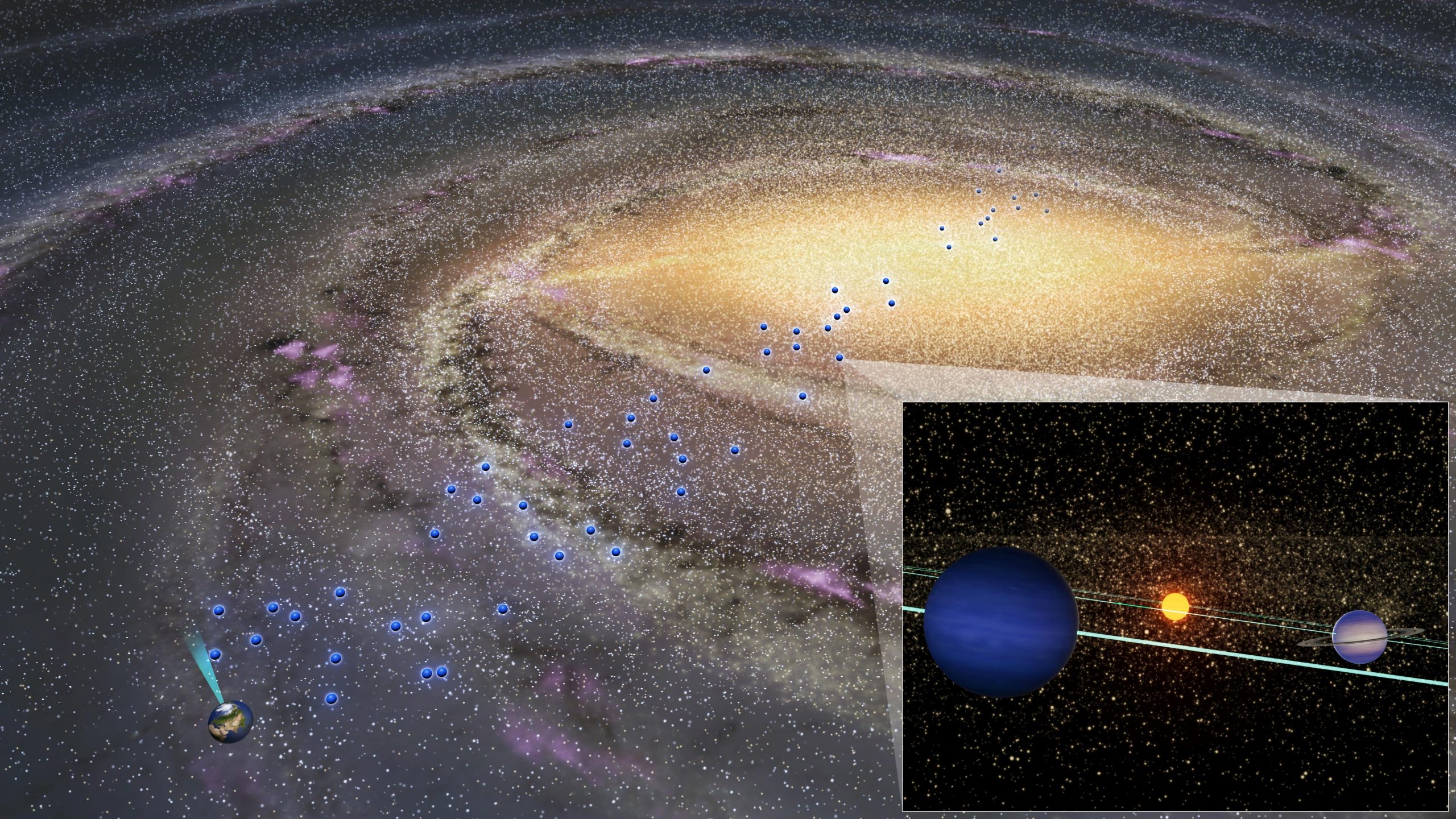
    An artist’s conception of cold planet distribution throughout the Milky Way. For comparison, the cyan cone is the Kepler transit survey field. The inset shows an artistic conception of a planetary system in the Galactic bulge. Credit: Osaka University

    Researchers led by Osaka University and NASA find that the distribution of cold planets in the Milky Way is not strongly dependent on the distance from the Galactic center.

    Although thousands of planets have been discovered in the Milky Way, most reside less than a few thousand light-years from Earth. Yet our Galaxy is more than 100,000 light-years across, making it difficult to investigate the Galactic distribution of planets. But now, a research team has found a way to overcome this hurdle.

    In a study published in The Astrophysical Journal Letters, researchers led by Osaka University and NASA have used a combination of observations and modeling to determine how the planet-hosting probability varies with the distance from the Galactic center.

    The observations were based on a phenomenon called gravitational microlensing, whereby objects such as planets act as lenses, bending and magnifying the light from distant stars. This effect can be used to detect cold planets similar to Jupiter and Neptune throughout the Milky Way, from the Galactic disk to the Galactic bulge—the central region of our Galaxy.

    “Gravitational microlensing currently provides the only way to investigate the distribution of planets in the Milky Way,” says Daisuke Suzuki, co-author of the study. “But until now, little is known mainly because of the difficulty in measuring the distance to planets that are more than 10,000 light-years from the Sun.”

    A New Modeling Approach to Reveal Planet Patterns

    To solve this problem, the researchers instead considered the distribution of a quantity that describes the relative motion of the lens and distant light source in planetary microlensing. By comparing the distribution observed in microlensing events with that predicted by a Galactic model, the research team could infer the Galactic distribution of planets.

    The results show that the planetary distribution is not strongly dependent on the distance from the Galactic center. Instead, cold planets orbiting far from their stars seem to exist universally in the Milky Way. This includes the Galactic bulge, which has a very different environment to the solar neighborhood, and where the presence of planets has long been uncertain.

    “Stars in the bulge region are older and are located much closer to each other than stars in the solar neighborhood,” explains lead author of the study Naoki Koshimoto. “Our finding that planets reside in both these stellar environments could lead to an improved understanding of how planets form and the history of planet formation in the Milky Way.”

    According to the researchers, the next step should be to combine these results with measurements of microlens parallax or lens brightness—two other important quantities associated with planetary microlensing.

    Reference: “No Large Dependence of Planet Frequency on Galactocentric Distance” by Naoki Koshimoto, David P. Bennett, Daisuke Suzuki and Ian A. Bond, 26 August 2021, The Astrophysical Journal Letters.
    DOI: 10.3847/2041-8213/ac17ec

    Never miss a breakthrough: Join the SciTechDaily newsletter.
    Follow us on Google and Google News.

    Astronomy Exoplanet Milky Way NASA Planets Popular University of Osaka
    Share. Facebook Twitter Pinterest LinkedIn Email Reddit

    Related Articles

    Perpendicular Planet: A 90° Orbit Over Twin Suns Leaves Scientists Stunned

    A Century-Old Cosmic Mystery Solved – Four Hidden Planets Found Near Earth

    In the “Hot Neptune Desert,” a Rare Planet Offers Clues to Cosmic Mysteries

    New Earth-Sized Planet Discovered Orbiting a Star That Will Live 100 Billion Years

    NASA Discovery Alert: A “Super-Earth” in the Habitable Zone Only 137 Light-Years Away

    Cyclones in Space? See How Hubble Uncovered Extreme Weather on a Distant Planet

    First Evidence for a Possible Planet Outside of the Milky Way Galaxy

    Discovery Alert: A “Cool” Neptune-Like Planet – With Plenty of Atmosphere?

    Hubble Discovers a Strange Exoplanet That Resembles the Long-Sought “Planet Nine”

    Leave A Reply Cancel Reply

    • Facebook
    • Twitter
    • Pinterest
    • YouTube

    Don't Miss a Discovery

    Subscribe for the Latest in Science & Tech!

    Trending News

    New “Nanozyme Hypothesis” Could Rewrite the Story of Life’s Origins

    Anatomy Isn’t Finished: The Human Body Still Holds Secrets

    “Pretty Close to Home”: The Hidden Earthquake Threat Beneath Seattle

    The Surprising Reason You Might Want To Sleep Without a Pillow

    Scientists Say This Natural Hormone Reverses Obesity by Targeting the Brain

    35-Million-Year-Old Mystery: Strange Arachnid Discovered Preserved in Amber

    Is AI Really Just a Tool? It Could Be Altering How You See Reality

    JWST Reveals a “Forbidden” Planet With a Baffling Composition

    Follow SciTechDaily
    • Facebook
    • Twitter
    • YouTube
    • Pinterest
    • Newsletter
    • RSS
    SciTech News
    • Biology News
    • Chemistry News
    • Earth News
    • Health News
    • Physics News
    • Science News
    • Space News
    • Technology News
    Recent Posts
    • Artificial Sweeteners May Harm Future Generations, Study Suggests
    • The Ocean Current Stronger Than All Rivers Changed Earth Forever
    • NASA Artemis II Splashdown and Astronaut Recovery Operation [Image Gallery]
    • Splashdown! NASA Artemis II Returns From Record-Breaking Moon Mission
    • Scientists Freeze a Spinning Nanoparticle to Its Quantum Limit
    Copyright © 1998 - 2026 SciTechDaily. All Rights Reserved.
    • Science News
    • About
    • Contact
    • Editorial Board
    • Privacy Policy
    • Terms of Use

    Type above and press Enter to search. Press Esc to cancel.