
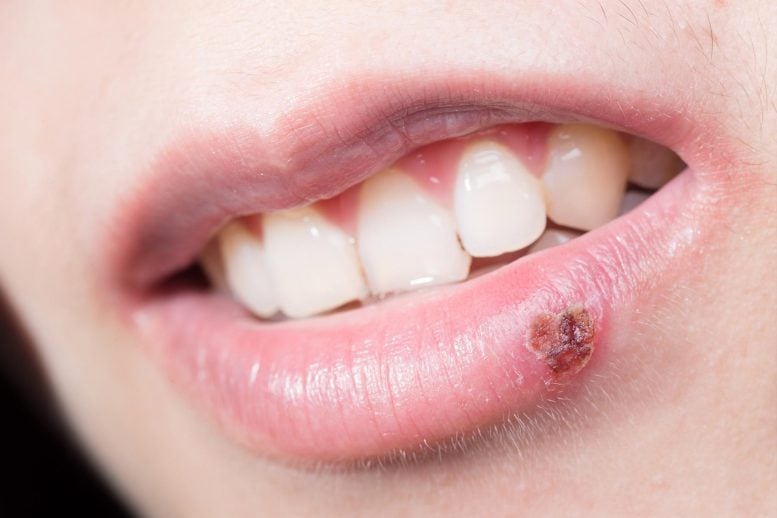
UVA researchers found that HSV reactivates by hijacking an immune cytokine, Interleukin 1 beta, which increases neuron excitability under stress or inflammation. This discovery could lead to new ways to prevent outbreaks.
Researchers at the University of Virginia School of Medicine have shed light on what causes herpes simplex virus to flare up, explaining how stress, illness, and even sunburn can trigger unwanted outbreaks.
The discovery could lead to new ways to prevent cold sores and herpes-related eye disease from recurring, the researchers report.
“Herpes simplex recurrence has long been associated with stress, fever, and sunburn,” said researcher Anna R. Cliffe, PhD, of UVA’s Department of Microbiology, Immunology and Cancer Biology. “This study sheds light on how all these triggers can lead to herpes simplex-associated disease.”
About Herpes Simplex Recurrence
Once you’re infected with herpes simplex virus (HSV) — and more than half of Americans are — the virus never really goes away. Instead, it lurks inside neurons, waiting for the right moment to strike again, a process known as reactivation.
Cold sores, also known as fever blisters, are one of the most common symptoms of HSV reactivation. Recurrent reactivation in the eye leads to herpes keratitis, which, if left untreated, can result in blindness. HSV infection has also been linked to the progression of Alzheimer’s disease.
Recurrences of HSV are typically associated with stress, illness or sunburn, but doctors have been uncertain exactly what causes the virus to reactivate. Cliffe and her collaborators found that when neurons harboring the virus were exposed to stimuli that induce “neuronal hyperexcitation,” the virus senses this particular change and seizes its opportunity to reactivate.
Working in a model developed by the Cliffe lab using mouse neurons infected with HSV, the researchers determined that the virus hijacks an important immune response within the body. In response to prolonged periods of inflammation or stress, the immune system releases a particular cytokine, Interleukin 1 beta. This cytokine is also present in epithelial cells in the skin and eye and is released when these cells are damaged by ultraviolet light.
Interleukin 1 beta then increases the excitability in the affected neurons, setting the stage for HSV to flare up, the UVA researchers discovered.
“It is really remarkable that the virus has hijacked this pathway that is part of our body’s immune response,” Cliffe said. “It highlights how some viruses have evolved to take advantage of what should be part of our infection-fighting machinery.”
The scientists say that more research will need to be done to fully understand the potential factors which play into herpes simplex disease. It may vary depending on the virus strain or the type of neuron infected, even. And it is still unknown if the virus alters how neurons respond to cytokines such as Interleukin 1 beta. But the new insights help doctors better understand what is happening in neurons and the immune system, and that could lead to ways to prevent unwanted outbreaks, the researchers hope.
“A better understanding of what causes HSV to reactivate in response to a stimulus is needed to develop novel therapeutics,” Cliffe said. “Ultimately, what we hope to do is target the latent virus itself and make it unresponsive to stimuli such as Interleukin 1 beta.”
Findings Published
The researchers have published their findings in the scientific journal eLife. The research team consisted of Sean R. Cuddy, Austin R. Schinlever, Sara Dochnal, Philip V. Seegren, Jon Suzich, Parijat Kundu, Taylor K. Downs, Mina Farah, Bimal N. Desai, Chris Boutell and Cliffe.
Reference: “Neuronal hyperexcitability is a DLK-dependent trigger of herpes simplex virus reactivation that can be induced by IL-1” by Sean R Cuddy, Austin R Schinlever, Sara Dochnal, Philip V Seegren, Jon Suzich, Parijat Kundu, Taylor K Downs, Mina Farah, Bimal N Desai, Chris Boutell and Anna R Cliffe, 22 December 2020, eLife.
DOI: 10.7554/eLife.58037
The work was supported by the National Institutes of Health’s National Institute of Neurological Disorder and Stroke, grant R01NS105630; the National Institute of Allergy and Infectious Diseases, grant T32AI007046; the National Eye Institute, grant F30EY030397; the National Institute of General Medical Sciences, grants T32GM008136, T32GM007267, GM108989 and GM007055; and Medical Research Council grant MC_UU_12014/5.
Never miss a breakthrough: Join the SciTechDaily newsletter.
Follow us on Google and Google News.