
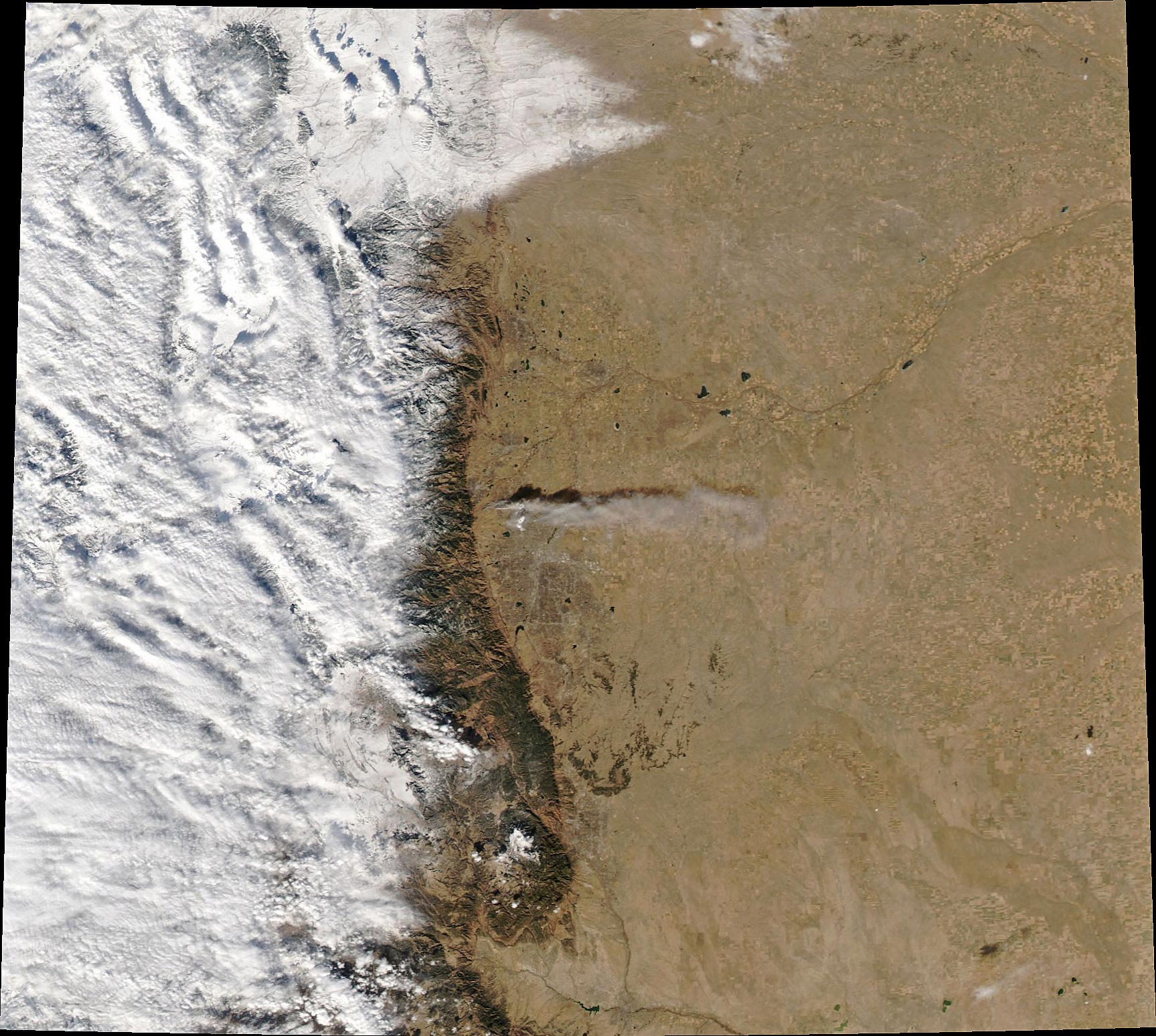
Hurricane-force winds whipped fires across drought-parched grasslands and into suburban neighborhoods near Denver.
On December 30, 2021, high winds roared out of the west and down the front slope of the Rocky Mountains. Northwest of Denver, peak gusts reached up to 115 miles (185 kilometers) per hour—the equivalent of a category 3 hurricane. Those winds whipped up intense grass and brush fires and blew them east down a small valley and road toward the towns of Superior and Louisville. By the time it was over, nearly 1,100 houses had been destroyed or damaged, and two people were reported missing.
Unlike many of the megafires of recent years—which typically occur in forests and wildlands—the Marshall fire quickly traveled into densely populated neighborhoods and transitioned from a wildfire to an urban conflagration.
Tens of thousands of residents were evacuated as flames were blown down streets and through cul-de-sacs. The fire was carried by what climate scientist and Boulder resident Daniel Swain called “an ember storm.” Blown by hurricane-force winds, the embers leaped from house to house, burning many from the inside out, while torching trees, igniting commercial buildings, and jumping a highway.
This natural-color image was acquired just a few hours after the fire started on December 30 by the Moderate Resolution Imaging Spectroradiometer (MODIS) on NASA’s Aqua satellite. The smoke plume, which was also visible on radar, stretched about 60 miles (100 kilometers) over Colorado’s eastern plains at the time. The fire also generated its own weather: the rising heat created a low-pressure area that drew surface winds toward the fire from all directions.
The next day brought much-needed moisture, as a cold front moved in and dropped more than 10 inches of snow—dampening the fire but also complicating the response. As of January 2, 2022, nearly 75 percent of the perimeter of the 6,200–acre (25 km²) fire was contained.
Climate Conditions and the Risk of Unseasonal Wildfires
High winds and wildfires are not uncommon on the Front Range, but a December wildfire is; the normal fire season lasts from May to September. One recent study found that increases in extreme fire weather are being driven by decreases in atmospheric humidity and increasing temperatures. In 2021, Colorado saw an unseasonably warm summer and fall, coupled with record dryness. The warm, dry spell followed an unusually wet spring, which reduced wildfires through the summer but fueled the growth of vegetation that dried out and provided ample tinder for the December fire.
At the time of the fire, the eastern part of Boulder County was in extreme drought. Nearby Denver, which normally has 30 inches (76 centimeters) of snow by this time of year, did not record its first winter snowfall until December 10, the latest on record.
NASA Earth Observatory image by Joshua Stevens, using MODIS data from NASA EOSDIS LANCE and GIBS/Worldview.
Never miss a breakthrough: Join the SciTechDaily newsletter.
Follow us on Google and Google News.
2 Comments
“One recent study found that increases in extreme fire weather are being driven by decreases in atmospheric HUMIDITY and increasing TEMPERATURES.”
Neither of which applied here! It was well below the temperatures associated with summertime “extreme fire weather,” and because the exotic cheatgrass had been senescent and dry since Summer, such a situation could have happened even in a cooling world.
It appears from preliminary investigations that the ignition point was a building. The fire was then driven by very high winds. The dense suburban construction didn’t employ any special precautions against windblown embers. In the absence of human ignition, and the fuel created by wooden homes, this would have just been an inconvenient prairie fire. The problem isn’t human caused climate change causing fires. It is human caused ignition and human supplied fuel.
“Humans caused 97 percent of all wildfires in the wildland-urban interface, 85 percent of all wildfires in “very-low-density housing” areas, and 59 percent of all wildfires in wildlands between 1992 and 2015.”
https://cires.colorado.edu/news/line-fire
It seems that there is always an attempt to link climate change to catastrophes, even when it should be obvious that climate change played no role. Why is that?
Why is that you ask? Because that is where the money and power are. Climate change is an unscientific, political ruse to take power and money from the little people. Panic porn is their method of choice. Dare to ask questions? Begone with you!