

Close Menu
    Facebook X (Twitter) Instagram
    SciTechDaily
    • Biology
    • Chemistry
    • Earth
    • Health
    • Physics
    • Science
    • Space
    • Technology
    Facebook X (Twitter) Pinterest YouTube RSS
    SciTechDaily
    Home»Chemistry»Colored LED Lighting Enhances Growth, Biosynthesis of Microalgae for Next-Generation Biofuel
    Chemistry

    Colored LED Lighting Enhances Growth, Biosynthesis of Microalgae for Next-Generation Biofuel

    By American Institute of PhysicsApril 11, 2021No Comments3 Mins Read
    Facebook Twitter Pinterest Telegram LinkedIn WhatsApp Email Reddit
    Share
    Facebook Twitter LinkedIn Pinterest Telegram Email Reddit
    Blue Particles Abstract
    Researchers demonstrate that using a mix of red and blue LED light enhances the growth and biosynthesis of essential components, like lipids, in a specific microalga for feedstock development.

    Combined Blue and Red Illumination Enhances Growth, Biosynthesis of D. salina Microalgae

    As ethanol, biodiesel, and other biofuels continue to present challenges, such as competing with food security or lacking the technology for more efficient and low-cost production, microalgae are gaining momentum as a biofuel energy crop.

    In their paper, published in the Journal of Renewable and Sustainable Energy, by AIP Publishing, Yangzhou University researchers in China show how a combination of monochromatic red and blue LED illumination on one type of microalga can enhance its growth and increase the biosynthesis of critical components, such as lipids, for microalgae feedstock development.

    The researchers focused on Dunaliella salina (D. salina), typically extracted from sea salt fields and found in salt lakes. Easily cultivated and known for its bright pink color because of its high levels of carotenoid, D. salina is widely used in foods and cosmetics.

    Microalgae tend to accumulate higher amounts of lipids (fatty acids that make up natural oils and waxes) than other biomass feedstocks do, which means a much higher percentage of the organisms can be turned into usable biofuel. In the case of D. salina, the lack of a cell wall could make algae biofuel production easier to pursue.
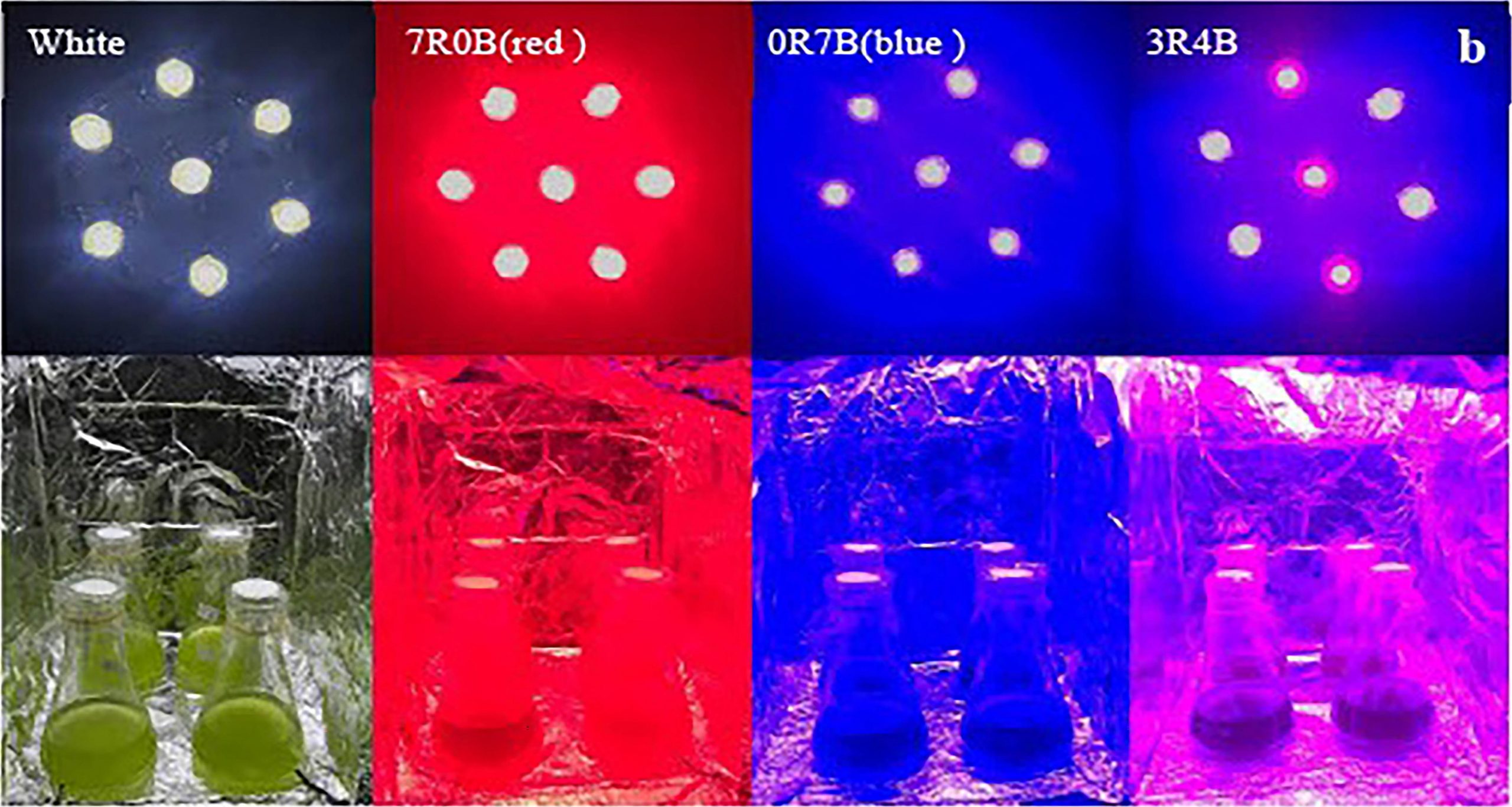
    Led Illuminators Installed With Different Combinations of Red and Blue Light
    Researchers show how a combination of monochromatic red and blue LED illumination on one type of microalga can enhance its growth and increase the biosynthesis of critical components. Here, LED illuminators installed with different combinations of red and blue light, with white as the control light. Credit: Xiaojian Zhou/Yangzhou University

    LEDs, as tunable single-color light sources, are already used to optimize plant growth, particularly in greenhouse cultivation. All parts of the visible spectrum are used in photosynthesis, but light also influences plant development. Adding more blue or red light, for instance, affects different plants in different ways. Optimal illumination conditions for microalgae growth and lipid production yield remain unknown.

    In their study, the researchers applied red, blue, or combined red-blue illumination to D. salina culture. They found different intensities of blue light did not significantly enhance microalgae growth but boosted the lipid, protein, and carbohydrate levels. Red light, on the other hand, reduced algae growth and lipid formation, compared to blue and white light.

    Optimal Illumination: Maximizing Lipid Productivity

    However, when red and blue lights were simultaneously applied in various ratios, the microalgae showed a major boost in growth and lipid productivity. The optimal 4-to-3 ratio of red and blue light significantly improved lipid productivity by more than 35% and increased dry biomass yield by more than 10% compared to the white light control.

    The researchers are planning to analyze the composition of fatty acids synthesized in the algae under the favorable combined lighting for increased lipid production.

    “Biodiesel performance is dependent on the composition of fatty acids, so we want to determine how the combined monochromatic lights would affect the quality of microalgae biodiesel,” author Xiaojian Zhou said.

    Reference: “Impact of combined monochromatic light on the biocomponent productivity of Dunaliella salina” by Cuili Jin, Binqi Yu, Shouyuan Qian, Qing Liu and Xiaojian Zhou, 30 March 2021, Journal of Renewable and Sustainable Energy.
    DOI: 10.1063/5.0041330

    Never miss a breakthrough: Join the SciTechDaily newsletter.
    Follow us on Google and Google News.

    Algae American Institute of Physics Biofuel Energy Green Energy
    Share. Facebook Twitter Pinterest LinkedIn Email Reddit

    Related Articles

    Banana Split: Extracting Hydrogen Fuel From Banana Peels

    Turning Kitchen Waste Into Biofuels – With Some Help From the “Muffin Monster”

    Not Your Average Refinery: Sustainable Energy Production Through Electrochemical Reduction

    Innovative Process Rapidly Turns Plant Waste Into Biofuels

    Powered by Sunlight, ‘Artificial Leaf’ Successfully Produces Clean Gas From CO2 and Water

    Devices That Make Fuel From Sunlight More Efficiently Possible With Nanoparticle Discovery From Electrode-Fitted Microscope

    New Concept Enables More Eco-Friendly Batteries With Twice the Energy Density

    Stanford Researchers Discover a New Route to Carbon-Neutral Fuels From Carbon Dioxide

    Catalytic Reactor Turns Greenhouse Gas Into Pure Liquid Fuel

    Leave A Reply Cancel Reply

    • Facebook
    • Twitter
    • Pinterest
    • YouTube

    Don't Miss a Discovery

    Subscribe for the Latest in Science & Tech!

    Trending News

    First-of-Its-Kind Discovery: Homer’s Iliad Found Embedded in a 1,600-Year-Old Egyptian Mummy

    Beyond Inflammation: Scientists Uncover New Cause of Persistent Rheumatoid Arthritis

    A Simple Molecule Could Unlock Safer, Easier Weight Loss

    Scientists Just Built a Quantum Battery That Charges Almost Instantly

    Researchers Unveil Groundbreaking Sustainable Solution to Vitamin B12 Deficiency

    Millions of People Have Osteopenia Without Realizing It – Here’s What You Need To Know

    Researchers Discover Boosting a Single Protein Helps the Brain Fight Alzheimer’s

    World-First Study Reveals Human Hearts Can Regenerate After a Heart Attack

    Follow SciTechDaily
    • Facebook
    • Twitter
    • YouTube
    • Pinterest
    • Newsletter
    • RSS
    SciTech News
    • Biology News
    • Chemistry News
    • Earth News
    • Health News
    • Physics News
    • Science News
    • Space News
    • Technology News
    Recent Posts
    • Magnesium Magic: New Drug Melts Fat Even on a High-Fat, High-Sugar Diet
    • Weight-Loss Drugs Like Ozempic May Come With an Unexpected Cost
    • After Decades, MIT Researchers Capture the First 3D Atomic View of a Mysterious Material
    • Your Favorite Fishing Spot Is Turning Brown – and the Fish Are Changing
    • 380-Million-Year-Old Fish Fossil Reveals Secrets of Life’s First Steps Onto Land
    Copyright © 1998 - 2026 SciTechDaily. All Rights Reserved.
    • Science News
    • About
    • Contact
    • Editorial Board
    • Privacy Policy
    • Terms of Use

    Type above and press Enter to search. Press Esc to cancel.