
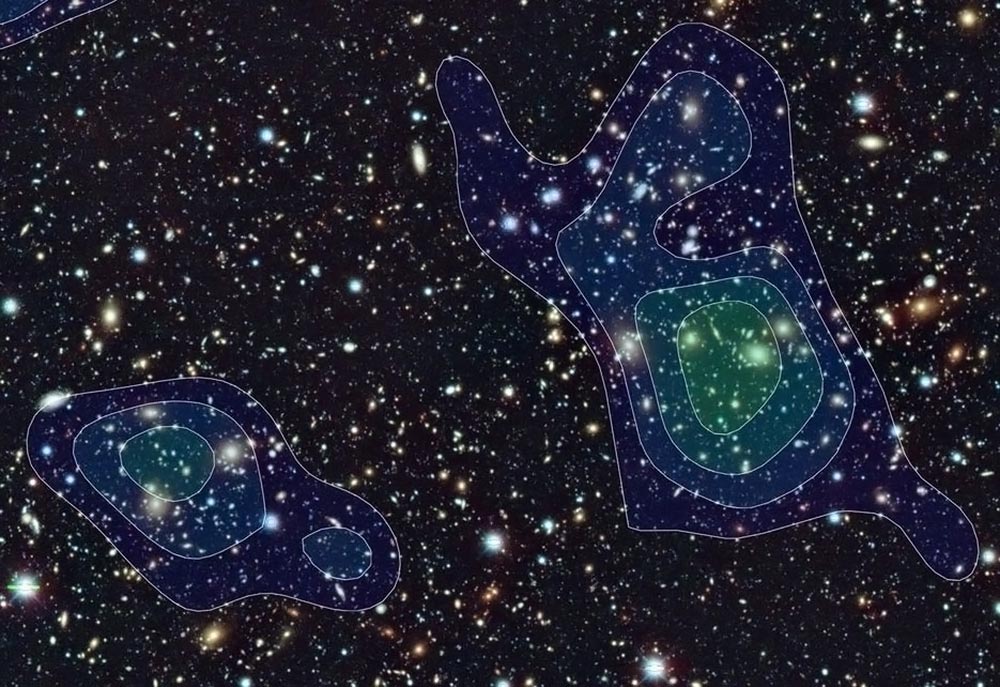
About eighty-five percent of the matter in the universe is in the form of dark matter, whose nature remains a mystery, and the rest is of the kind found in atoms. Dark matter exhibits gravity but otherwise does not interact with normal matter, nor does it emit light. Astronomers studying the evolution of galaxies find that because it is so abundant dark matter does, however, dominate the formation in the universe of large-scale structures like clusters of galaxies.
Despite being hard to detect directly, dark matter can be traced by modeling sensitive observations of the distributions of galaxies across a range of scales. Galaxies generally reside at the centers of vast clumps of dark matter called halos because they surround the galaxies. Gravitational lensing of more distant galaxies by foreground dark matter halos offers a particularly unique and powerful probe of the detailed distribution of dark matter. “Weak lensing” results in modestly yet systematically deforming shapes of background galaxies and can provide robust constraints on the distribution of dark matter within the clusters; “strong lensing,” in contrast, creates highly distorted, magnified and occasionally multiple images of a single source.
In the past decade, observations and hydrodynamic simulations have significantly furthered our understanding of how massive galaxies develop, with a two-phase scenario now favored. In the first step, the massive cores of today’s galaxies form at cosmological times from the gravitational collapse of matter into a galaxy, together with their surrounding dark matter halo. Star-formation then boosts the stellar mass of the galaxy. The most massive galaxies, however, have a second phase in which they capture stars from the outer regions of other galaxies, and once their own star formation subsides this phase dominates their assembly. Computer models and some observational results appear to confirm this scenario.
CfA astronomer Joshua Speagle was a member of a team that used ultra-sensitive, wide-field-of-view imaging at optical and near-infrared wavelength on the Subaru telescope to study massive galaxy assembly. Their technique took advantage of weak lensing effects because massive galaxies also tend to have more massive, dark matter halos that distort light. The astronomers studied about 3200 galaxies whose stellar masses are more than that of the Milky Way (roughly about four hundred billion solar masses). Using weak lensing analyses, they found that information about the assembly history of massive dark matter halos is encoded in the stellar mass distributions of massive central galaxies. Among other implications, the scientists show that for galaxies of the same mass, those with more extended shapes tend to have more massive dark matter halos. The results open a new window for exploring how massive galaxies form and evolve over cosmic time.
Reference: “Weak lensing reveals a tight connection between dark matter halo mass and the distribution of stellar mass in massive galaxies” by Song Huang, Alexie Leauthaud, Andrew Hearin, Peter Behroozi, Christopher Bradshaw, Felipe Ardila, Joshua Speagle, Ananth Tenneti, Kevin Bundy, Jenny Greene, Cristóbal Sifón and Neta Bahcall, 5 December 2019, Monthly Notices of the Royal Astronomical Society.
DOI: 10.1093/mnras/stz3314
Never miss a breakthrough: Join the SciTechDaily newsletter.
Follow us on Google and Google News.
2 Comments
A recent new theory that our particular bubble may be different perhaps in the retained resonance, from a larger bubble next door seems worth considering. Maybe we are a bubble even inside a larger bubble. So our matter component would be different from the other.
To understand the rotation of galaxies, the idea of the existence of dark matter was created. Through a
better observation of reality, analyzing the distribution of matter, we conclude that this distribution is very close to
that proportional to the radius cube, thus remembering the spherical distribution. With the appearance of the
accretion disk, it retained a large part of the matter that gravitated the gravitational sphere of the galaxy, maintaining
its distribution proportional to the cube of the radius, part of the total matter will be contained in the Accretion Disc
and the rest will continue to gravitate to the galaxy. Given the large size of the galaxy, the latter may be practically
printable given its dispersion in the total volume of the galaxy. We conclude that the idea of the existence of dark
matter is not necessary to justify the rotation of the galaxy.
http://www.sciepub.com/IJP/abstract/12651