
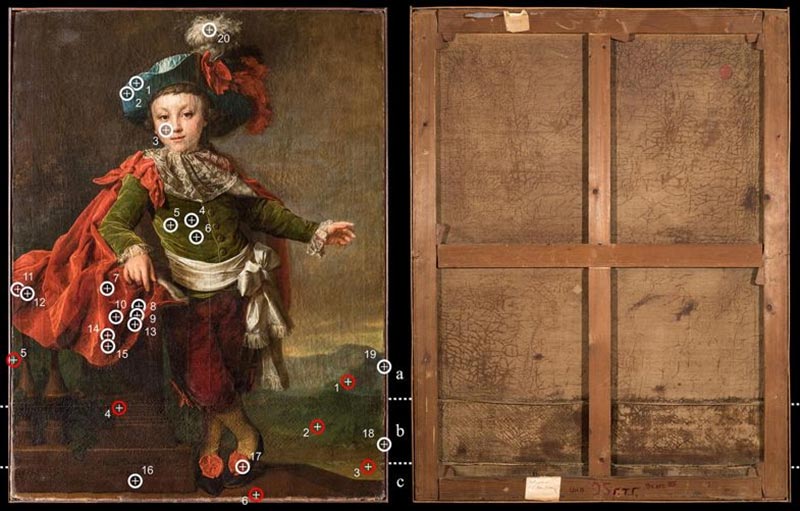
Russian researchers from the Moscow Institute of Physics and Technology, Kurnakov Institute of General and Inorganic Chemistry of RAS, and Russia’s famed Tretyakov Gallery have conducted a comprehensive preconservation study of “The Portrait of F.P. Makerovsky in a Masquerade Costume” (1789) by the Russian painter Dmitry Levitsky. The paper was published in the journal Heritage Science.
The portrait analyzed in the study is one of the masterpieces of the renowned painter’s mature period and a rare example of a children’s dress-up portrait in Russian art. However, rough restoration interventions of a century ago, thick layers of old yellowed varnish, and damage to the paint layer of unknown origin distorted the aesthetic perception of the image. The conservator, Tatiana Seregina, faced the difficult task of bringing the portrait as close to its original state as possible today, without affecting the painter’s work.
“Our laboratory and the gallery’s research team maintain a long-standing methodological collaboration, which manifested itself in a 2017 agreement between MIPT and the Tretyakov Gallery, with the support of its chief curator Tatiana Gorodkova,” said Viktor Ivanov, the head of the Center for Functional Materials Testing at MIPT. “Under that agreement, we jointly develop approaches for comprehensive studies of artworks using modern methods for local analysis of materials and nanomaterials. The methodological expertise that we accumulated enabled us to participate in a preconservation study of the painting by Dmitry Levitsky and establish the unity of the paint layers across the entire canvas.”
The research team comprised numerous physicists, chemists, art specialists, and conservators from MIPT, IGIC RAS, and the State Tretyakov Gallery.
Besides enabling more grounded decisions regarding the conservation techniques to be used, the analysis of the art materials also resolved a long-standing mystery. Levitsky’s painting consists of three fragments, and while there were never any doubts concerning the authorship of the main part, it remained unknown when the two horizontal extension pieces with the figure from the knees down had been sewn to the canvas. While the extension pieces are visible in early-20th-century photographs, there were reservations about the earlier period in the painting’s history, because of a distinct structure of the seams connecting the three fragments: While the upper seam is very neat, the lower one is much coarser.
“The last time the portrait underwent conservation was in 1914,” study co-author Nikolay Simonenko from IGIC RAS and MIPT said. “We conducted a comprehensive preconservation analysis of art materials composition. This allowed us to establish that the extension pieces were indeed painted by Levitsky.”
Painter in a hurry?
By analyzing the ground layers, the team first revealed a distinction between the main canvas and the extension pieces. The two layers of ground, customarily used by the painter, were only found in the main canvas. However, a closer look revealed the structure and composition of the ground in the two extensions to be alike. It also proved similar to the lower of the two ground layers of the main canvas.
The authors of the paper suggest that the painter might have had more time at the outset to thoroughly prepare the canvas. It is likely, the researchers hypothesize, that Levitsky’s concept of the painting evolved as the work progressed, necessitating a bigger canvas. To accommodate his new vision, the painter first added one extension piece and then another.
Malachite pigment
By examining the paint layers, the team could show their similar composition across the entire painting, including the two extension pieces. Specifically, the green pigment is present in each of the three fragments and has a common nature: Infrared spectroscopy revealed it was malachite.
Interestingly, none of the other 10 or so analytic techniques used in the study could identify malachite, although elemental analysis did provide an indirect confirmation by detecting copper in the green paint. This is why the researchers had to employ such a wide range of tools in their study.
The common origin of the two extension pieces was also confirmed by the analysis of the brown pigment, which involved infrared and Raman spectroscopy, and scanning electron microscopy combined with energy dispersive X-ray spectroscopy.
By investigating the painted layer, the team established that it belonged to Levitsky in its entirety, confirming the hypothesis that a single artistic process united all three parts of the canvas.
Fine arts and hard sciences
In a research project like this, the chemists and physicists are after great detail in the results, which may in part go against the wish of the museum workers and conservators to preserve the work of art fully intact.
“In my opinion, the presence of art historians, chemists, and physicists in one team was key to the success of this endeavor,” said Ivan Volkov, a chief researcher at the MIPT lab involved in the study. “We held regular meetings featuring both the Tretyakov Gallery team and us, materials scientists. We had to slowly work out a common language, but it was worth it. There was also an arrangement for the sampling methods and tools to be approved by the gallery staff.”
With no room for error, the team needed to be very careful in taking samples, and extract maximum information from each of them. The researchers sought a middle ground to draw information from the portrait without damaging it. For example, some of the samples were taken from the edges of the painting.
New discoveries
This is the first time such a detailed and comprehensive study of a painting by Levitsky has been carried out. According to art specialists from the Tretyakov Gallery, the study has not only been important for preparing the conservation task, but also expanded the understanding of Levitsky’s oeuvre and the late 18th-century art practice in Russia.
Now that the methodology has been developed and successfully tested, it can be applied to other works. Meanwhile, the conservation of Makerovsky’s portrait is in its final stages, and it will soon return to the main exhibition. The conservation began long before the publication in Heritage Science and lasted about a year and a half.
Reference: ‘A study of “The Portrait of F.P. Makerovsky in a Masquerade Costume” by Dmitry Levitsky from the collection of the State Tretyakov Gallery’ by Nikolay P. Simonenko, Valentin R. Solovey, Kirill V. Shumikhin, Anna A. Lizunova, Stepan V. Lisovskii, Elena A. Liubavskaya, Tatyana V. Seregina, Irina G. Basova, Yulia B. Dyakonova, Tatiana L. Simonenko, Elizaveta P. Simonenko, Ivan A. Volkov, Yulian A. Khalturin and Viktor V. Ivanov, 27 January 2020, Heritage Science.
DOI: 10.1186/s40494-020-0351-1
Dmitry Levitsky is one of the most famous Russian portrait painters of the 18th century, achieving recognition in his day. For 17 years, he headed the portrait class of the Academy of Arts in St. Petersburg. Levitsky painted the imperial family members, court aristocrats, cultural figures. Among his portraits are those of Catherine the Great, Enlightenment thinker Denis Diderot, and a number of aristocratic children, including the future Emperor Alexander I.
Never miss a breakthrough: Join the SciTechDaily newsletter.
Follow us on Google and Google News.