
Note: There is now a newer Novel Coronavirus (2019-nCoV) Situation Report 14.
WHO Novel Coronavirus (2019-nCoV) Situation Report 13
- No new countries have reported cases of 2019-nCoV acute respiratory disease in the last 24 hours.
- WHO is receiving information about cases from a number of countries. As additional details become known, WHO requests countries to share information in a timely manner as specified in the guidance on Global Surveillance for human infection with novel coronavirus (2019-nCoV).
- The first death has been reported outside of China, in the Philippines. The patient was a close contact of the first patient confirmed in the Philippines.
- Due to the high demand for timely and trustworthy information about 2019-nCoV WHO technical risk communication and social media teams have been working closely to track and respond to myths and rumors.
Risk Assessment
China: Very High
Regional Level: High
Global Level: High
Coronavirus Situation in Numbers
Globally
- 14557 confirmed (2604 new)
China
- 14411 confirmed (2590 new)
- 2110 severe (315 new)
- 304 deaths (45 new)
Outside of China
- 146 confirmed (14 new)
- 23 countries (0 new)
- 1 death (1 new)
Technical Focus: Risk communication and community engagement
Managing the 2019-nCoV ‘infodemic’
The 2019-nCoV outbreak and response has been accompanied by a massive ‘infodemic’ – an over-abundance of information – some accurate and some not –that makes it hard for people to find trustworthy sources and reliable guidance when they need it.
Due to the high demand for timely and trustworthy information about 2019-nCoV, WHO technical risk communication and social media teams have been working closely to track and respond to myths and rumors. Through its headquarters in Geneva, its six regional offices and its partners, the Organization is working 24 hours a day to identify the most prevalent rumors that can potentially harm the public’s health, such as false prevention measures or cures. These myths are then refuted with evidence-based information. WHO is making public health information and advice on the 2019-nCoV, including myth busters, available on its social media channels (including Weibo, Twitter, Facebook, Instagram, LinkedIn, Pinterest) and website.
Social media users have engaged with WHO content on the 2019-nCoV outbreak in record numbers, and WHO experts have been reaching users through different channels such as live events.
Country risk communication and community engagement (RCCE) preparedness and response
Country risk communication and community engagement (RCCE) is a critical public health intervention in all countries. Countries should prepare to communicate rapidly, regularly and transparently with the population. All countries should prepare existing public health communication networks, media and community engagement staff to be ready for a possible case, and for the appropriate response if this happens. Countries should coordinate communications with other response organizations and include the community in response operations. WHO stands ready to coordinate with partners to support countries in their communication and community engagement response.
Ensuring a people-centered response to 2019-nCoV
An expanding group of global response organizations such as the United Nations Children’s Fund (UNICEF) and the International Federation of Red Cross and Red Crescent Societies (IFRC) are coordinating efforts with WHO to ensure that biomedical recommendations can be applied at the community level. These organizations are active at the global, regional and country level to ensure that affected populations have a voice and are part of the response. Ensuring that global recommendations and communication are tested, adapted and localized will help countries better control the 2019-nCoV outbreak.
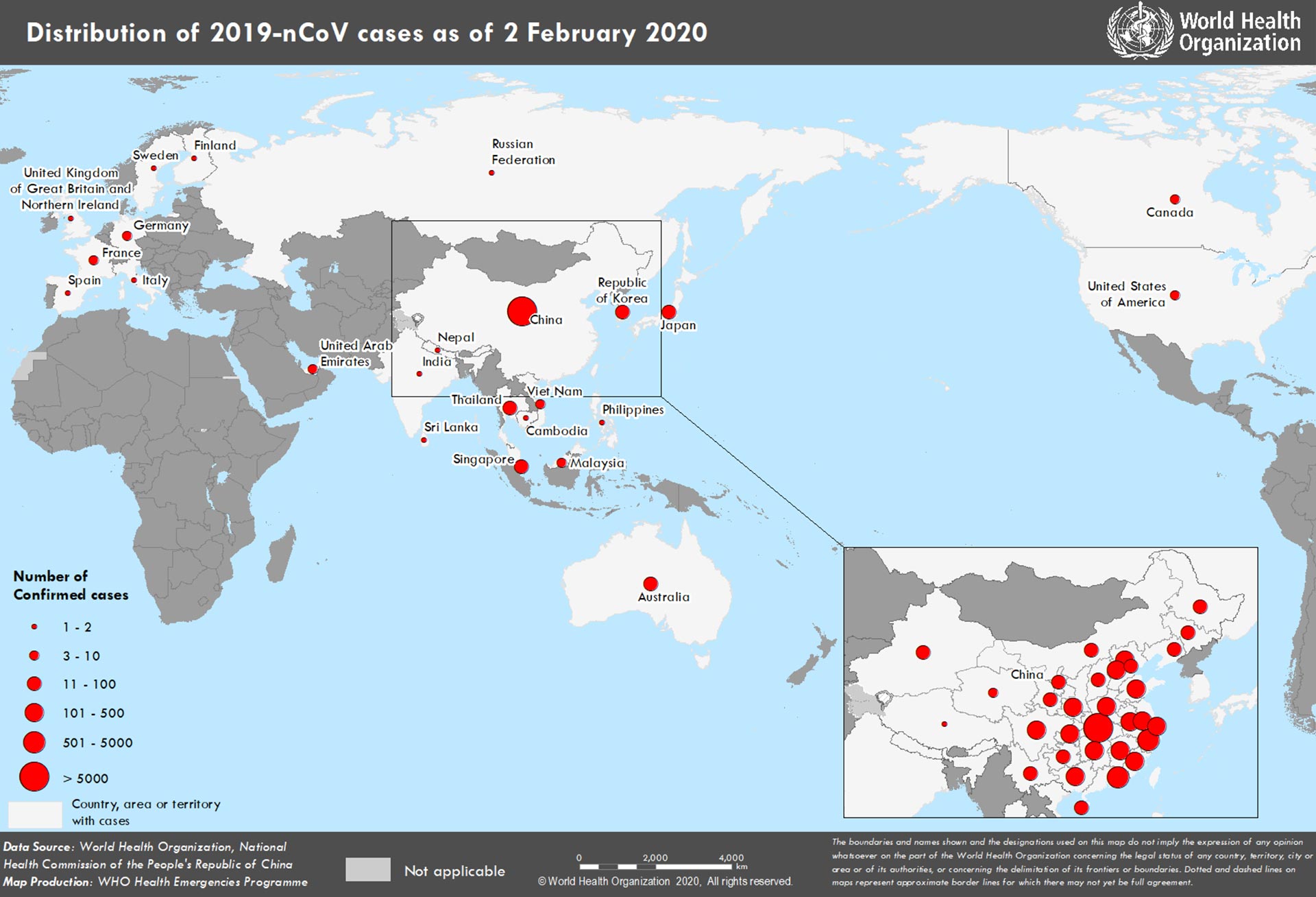
Countries, territories or areas with reported confirmed cases of 2019-nCoV, February 2, 2020
| Country/Territory/Area | Confirmed Cases |
|---|---|
| China | 14411 |
| Japan | 20 |
| Thailand | 19 |
| Singapore | 18 |
| Republic of Korea | 15 |
| Australia | 12 |
| Germany | 8 |
| Malaysia | 8 |
| United States of America | 8 |
| Vietnam | 7 |
| France | 6 |
| United Arab Emirates | 5 |
| Canada | 4 |
| India | 2 |
| Italy | 2 |
| Philippines | 2 |
| Russian Federation | 2 |
| United Kingdom | 2 |
| Cambodia | 1 |
| Finland | 1 |
| Nepal | 1 |
| Spain | 1 |
| Sri Lanka | 1 |
| Sweden | 1 |
| Total | 14557 |
Recommendations and Advice for the Public
During previous outbreaks due to other coronaviruses (Middle-East Respiratory Syndrome (MERS) and Severe Acute Respiratory Syndrome (SARS), human-to-human transmission occurred through droplets, contact, and fomites, suggesting that the transmission mode of the 2019-nCoV can be similar. The basic principles to reduce the general risk of transmission of acute respiratory infections include the following:
- Avoiding close contact with people suffering from acute respiratory infections.
- Frequent hand-washing, especially after direct contact with ill people or their environment.
- Avoiding unprotected contact with farm or wild animals.
- People with symptoms of acute respiratory infection should practice cough etiquette (maintain distance, cover coughs and sneezes with disposable tissues or clothing, and wash hands).
- Within healthcare facilities, enhance standard infection prevention and control practices in hospitals, especially in emergency departments.
WHO does not recommend any specific health measures for travelers. In case of symptoms suggestive of respiratory illness either during or after travel, travelers are encouraged to seek medical attention and share their travel history with their healthcare provider.
Never miss a breakthrough: Join the SciTechDaily newsletter.
Follow us on Google and Google News.