
Close Menu
    Facebook X (Twitter) Instagram
    SciTechDaily
    • Biology
    • Chemistry
    • Earth
    • Health
    • Physics
    • Science
    • Space
    • Technology
    Facebook X (Twitter) Pinterest YouTube RSS
    SciTechDaily
    Home»Space»Continuous Electromagnetic and Gravitational Radiation From Triaxially-Deformed, Freely-Precessing Neutron Stars
    Space

    Continuous Electromagnetic and Gravitational Radiation From Triaxially-Deformed, Freely-Precessing Neutron Stars

    By ARC Centre of Excellence for Gravitational Wave DiscoveryOctober 14, 20201 Comment2 Mins Read
    Facebook Twitter Pinterest Telegram LinkedIn WhatsApp Email Reddit
    Share
    Facebook Twitter LinkedIn Pinterest Telegram Email Reddit
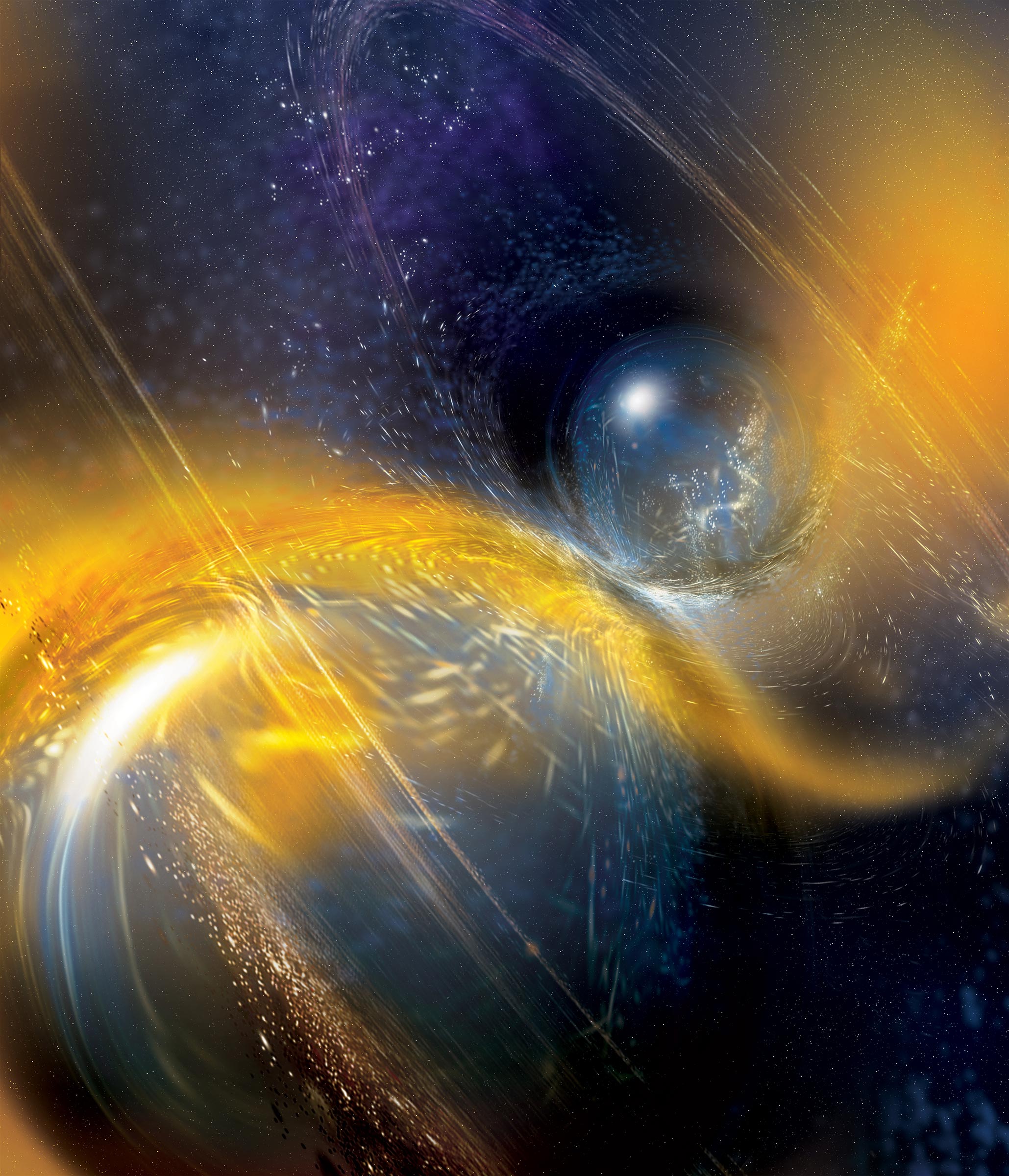
    Artist Rendition Binary Neutron Star Merger
    Artist’s rendition of a binary neutron star merger. Credit: National Science Foundation/LIGO/Sonoma State University/A. Simonnet

    Rapidly rotating, asymmetric neutron stars that undergo free precession can produce both modulated pulse signals and continuous gravitational radiation with characteristic features, and thus are potential interesting multi-messenger astrophysical sources.

    Studies have been carried out to characterize the electromagnetic and gravitational-wave signals from freely-precessing neutron stars, mostly focused on biaxial stars; however, in the most generic cases, triaxially-deformed neutron stars demonstrate more complex features as a result of free precession. In this study, co-authored by OzGrav Associate Investigator Lilli Sun from Australian National University (who was working with Caltech at the time of this research), scientists extend previous work and derive the dynamical evolution of a generic, triaxially-deformed, freely-precessing neutron star with both analytical and numerical approaches.

    If the neutron star is observed as a pulsar via radio and/or X-ray telescopes, the free precession could introduce observable characteristic modulations in both the timing and width of the pulse signals, depending on the wobble angle and other source properties. Moreover, free precession of a triaxially-deformed neutron star could manifest as additional lines in the spectra of continuous gravitational waves, detectable by the ground-based gravitational-wave detectors like Advanced LIGO, Virgo, and KAGRA.
     
    The researchers introduce a numerical method to integrate the equations of motion in generic cases where analytical solutions are difficult to derive. The timing residuals, pulse-width modulations, as well as the gravitational-wave spectra of a precessing triaxial star, are presented with concrete examples. The results in this work provide guidance for future multi-messenger studies of triaxially-deformed, freely-precessing neutron stars.

    Multi-messenger observation of precessing neutron stars will become promising with future high-precision electromagnetic observations (e.g., NICER X-ray timing) and next-generation gravitational-wave detectors (e.g., Einstein Telescope and Cosmic Explorer). Combining characteristic features in radio/X-ray signals and continuous gravitational waves of precessing neutron stars allows scientists to obtain valuable information about the source properties, e.g., the wobble angle, the non-axisymmetry and oblateness of the star. These measurements could shed light on the long-standing questions about the neutron star internal structure and the supranuclear matter equation of state.

    Reference: ” Triaxially deformed freely precessing neutron stars: continuous electromagnetic and gravitational radiation” by Yong Gao, Lijing Shao, Rui Xu, Ling Sun, Chang Liu and Ren-Xin Xu, 17 August 2020, Monthly Notices of the Royal Astronomical Society.
    DOI: 10.1093/mnras/staa2476

    Never miss a breakthrough: Join the SciTechDaily newsletter.
    Follow us on Google and Google News.

    Astronomy Astrophysics Gravitational Waves Neutron Star OzGrav
    Share. Facebook Twitter Pinterest LinkedIn Email Reddit

    Related Articles

    Searching for Elusive Continuous Gravitational Waves From the Densest Objects in the Universe

    The Aftermath of Binary Neutron Star Mergers: What Remains Behind?

    Exploring Common Envelope Outcomes of Binary Stellar Evolution

    Bayesian Inference for Gravitational Waves From Binary Neutron Star Mergers in 3G Observatories

    Spinning Neutron Stars Reveal New Insights Into Elusive Continuous Gravitational Waves

    Deciphering the Lives of Double Neutron Stars Using the Ripples in the Fabric of Space and Time

    Gravitational-Wave Scientists’ Brilliant New Method To Refine the Hubble Constant – The Expansion and Age of the Universe

    Massive Stellar Triples Leading to Sequential Binary Black-Hole Mergers

    New Measurement of the Hubble Constant – Rate of Expansion of the Universe – From Combined Observations of Neutron Stars

    1 Comment

    1. Jose on October 14, 2020 6:37 am

      Can someone translate this to “dumb language” for me?

      Reply
    Leave A Reply Cancel Reply

    • Facebook
    • Twitter
    • Pinterest
    • YouTube

    Don't Miss a Discovery

    Subscribe for the Latest in Science & Tech!

    Trending News

    Collapsing Plasma May Hold the Key to Cosmic Magnetism

    This Breakthrough Solar Panel Generates Power From Both Sunlight and Raindrops

    Scientists Uncover New Metabolic Effects Beyond Weight Loss of Mounjaro

    Scientists Discover Cancer Tumors Are “Addicted” to This Common Antioxidant

    1,800 Miles Down: Scientists Uncover Mysterious Movements at the Edge of Earth’s Core

    Scientists Discover Hidden “Good Fats” in Green Rice That Could Transform Nutrition

    Your Child’s Clothes Could Contain Toxic Lead, Study Finds

    Researchers Break a 150-Year-Old Math Law With a Surprising Donut Discovery

    Follow SciTechDaily
    • Facebook
    • Twitter
    • YouTube
    • Pinterest
    • Newsletter
    • RSS
    SciTech News
    • Biology News
    • Chemistry News
    • Earth News
    • Health News
    • Physics News
    • Science News
    • Space News
    • Technology News
    Recent Posts
    • The Mystery of the Notes: Why No One Knows How This 120-Year-Old Song Should Sound
    • Scientists Discover 132-Million-Year-Old Dinosaur Tracks on South Africa’s Coast
    • Scientists Uncover the Secret Ingredient Behind the Spark That May Have Started Life on Earth
    • Natural Oils vs. Antibiotics: The Swine Study That Could Change Farming
    • The Biggest Volcanic Event in Earth’s History Transformed an Entire Oceanic Plate
    Copyright © 1998 - 2026 SciTechDaily. All Rights Reserved.
    • Science News
    • About
    • Contact
    • Editorial Board
    • Privacy Policy
    • Terms of Use

    Type above and press Enter to search. Press Esc to cancel.