
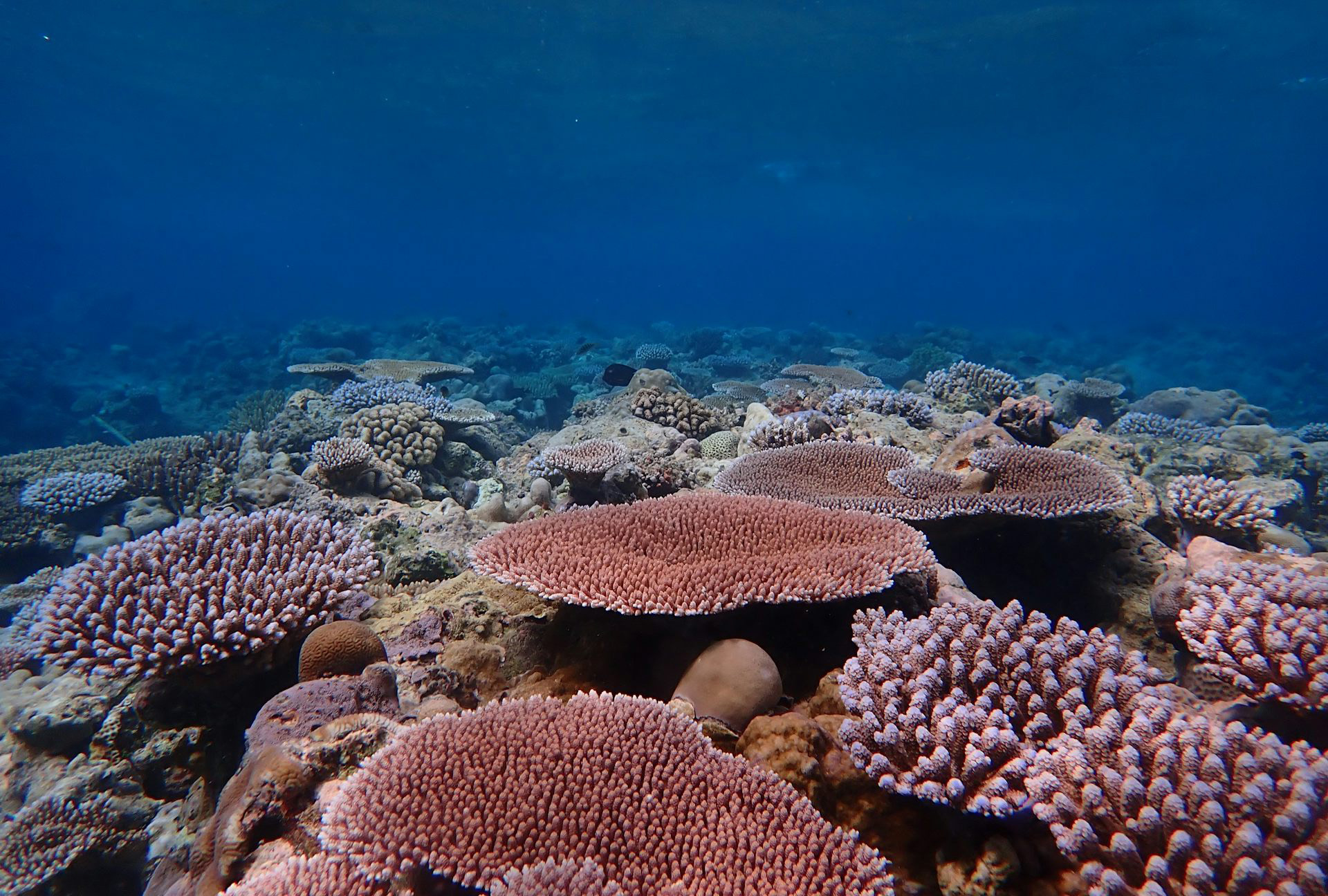
Without swift and substantial cuts to global greenhouse gas emissions, coral adaptation to rising ocean temperatures and marine heatwaves will likely fail to keep pace with climate change.
Coral adaptation to ocean warming and marine heatwaves is unlikely to keep pace without swift and significant reductions in global greenhouse gas emissions, an international team of scientists has warned.
Their study, led by Dr. Liam Lachs of Newcastle University, reveals that coral heat tolerance adaptation via natural selection could keep pace with ocean warming, but only if Paris Agreement commitments are realized, limiting global warming to two degrees Celsius.
“The reality is that marine heatwaves are triggering mass coral bleaching mortality events across the world’s shallow tropical reef ecosystems, and the increasing frequency and intensity of these events is set to ramp up under climate change,” said Dr. Lachs.
“While emerging experimental research indicates scope for adaptation in the ability of corals to tolerate and survive heat stress, a fundamental question for corals has remained: can adaptation through natural selection keep pace with global warming? Our study shows that scope for adaptation will likely be overwhelmed for moderate to high levels of warming.”

The international team of scientists studied the corals of Palau in the western Pacific Ocean, developing an eco-evolutionary simulation model of coral populations.
This model incorporates data on the thermal and evolutionary biology of common yet thermally sensitive corals, as well as their ecology. Published in Science, the study simulates the consequences of alternative futures of global development and fossil fuel usage that were created by the Intergovernmental Panel on Climate Change.
The Consequences of Unchecked Warming
Prof. Peter Mumby, a co-author of the study based at The University of Queensland, explains that “our world is expected to warm by 3-5 degrees by the end of this century if we do not achieve Paris Agreement commitments. Under such levels of warming, natural selection may be insufficient to ensure the survival of some of the more sensitive yet important coral species.”

“We can still have fairly healthy corals in the future, but this requires more aggressive reductions in global emissions and strategic approaches to coral reef management.”
Dr. Lachs explains that “with current climate policies, we are on track for a middle-of-the-road emissions scenario – leading to around 3 °C of warming – in which natural selection for heat tolerance could determine whether some coral populations survive.”
“From modeling this current emissions scenario, we expect to see profound reductions in reef health and an elevated risk of local extinction for thermally sensitive coral species. We also acknowledge that considerable uncertainty remains in the “evolvability” of coral populations.”

Study co-author Dr. James Guest, who leads the Coralassist Lab, says there is an urgent need to understand how to design climate-smart management options for coral reefs.
“We need management actions that can maximize the natural capacity for genetic adaptation, whilst also exploring whether it will be possible to increase the likelihood of adaptation in wild populations.”
“One such option, still at the experimental stages to date, would be the use of targeted assisted evolution interventions that, for instance, could improve heat tolerance through selective breeding,” Dr. Guest said, referring to a separate paper recently published by the Coralassist Lab.
Coral reefs are remarkably diverse and critically important marine ecosystems. “Taken together,” says Dr. Lachs, “the results of our models suggest that genetic adaptation could offset some of the projected loss of coral reef functioning and biodiversity over the 21st Century, if rapid climate action can be achieved.”
Reference: “Natural selection could determine whether Acropora corals persist under expected climate change” by Liam Lachs, Yves-Marie Bozec, John C. Bythell, Simon D. Donner, Holly K. East, Alasdair J. Edwards, Yimnang Golbuu, Marine Gouezo, James R. Guest, Adriana Humanes, Cynthia Riginos and Peter J. Mumby, 28 November 2024, Science.
DOI: 10.1126/science.adl6480
Never miss a breakthrough: Join the SciTechDaily newsletter.
Follow us on Google and Google News.
2 Comments
I call total BS.
We were supposed to all have gone extinct 50 years ago according to the “experts”.
I’m not sure we should suicide the global economy over some exotic stuff few of us ever get to visit.
Sad as it is, if it’s true at all, we’re now in the realm of tradeoffs.