
Close Menu
    Facebook X (Twitter) Instagram
    SciTechDaily
    • Biology
    • Chemistry
    • Earth
    • Health
    • Physics
    • Science
    • Space
    • Technology
    Facebook X (Twitter) Pinterest YouTube RSS
    SciTechDaily
    Home»Space»Cosmic Sandwiches: A New Explanation for Planet Formation
    Space

    Cosmic Sandwiches: A New Explanation for Planet Formation

    By University of WarwickJuly 4, 20231 Comment4 Mins Read
    Facebook Twitter Pinterest Telegram LinkedIn WhatsApp Email Reddit
    Share
    Facebook Twitter LinkedIn Pinterest Telegram Email Reddit
    Sandwitched Planets Forming
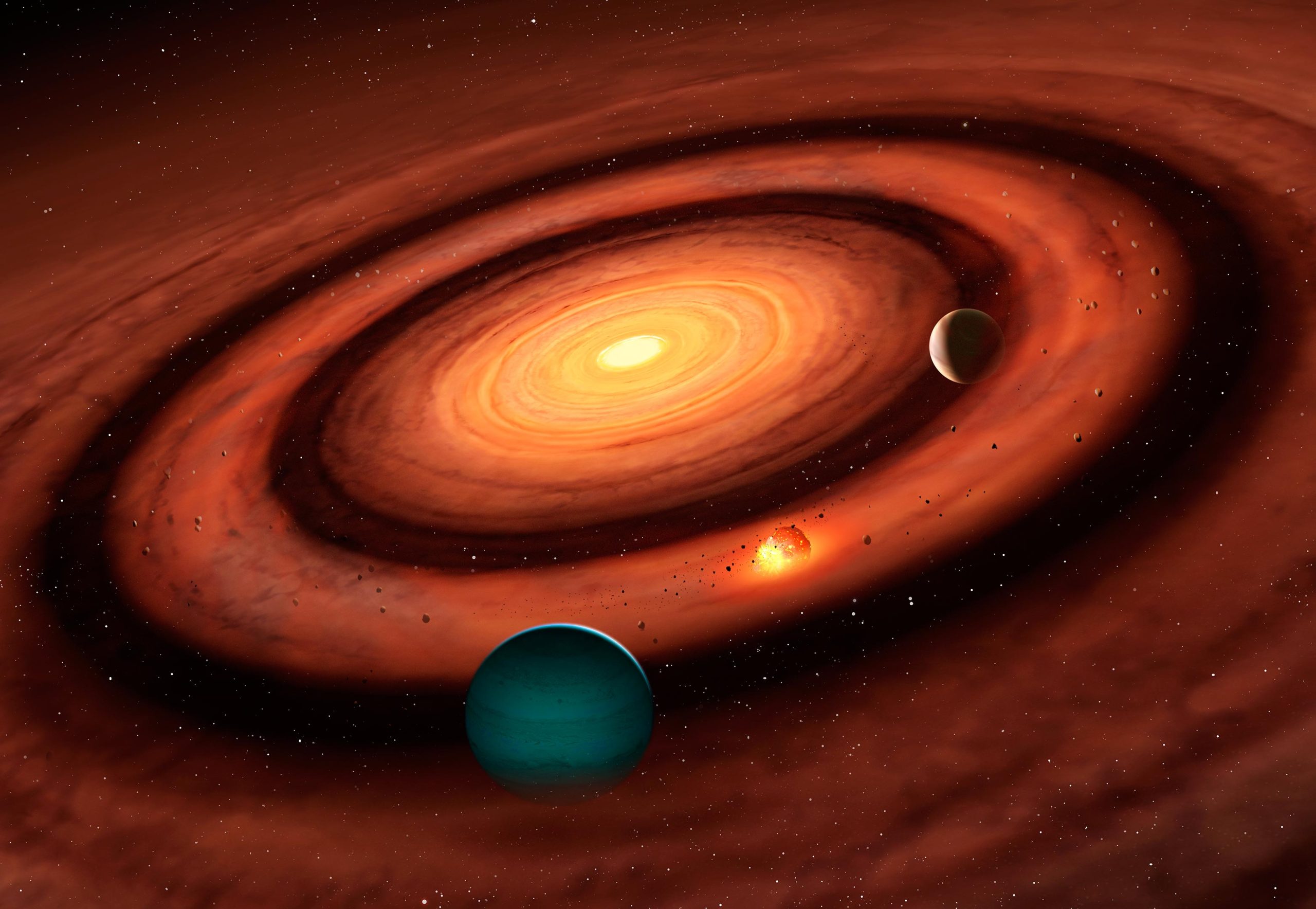
    Researchers have unearthed a new process of planet formation within the “birth environment” or the protoplanetary disc of dust and gas swirling around a central star. The method, termed “sandwiched planet formation,” suggests that the presence of two large planets in a protoplanetary disc can lead to the formation of a smaller planet between them. This is due to the two larger planets hindering the inward flow of dust, leading to the accretion of less dust between them. Over time, the gathered dust can come together to form a smaller planet “sandwiched” between the two larger ones. (Image depicts a planet forming in between two large planets.) Credit: Dr. Mark Garlick/University of Warwick

    Scientists from the University of Warwick propose a new method of planet formation, known as “sandwiched planet formation,” where a smaller planet forms between two larger ones in a protoplanetary disc. This potentially provides an explanation for the formation of smaller planets like Mars and Uranus.

    Scientists have made a new discovery on how small planets might form.

    Researchers at the University of Warwick investigated the “birth environment” of planets – areas of gas and dust that swirl around a central star – known as the protoplanetary disc.

    They discovered a new method of planet formation in this region, not yet described in previous research. The work has been submitted to the journal Monthly Notices of the Royal Astronomical Society and is showcased at the National Astronomy Meeting which begins today, Monday 3 July. The team showed how two large planets in the protoplanetary disc can potentially give rise to a smaller planet in between them – which they term “sandwiched planet formation”.

    The reason for this is that the two original, large planets restrict an inwards flow of dust. This means that the amount of dust that collects between them is reduced compared to if there were no outer planets. If that dust was to eventually come together to form a planet, then the middle planet would likely be smaller than the outer two planets – like the filling of a sandwich.

    A Possible Explanation for Mars and Uranus

    While further research is needed in the field, this theory could present a possible explanation for the formation of small planets; like Mars and Uranus, which are each surrounded by larger planets.

    Associate Professor and Dorothy Hodgkin Fellow, Farzana Meru, from the Department of Physics at the University of Warwick, said: “In the last decade, observations have revealed that rings and gaps exist in protoplanetary discs. The gaps are where we expect planets to be, and we know from theory work that planets cause dust rings to form just exterior to them. What exactly is happening in those rings poses an important question to astronomers around the world.

    “In our study, we propose the rings as sites of planet formation; specifically, that there are sandwiched planets currently being formed in those rings. This is very different to the conventional view of planet formation, where we typically expect that the planets form sequentially from the inside to the outside of the disc and get more and more massive further out. What is also really interesting is that there are examples that we have found from exoplanet observations that actually show this sandwiched planet architecture — where the middle planet is less massive than its neighbors; it is a reasonable proportion of the systems too.

    “The field of planet formation has been revolutionized recently. High resolution images of planet-forming discs have come out in the last ten years, since a new sophisticated telescope (the Atacama Large Millimeter/submillimeter Array) started observing the night sky.  These images have given us clues about how planets form and evolve; it’s exciting to be at the forefront of this research.”

    The study, which was funded by The Royal Society, is being presented at the National Astronomy Meeting and has been submitted to the journal Monthly Notices of the Royal Astronomical Society (MNRAS) for publication.

    Never miss a breakthrough: Join the SciTechDaily newsletter.
    Follow us on Google and Google News.

    Astronomy Astrophysics Exoplanet Planets Popular University of Warwick
    Share. Facebook Twitter Pinterest LinkedIn Email Reddit

    Related Articles

    Methane on a 3000°C Planet? Webb Just Shattered Expectations

    NASA Just Found One of the Coldest Planets Ever – And It’s in a Twisted Orbit

    This Giant Planet Shouldn’t Exist – But Astronomers Just Found It Around a Tiny Star

    Perpendicular Planet: A 90° Orbit Over Twin Suns Leaves Scientists Stunned

    Earth Has a Hot New Neighbor – And It Could Change How We Look for Life in the Universe

    Vaporized Crusts of Earth-Like Planets Discovered in Dying Stars

    Astronomers Detect Possible Radio Emission From Exoplanet for the First Time

    Astronomers Discover 5,400 mph Winds on Exoplanet HD 189733b

    WASP-12 b, A Planet Being Consumed By Its Own Sun

    1 Comment

    1. JR on July 5, 2023 11:03 am

      Why is that science news leans so heavily on metaphors to describe observed phenomena? Are the metaphors chosen really all illuminating or does the reader have to parse the authors choice in order to glean meaning?

      Reply
    Leave A Reply Cancel Reply

    • Facebook
    • Twitter
    • Pinterest
    • YouTube

    Don't Miss a Discovery

    Subscribe for the Latest in Science & Tech!

    Trending News

    One of the Universe’s Largest Stars May Be Getting Ready To Explode

    Scientists Discover Enzyme That Could Supercharge Ozempic-Like Weight Loss Drugs

    Popular Sweetener Linked to DNA Damage – “It’s Something You Should Not Be Eating”

    Ancient “Rock” Microbes May Reveal How Complex Life Began

    Researchers Capture Quantum Interference in One of Nature’s Rarest Atoms

    “A Plague Is Upon Us”: The Mass Death That Changed an Ancient City Forever

    Scientists Discover Game-Changing New Way To Treat High Cholesterol

    This Small Change to Your Exercise Routine Could Be the Secret to Living Longer

    Follow SciTechDaily
    • Facebook
    • Twitter
    • YouTube
    • Pinterest
    • Newsletter
    • RSS
    SciTech News
    • Biology News
    • Chemistry News
    • Earth News
    • Health News
    • Physics News
    • Science News
    • Space News
    • Technology News
    Recent Posts
    • Scientists Prove There Are Just Six Degrees of Separation in a Social Network
    • Bee Bacteria Could Fix a Major Flaw in Plant-Based Milk
    • Scientists Discover a Surprising Way To Make Bread Healthier and More Nutritious
    • Natural Compounds Boost Bone Implant Success While Killing Bacteria and Cancer Cells
    • After 60 Years, Scientists Uncover Unexpected Brain Effects of Popular Diabetes Drug Metformin
    Copyright © 1998 - 2026 SciTechDaily. All Rights Reserved.
    • Science News
    • About
    • Contact
    • Editorial Board
    • Privacy Policy
    • Terms of Use

    Type above and press Enter to search. Press Esc to cancel.