
Recent discoveries by the James Webb Space Telescope reveal that supermassive black holes were present much earlier than previously thought, posing significant questions about their origins and growth.
The James Webb Space Telescope (JWST) has revealed that supermassive black holes (SMBHs), with masses exceeding one million times that of the Sun, existed as early as 450 million years after the Big Bang. This raises a compelling question: how did these colossal objects form so quickly?
Researchers at the Max Planck Institute for Astrophysics (MPA) have used advanced supercomputer simulations to uncover a plausible pathway. Their findings show that SMBH seeds, with masses of a few thousand solar masses, could form rapidly in dense and dynamic star clusters in the early Universe. Within these clusters, collisions between massive stars produce supermassive stars, which eventually collapse directly into black holes. These black holes can then grow further through mergers with other black holes.
This new model aligns well with JWST observations and offers a realistic explanation for the formation of SMBH seeds that are massive enough to evolve into the earliest supermassive black holes observed. Importantly, the researchers predict that this process leaves behind a distinctive gravitational wave signal from black hole mergers. These signals could be directly tested with the next generation of gravitational wave observatories, providing a critical test for their model.
Supermassive Black Holes and Early Universe Mysteries
Supermassive black holes (SMBHs), with masses exceeding one million times that of the Sun, are found in nearly all massive galaxies, including the Milky Way. Recent observations by the James Webb Space Telescope (JWST) have revealed that these colossal objects existed as early as 450 million years after the Big Bang. Their origins remain one of the most intriguing and unsolved puzzles in modern astrophysics.
Origins and Challenges of Early SMBH Seeds
The first stars in the Universe may have left behind black holes with masses of a few hundred solar masses. However, these “light” SMBH seeds face challenges in explaining the observed population of rapidly growing SMBHs in the early Universe. The maximum rate at which these black holes can grow by consuming gas, known as the Eddington limit, imposes strict constraints on their growth speed. Given the limited time available — just a few hundred million years — light seeds cannot account for the massive SMBHs already observed at high redshifts.
To address this, many theoretical models propose that SMBH seeds were instead “heavy,” forming with initial masses exceeding a thousand solar masses. These heavy seeds would have had a significant growth advantage over their lighter counterparts. Key formation scenarios for these heavy seeds include runaway stellar collisions in dense star clusters, the direct collapse of metal-free gas clouds in atomic cooling halos, and more speculative ideas involving exotic ‘new’ physics, such as primordial black holes. These scenarios offer a range of pathways to explain how the first supermassive black holes emerged so quickly in the early cosmos.
Runaway Collisions and Supermassive Star Formation
In dense star clusters, repeated stellar collisions may build up very massive and even supermassive stars. In early Universe which is still little enriched with heavy elements, stellar winds are typically weak and the stellar collision products will retain most of their mass. At the ends of their lives, these collisionally formed supermassive stars collapse and form the seeds for SMBHs.
Advanced Simulations Reveal New Insights
Past simulations had focused on studying isolated, spherical star clusters. Both the JWST observations and state-of-the-art hydrodynamical galaxy formation simulations instead support the picture that massive star clusters form through a complex hierarchical assembly. This was the key motivation for the researchers at the MPA to re-explore the runaway collisional SMBH seed formation scenario in the more realistic clustered setup. Such a scenario is very different to the direct collapse gas cloud scenario which relies on avoiding cloud cooling and fragmentation into clusters of stars.
Collision Dynamics and Future Research Potential
The researchers performed new simulations of massive star clusters with several million individual stars forming from the rapid assembly of several hundred proto-clusters. The newly developed direct N-body simulation code BIFROST used for the simulations runs on energy-efficient GPU hardware can follow stellar evolution, stellar mergers, and accurately accounts for general relativistic effects during the interaction of black holes.
In particular, the code computes the gravitational wave emission when two black holes merge. At the end of the merger anisotropic gravitational wave emission can kick the newly formed black holes up to speeds of several thousand km/s. These gravitational wave recoil kicks which can eject black hole merger remnants from their birth clusters are also modelled with the code.
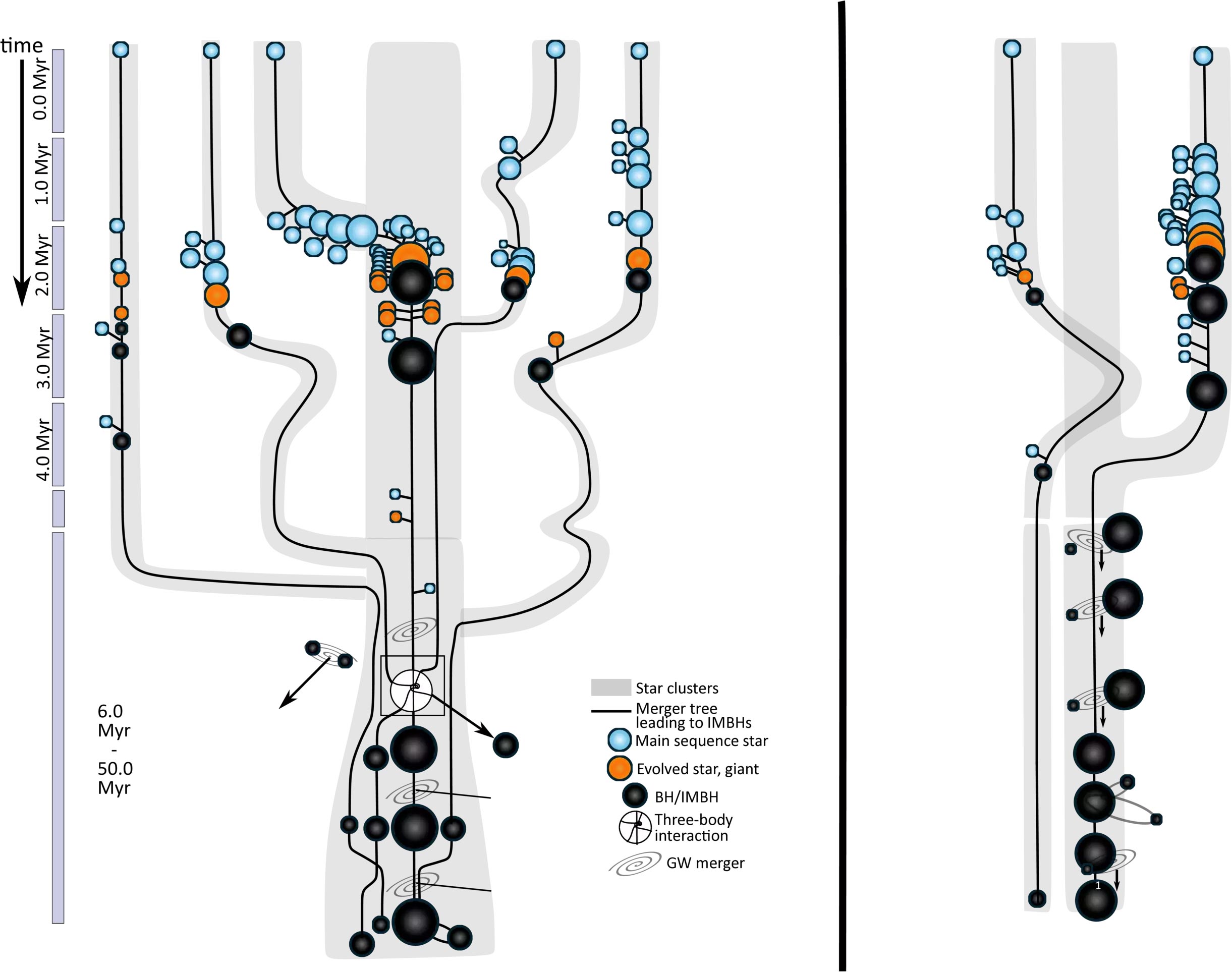
The collision pathways of massive stars and the formed SMBH seeds are illustrated in Figure 1. Typically, only the most massive star in sub-clusters grows rapidly by collisions with other massive stars. Once the stars exceed the mass of several hundred solar masses, stellar evolution models predict that they directly collapse into black holes at the end of their lives.
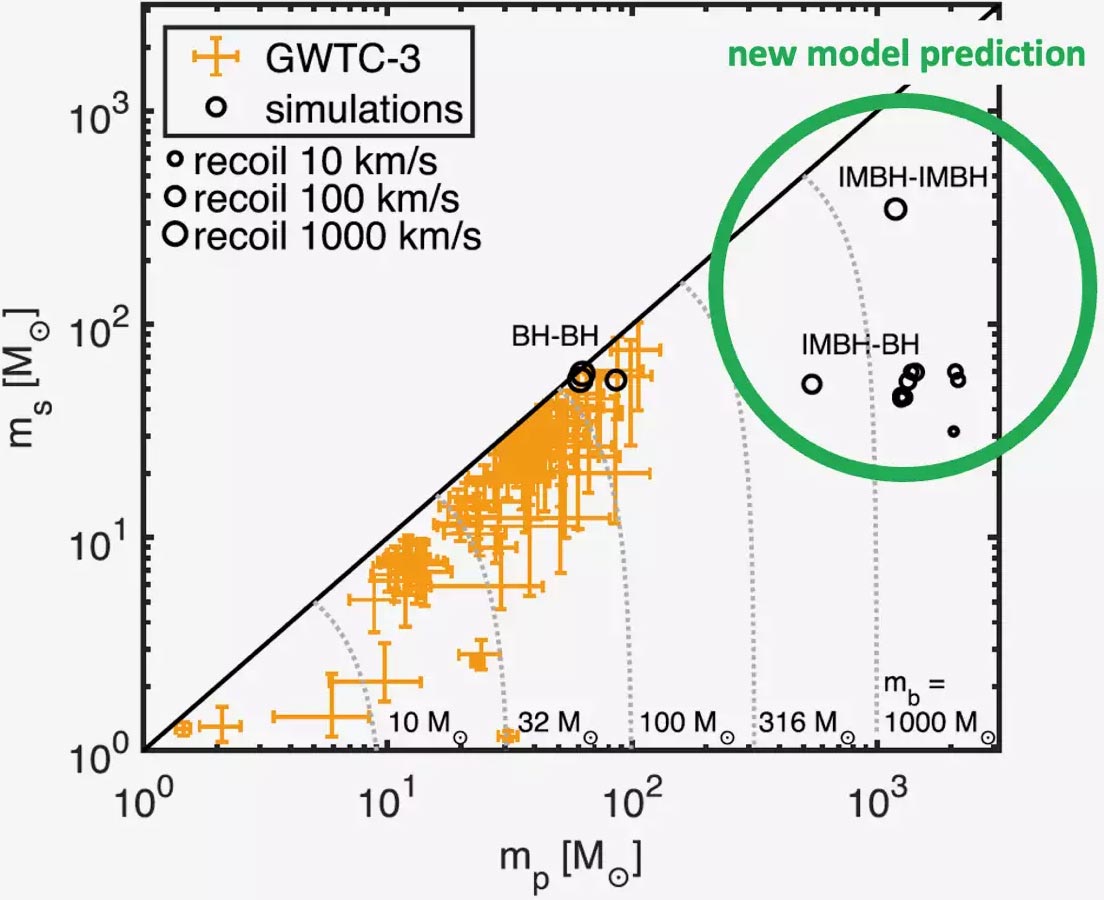
After their formation, the several SMBH seeds in the assembled massive star cluster experience a rich history of interactions and mergers by which the SMBH seeds can further grow. Several black holes are ejected from the cluster through strong Newtonian few-body interactions or relativistic gravitational wave recoil kicks. The hierarchical runaway scenario predicts a population of gravitational wave mergers at high redshifts in which the SMBH seeds merge with stellar mass black holes of several 10 to 100 solar masses (Figure 2).
Current gravitational wave observatories cannot detect black hole mergers above 500 solar masses or high redshifts very well. However, the scenario of the MPA researchers can be tested with the next-generation gravitational wave experiments such as LISA and the Einstein Telescope.
References:
“FROST-CLUSTERS – I. Hierarchical star cluster assembly boosts intermediate-mass black hole formation” by Antti Rantala, Thorsten Naab and Natalia Lahén, 6 June 2024, Monthly Notices of the Royal Astronomical Society.
DOI: 10.1093/mnras/stae1413
“BIFROST: simulating compact subsystems in star clusters using a hierarchical fourth-order forward symplectic integrator code” by Antti Rantala, Thorsten Naab, Francesco Paolo Rizzuto, Matias Mannerkoski, Christian Partmann and Kristina Lautenschütz, 5 May 2023, Monthly Notices of the Royal Astronomical Society.
DOI: 10.1093/mnras/stad1360
The authors thank Markus Rampp and Klaus Reuter of the Max Planck Computing and Data Facility (MPCDF) for performance optimization of the BIFROST GPU code. The simulations for the study were run using the MPCDF supercomputer Raven in Garching.
Never miss a breakthrough: Join the SciTechDaily newsletter.
Follow us on Google and Google News.