
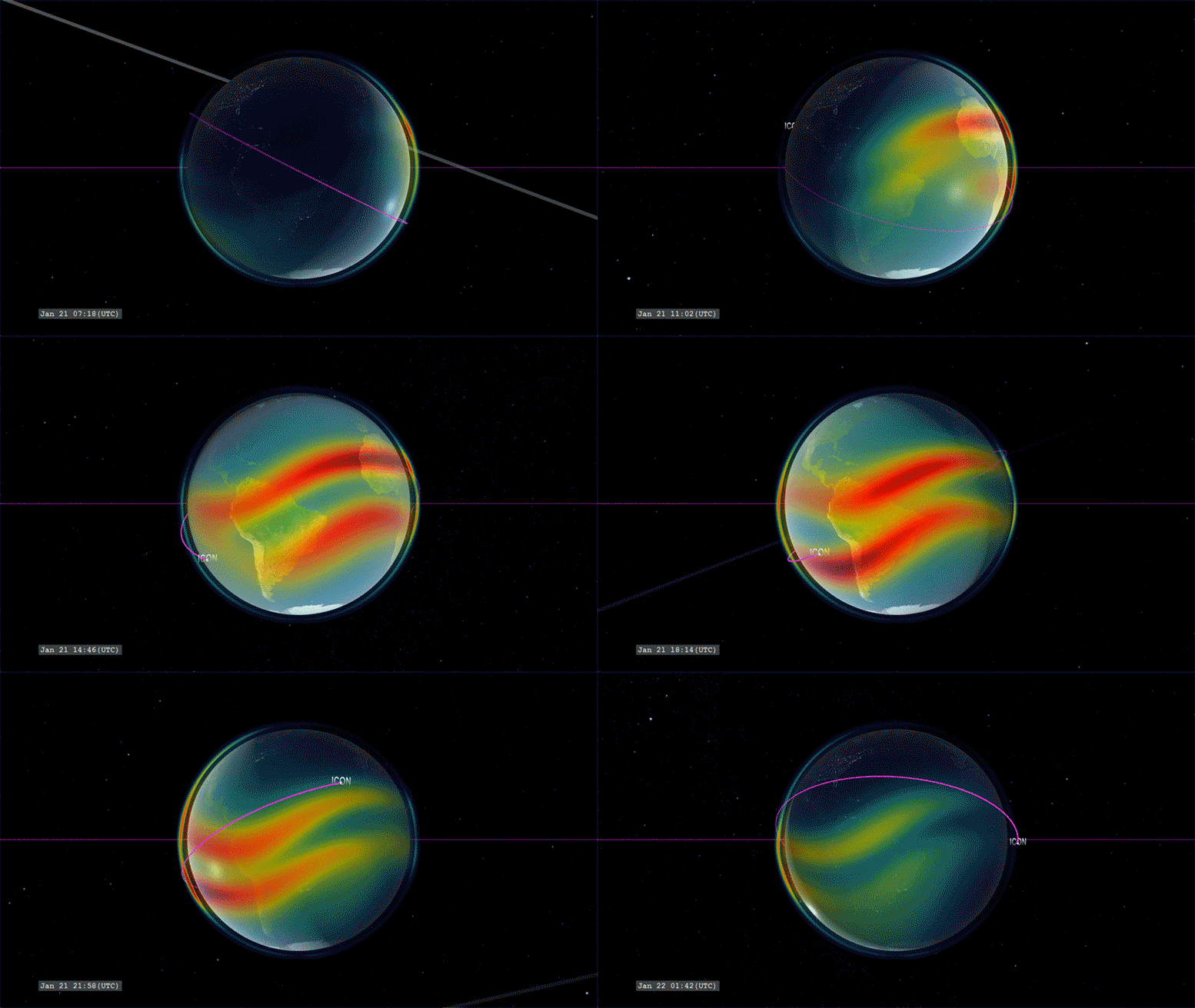
In October 2018, we’re launching the Ionospheric Connection Explorer, or ICON, to study Earth’s dynamic interface to space. Its combination of remote and in situ measurements will help scientists better understand this region — and how it changes in response to both space weather from above and terrestrial weather from below, a dynamic mix that can affect our communications, satellites, and astronauts.
10-mile-per-hour sensitivity
Though the ICON spacecraft zooms around Earth at upwards of 14,000 miles (22,500 kilometers) per hour, its wind-measuring instrument MIGHTI can detect changes in wind speed smaller than 10 miles per hour. MIGHTI makes use of the Doppler effect — the same phenomenon that makes an ambulance siren change pitch as it passes you — and measures the tiny shifts in color caused by the motion of glowing gases in the upper atmosphere, which reveals their speed and direction.
97-minute orbital period
ICON circles Earth in just over an hour and a half, completing nearly 15 orbits per day. Its orbit is inclined by 27 degrees, so over time, its measurements will completely cover its zone of interest near the equator.
8 1/3-foot solar panel
ICON doesn’t carry any onboard fuel. Instead, its single solar panel — measuring about 100 inches (254 centimeters) long and 33 inches (84 centimeters) wide, a little bit bigger than a standard door — produces power for the spacecraft. In science mode, ICON draws about 209-265 Watts of power.
7 years of teamwork
The idea for ICON was selected for further study in 2011, and the team has been hard at work ever since.
634 pounds
How much does good science weigh? In ICON’s case, about as much as a vending machine. The observatory weighs 634 pounds (288 kilograms) altogether.
5 snapshots per minute from FUV
Because ICON travels so fast, its Far Ultraviolet instrument takes eight snapshots per second of passing structures. This avoids blurring the images and captures the fine detail scientists need. But ICON’s bandwidth only allows FUV to send 5 images per minute, so the instrument uses a de-blurring technique called time-delay integration to combine 12 seconds’ worth of data into a single image.
4 types of instruments collecting data in tandem
ICON carries four distinct instruments to study Earth’s boundary to space.
- 2 MIGHTIs (Michelson Interferometer for Global High-resolution Thermospheric Imaging): Built by the Naval Research Laboratory in Washington, D.C., to observe the temperature and speed of the neutral atmosphere. There are two identical MIGHTI instruments onboard ICON.
- 2 IVMs (Ion Velocity Meter): Built by the University of Texas at Dallas to observe the speed of the charged particle motions, in response to the push of the high-altitude winds and the electric fields they generate. ICON carries two, and they are the missions only in situ instruments.
- EUV (Extreme Ultra-Violet instrument): Built by the University of California at Berkeley to capture images of oxygen glowing in the upper atmosphere, in order to measure the height and density of the daytime ionosphere.
- FUV (Far Ultra-Violet instrument): Built by UC Berkeley to capture images of the upper atmosphere in the far ultraviolet light range. At night, FUV measures the density of the ionosphere, tracking how it responds to weather in the lower atmosphere. During the day, FUV measures changes in the chemistry of the upper atmosphere — the source for the charged gases found higher up in space.
360 miles above Earth
ICON orbits about 360 miles (580 kilometers) above Earth, near the upper reaches of the ionosphere — the region of Earth’s atmosphere populated by electrically-charged particles. From this vantage point, ICON combines remote measurements looking down along with direct measurements of the material flowing around it to connect changes throughout this region.

2 missions working together
NASA’s GOLD mission — short for Global-scale Observations of the Limb and Disk — launched aboard a commercial communications satellite on Jan. 25, 2018. From its vantage point in geostationary orbit over Brazil, GOLD gets a full-disk view of the same region of space that ICON studies, helping scientists connect the big picture with the details.
1 gigabit of data per day
Together, ICON’s instruments produce and downlink about 1 gigabit of data per day — about 125 megabytes. This adds up to about 1 gigabyte per week. ICON produces 10 different data products, ranging from measurements of wind speeds and ionospheric density to more complex models, that will help scientists shed new light on this ever-changing region.
Never miss a breakthrough: Join the SciTechDaily newsletter.
Follow us on Google and Google News.