
Close Menu
    Facebook X (Twitter) Instagram
    SciTechDaily
    • Biology
    • Chemistry
    • Earth
    • Health
    • Physics
    • Science
    • Space
    • Technology
    Facebook X (Twitter) Pinterest YouTube RSS
    SciTechDaily
    Home»Health»COVID-19 Linked to Signs of Possible Long-Term Liver Injury
    Health

    COVID-19 Linked to Signs of Possible Long-Term Liver Injury

    By Radiological Society of North AmericaDecember 9, 2022No Comments4 Mins Read
    Facebook Twitter Pinterest Telegram LinkedIn WhatsApp Email Reddit
    Share
    Facebook Twitter LinkedIn Pinterest Telegram Email Reddit
    Liver Disease Concept Illustration
    According to the results of a new study, COVID-19 infection is associated with increased liver stiffness, a sign of possible long-term liver injury.

    COVID-19 Patients Show Liver Injury Months After Infection

    COVID-19 infection is linked with increased liver stiffness, a sign of possible long-term liver injury. This is according to the results of a new study presented at the annual meeting of the Radiological Society of North America (RSNA).

    “Our study is part of emerging evidence that COVID-19 infection may lead to liver injury that lasts well after the acute illness,” said Firouzeh Heidari, M.D., a post-doctorate research fellow at Massachusetts General Hospital in Boston.

    Liver stiffness is a marker of liver damage, such as inflammation or fibrosis. Fibrosis is the buildup of scar tissue in the liver. Over time, healthy liver tissue diminishes, and the liver can no longer function properly. Progressive fibrosis can lead to liver cancer and liver failure.

    Comparing Liver Stiffness Across Groups

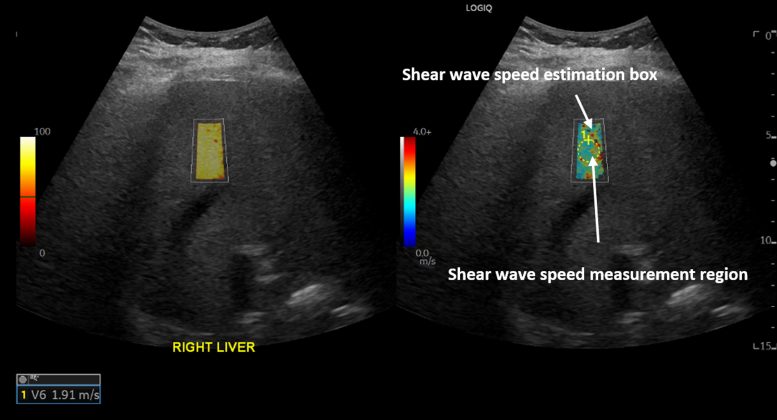
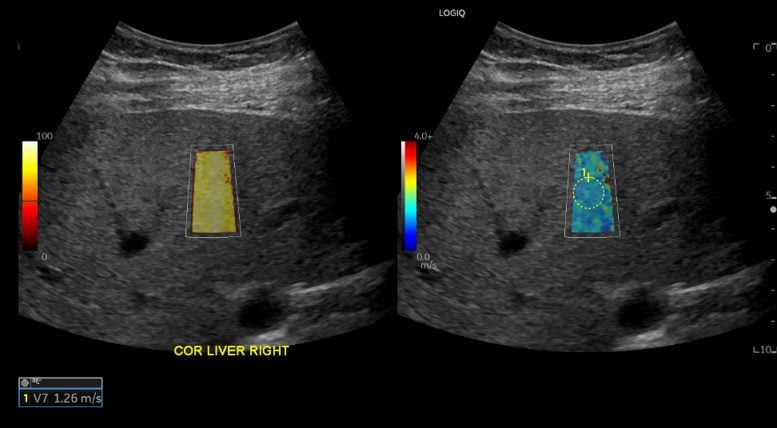
    In the retrospective study, the researchers compared liver stiffness of patients with a history of COVID-19 infection to two control groups. All patients underwent ultrasound shear wave elastography between 2019 and 2022 at Massachusetts General Hospital. Shear wave elastography is a specialized technique that uses sound waves to measure the stiffness of tissue.
    COVID-19 Patients Show Liver Injury Months After Infection
    A 55-year-old female with a history of COVID-19 infection 38 weeks before the date of ultrasound shear wave elastography. The shear wave speed of 1.91 m/s corresponds to Young’s modulus of 10.94 kPa which indicates abnormally high liver stiffness and may reflect chronic liver injury. Credit: RSNA and Firouzeh Heidari, M.D.

    The patients were categorized into one of three groups based on when they underwent elastography and whether they tested positive for COVID-19. The COVID-19 positive group contained 31 patients who had a positive COVID-19 PCR test result at least 12 weeks before the elastography exam. The pandemic control group consisted of a random sample of 50 patients who underwent elastography during the COVID-19 pandemic and had a history of only negative COVID-19 PCR test results. The pre-pandemic control group consisted of a random sample of 50 patients who underwent an elastography exam prior to the COVID-19 pandemic.

    The mean age was 53.1 years for the COVID-positive patients, 55.2 years for the pandemic control group, and 58.2 years for the pre-pandemic control group. Of the total cohort, 67 were women. In the COVID-positive group, elastography exams were performed an average of 44 weeks after a positive PCR test result.
    COVID-19 Patients Show Liver Injury Months After Infection Ultrasound
    A 57-year-old female without a history of positive COVID-19 test before the date of ultrasound shear wave elastography. The shear wave speed of 1.26 m/s corresponds to Young’s modulus of 4.76 kPa which indicates normal liver stiffness. Credit: RSNA and Firouzeh Heidari, M.D.

    Higher Liver Stiffness Among COVID-19 Patients

    After controlling for age, sex, and time period, a statistical analysis of the elastography results revealed that COVID-positive patients had a statistically significant higher liver stiffness than the control patients.

    COVID-positive patients had a higher median live stiffness (7.68 kPa) than pandemic control patients (5.99 kPa).

    Unexpectedly, the pre-pandemic control group also had a higher median stiffness (7.01) compared to the pandemic control group. The reason for this finding is not yet understood but is believed to be a result of changing referral patterns during the pandemic. Additionally, patients referred for elastography before the pandemic were noted to be older than patients referred after the start of the pandemic.

    “We don’t yet know if elevated liver stiffness observed after COVID-19 infection will lead to adverse patient outcomes,” Dr. Heidari said. “We are currently investigating whether the severity of acute COVID-related symptoms is predictive of long-term liver injury severity. We hope to enrich our existing database with additional patient data and a broader scope of co-variates to better understand the post-acute effects of COVID-19 within the liver.”

    Co-authors are Theodore Pierce, M.D., Anthony Samir, M.D., M.P.H., Arinc Ozturk, M.D., Madhangi Parameswaran, M.B.B.S., M.Res., Marian Martin, M.D., M.P.H., and Hannah Edenbaum, M.S.

    Meeting: 108th Scientific Assembly and Annual Meeting of the Radiological Society of North America

    Never miss a breakthrough: Join the SciTechDaily newsletter.
    Follow us on Google and Google News.

    COVID-19 Infectious Diseases Liver Popular Radiological Society of North America
    Share. Facebook Twitter Pinterest LinkedIn Email Reddit

    Related Articles

    Significant Post-COVID Brain Abnormalities Revealed by Special MRI

    New Study Finds COVID-19 Less Severe in Fully Vaccinated Patients

    MRI Scans Link COVID-19 to Potentially Dangerous Eye Abnormalities

    Vitamin D Determines Severity in COVID-19: Researchers Urge Government to Change Advice

    How COVID-19 Kills: New Study Explains the Mechanisms of the New Coronavirus

    Vitamin D Linked to Low Coronavirus Death Rate

    Infection Researchers Identify How Coronaviruses From Animals Need to Change to Spread to Humans

    How Effective Are Cloth Masks Against Coronavirus? [Video]

    Key Insights on How Coronavirus Spreads From Chinese Megacity of Shenzhen

    Leave A Reply Cancel Reply

    • Facebook
    • Twitter
    • Pinterest
    • YouTube

    Don't Miss a Discovery

    Subscribe for the Latest in Science & Tech!

    Trending News

    Scientists Uncover Potential Brain Risks of Popular Fish Oil Supplements

    Scientists Discover a Surprising Way To Make Bread Healthier and More Nutritious

    After 60 Years, Scientists Uncover Unexpected Brain Effects of Popular Diabetes Drug Metformin

    New Research Uncovers Hidden Side Effects of Popular Weight-Loss Drugs

    Scientists Rethink Extreme Warming After Surprising Ocean Discovery

    Landmark Study Links Never Marrying to Significantly Higher Cancer Risk

    Researchers Discover Unknown Beetle Species Just Steps From Their Lab

    Largest-Ever Study Finds Medicinal Cannabis Ineffective for Anxiety, Depression, PTSD

    Follow SciTechDaily
    • Facebook
    • Twitter
    • YouTube
    • Pinterest
    • Newsletter
    • RSS
    SciTech News
    • Biology News
    • Chemistry News
    • Earth News
    • Health News
    • Physics News
    • Science News
    • Space News
    • Technology News
    Recent Posts
    • Students Build Dark Matter Detector and Set New Experimental Limits
    • Scientists Discover Caffeine Can Repair Key Memory Circuits After Sleep Loss
    • Strange 65-Foot Dinosaur Discovered in Argentina
    • Researchers Uncover Source of Strange Deformation in Earth’s Largest Continental Rift
    • Scientists Solve Mystery of Where the Colorado River Vanished Millions of Years Ago
    Copyright © 1998 - 2026 SciTechDaily. All Rights Reserved.
    • Science News
    • About
    • Contact
    • Editorial Board
    • Privacy Policy
    • Terms of Use

    Type above and press Enter to search. Press Esc to cancel.