
Close Menu
    Facebook X (Twitter) Instagram
    SciTechDaily
    • Biology
    • Chemistry
    • Earth
    • Health
    • Physics
    • Science
    • Space
    • Technology
    Facebook X (Twitter) Pinterest YouTube RSS
    SciTechDaily
    Home»Physics»Cutting Edge AI Learns to Model Our Universe
    Physics

    Cutting Edge AI Learns to Model Our Universe

    By Kavli Institute for the Physics and Mathematics of the UniverseSeptember 1, 2019No Comments4 Mins Read
    Facebook Twitter Pinterest Telegram LinkedIn WhatsApp Email Reddit
    Share
    Facebook Twitter LinkedIn Pinterest Telegram Email Reddit

    Abstract Fractal Design

    Researchers have successfully created a model of the Universe using artificial intelligence, reports a new study.

    Researchers seek to understand our Universe by making model predictions to match observations. Historically, they have been able to model simple or highly simplified physical systems, jokingly dubbed the “spherical cows,” with pencils and paper. Later, the arrival of computers enabled them to model complex phenomena with numerical simulations. For example, researchers have programmed supercomputers to simulate the motion of billions of particles through billions of years of cosmic time, a procedure known as the N-body simulations, in order to study how the Universe evolved to what we observe today.

    “Now with machine learning, we have developed the first neural network model of the Universe, and demonstrated there’s a third route to making predictions, one that combines the merits of both analytic calculation and numerical simulation,” said Yin Li, a Postdoctoral Researcher at the Kavli Institute for the Physics and Mathematics of the Universe, University of Tokyo, and jointly the University of California, Berkeley.
    Two Models of the Universe
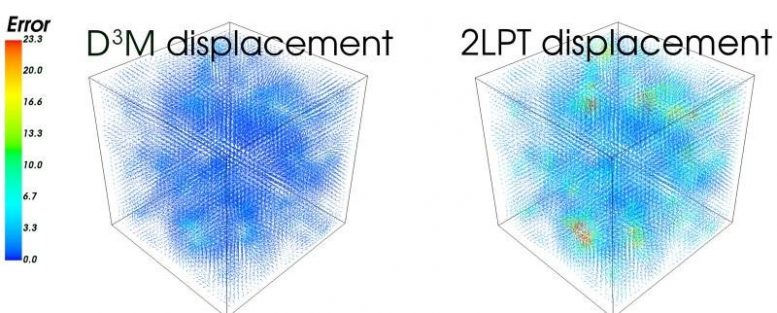
    A comparison of the accuracy of two models of the Universe. The new deep learning model (left), dubbed D3M, is much more accurate than an existing analytic method (right) called 2LPT. The colors represent the error in displacement at each point relative to the numerical simulation, which is accurate but much slower than the deep learning model. Credit: S. He et al./PNAS 2019

    At the beginning of our Universe, things were extremely uniform. As time went by, the denser parts grew denser and sparser parts became sparser due to gravity, eventually forming a foam-like structure known as the “cosmic web.” To study this structure formation process, researchers have tried many methods, including analytic calculations and numerical simulations. Analytic methods are fast, but fail to produce accurate results for large density fluctuations. On the other hand, numerical (N-body) methods simulate structure formation accurately, but tracking gazillions of particles is costly, even on supercomputers. Thus, to model the Universe, scientists often face the accuracy versus efficiency trade-off.

    However, the explosive growth of observational data in quality and quantity calls for methods that excel in both accuracy and efficiency.

    To tackle this challenge, a team of researchers from the US, Canada, and Japan, including Li, set their sights on machine learning, a cutting-edge approach to detecting patterns and making predictions. Just as machine learning can transform a young man’s portrait into his older self, Li and colleagues asked whether it can also predict how universes evolve based on their early snapshots. They trained a convolutional neural network with simulation data of trillions of cubic light-years in volume, and built a deep learning model that was able to mimic the structure formation process. The new model is not only many times more accurate than the analytic methods, but is also much more efficient than the numerical simulations used for its training.

    “It has the strengths of both previous [analytic calculation and numerical simulation] methods,” said Li.

    Li says the power of AI emulation will scale up in the future. N-body simulations are already heavily optimized, and as a first attempt, his team’s AI model still has large room for improvement. Also, more complicated phenomena incur a larger cost on simulation, but not likely so on emulation. Li and his colleagues expect a bigger performance gain from their AI emulator when they move on to including other effects, such as hydrodynamics, into the simulations.

    “It won’t be long before we can uncover the initial conditions of and the physics encoded in our Universe along this path,” he said.

    Reference: “Learning to predict the cosmological structure formation” by Siyu He, Yin Li, Yu Feng, Shirley Ho, Siamak Ravanbakhsh, Wei Chen, and Barnabás Póczos, 24 June 2019, PNAS.
    DOI: 10.1073/pnas.1821458116


    Never miss a breakthrough: Join the SciTechDaily newsletter.
    Follow us on Google and Google News.

    Artificial Intelligence Kavli Institute Machine Learning Popular
    Share. Facebook Twitter Pinterest LinkedIn Email Reddit

    Related Articles

    Engineers Find a Shared Principle Linking AI, Physics, and Biology

    AI Breakthrough in Detecting New Particles at the Large Hadron Collider

    State-of-the-Art Artificial Intelligence Sheds New Light on the Mysterious First Stars

    Uncovering Hidden Patterns: AI Reduces a 100,000-Equation Quantum Physics Problem to Only Four Equations

    Validating Models for Next-Generation Fusion Power Plants

    Uncovering the Secrets of the Big Bang With Artificial Intelligence

    Quantum Machine Learning Hits a Limit: A Black Hole Permanently Scrambles Information That Can’t Be Recovered

    Artificial Intelligence Algorithm Helps Unravel the Physics Underlying Quantum Systems

    New Machine Learning Theory Raises Questions About the Very Nature of Science

    Leave A Reply Cancel Reply

    • Facebook
    • Twitter
    • Pinterest
    • YouTube

    Don't Miss a Discovery

    Subscribe for the Latest in Science & Tech!

    Trending News

    289-Million-Year-Old Reptile Mummy Reveals Origin of Human Breathing System

    New Brain Discovery Challenges Long-Held Theory of Teenage Brain Development

    Scientists Discover Plants “Scream” – We Just Couldn’t Hear Them Until Now

    Scientists Discover a Surprising Reason Intermittent Fasting Extends Life

    This Simple Fruit Wash Could Make Produce Safer and Last Days Longer

    Scientists Say Adding This Unusual Seafood to Your Diet Could Reverse Signs of Aging

    Scientists Say a Hidden Structure May Exist Inside Earth’s Core

    Doctors Surprised by the Power of a Simple Drug Against Colon Cancer

    Follow SciTechDaily
    • Facebook
    • Twitter
    • YouTube
    • Pinterest
    • Newsletter
    • RSS
    SciTech News
    • Biology News
    • Chemistry News
    • Earth News
    • Health News
    • Physics News
    • Science News
    • Space News
    • Technology News
    Recent Posts
    • Scientists Propose Radical New Way To Detect Alien Life – Without Traditional Biosignatures
    • Scientists Just Discovered Light Can Actually Slow Plant Growth
    • Scientists Finally Solved One of Water’s Biggest Mysteries
    • 7,000-Year-Old DNA Rewrites the Story of the “Neolithic Revolution”
    • Missing Medieval Relic of Legendary English King Found After Being Missing for 40 Years
    Copyright © 1998 - 2026 SciTechDaily. All Rights Reserved.
    • Science News
    • About
    • Contact
    • Editorial Board
    • Privacy Policy
    • Terms of Use

    Type above and press Enter to search. Press Esc to cancel.