

Texas Advanced Computing Center (TACC) systems support catalog release of over 200,000 new star and galaxy locations.
Astronomers have barely scratched the surface of mapping the nearly endless stars and galaxies of the heavens. Using supercomputers and the help of thousands of citizen scientists around the world, researchers with The University of Texas at Austin have now revealed the locations of more than 200,000 new astronomical objects. Their goal is to map even more and use that knowledge to predict the ultimate fate of the universe.
The Hobby-Eberly Telescope Dark Energy Experiment (HETDEX) has scanned the dark skies of the Davis Mountains in West Texas since 2017 with a keen eye toward capturing spectroscopic data on Lyman-alpha frequency light from neutral hydrogen emission in galaxies over 10 billion light years away. These galaxies emit a signature wavelength of light from hydrogen that signals to astronomers the intense creation of new stars.
The HETDEX collaboration involves a large team including astronomers, engineers, technicians, and graduate students from six academic institutions in the United States and Germany.
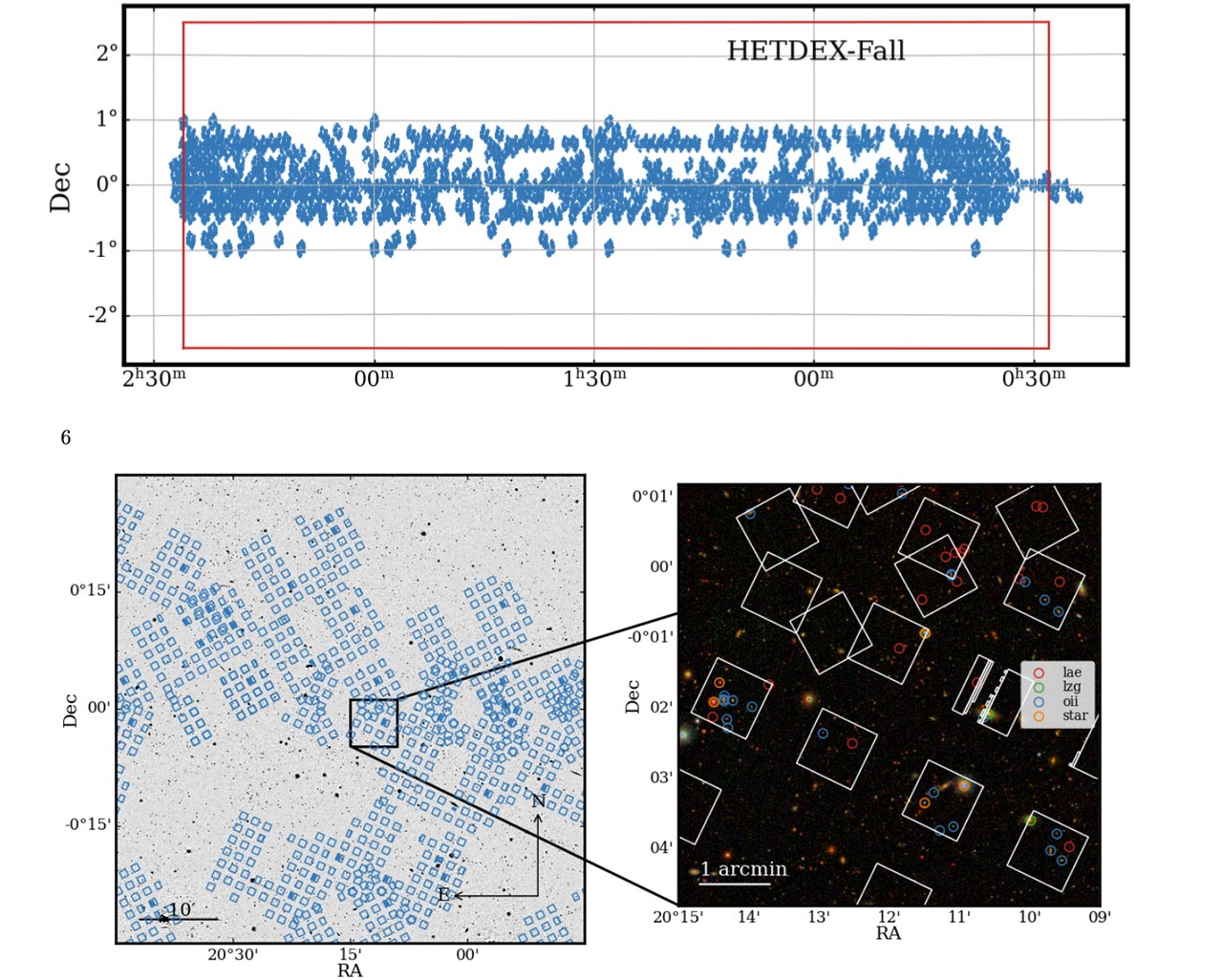
The paper describing the catalog was published on February 7, 2023, in The Astrophysical Journal.
“We’ve just exploded in terms of the number of redshifts cataloged for the first time,” said study co-author Erin Mentuch Cooper, a research scientist at The University of Texas at Austin (UT Austin). Cooper is the data manager for the HETDEX project.
“There is a gold mine of astronomy exploration in the HETDEX catalog. That’s what I love about it,” said study co-author Karl Gebhardt, the Herman and Joan Suit Professor in Astronomy, College of Natural Sciences, UT Austin. Gebhardt is project scientist and principal investigator of HETDEX.
A star’s redshift tells astronomers how fast a star is moving away from the Earth because its frequency, akin to its color, gets lower as it moves away, much like the horn of a train as it passes by.
The faster a star moves away, the farther away it is. That relationship between speed and distance, called Hubble’s Law, can pin down a galaxy’s location and allows astronomers to create a 3D map of over 200,000 stars and galaxies with HETDEX.
“This is only a small percentage of what we will find, but it’s a good start. Ultimately, HETDEX aims to map one million red-shifted galaxies,” Cooper said.
HETDEX is unique from previous large sky surveys because it’s a non-targeted survey, blanketing the sky and collecting spectra from the 35,000 fiber optic cables of the Visible Integral Field Replicable Unit Spectrograph (VIRUS).
VIRUS takes starlight from distant galaxies and splits the light into its component colors like a prism does. HETDEX tiles the sky, collecting 35,000 spectra in a moon-sized swath of sky and moving from spot to spot. It collects about 500-600 hours of observations each year for its survey data.
Advanced Supercomputing and Data Analysis
“We have the largest spectroscopic instrument on the planet, and we’re doing one of the longest surveys in terms of time,” Gebhardt said. “To analyze this data, we need the fastest computer we can get our hands on, and that’s where TACC comes in. TACC does all the data storage and all the data analysis for this giant survey.”
The data from the telescope goes straight to the TACC Corral data storage system via high speed lines at 100 Gigabits/second.
“TACC has worked hard with us to streamline our system, and it’s just working fantastically. We can process years of data in a couple of days, maybe a week of time on TACC systems. And we do it multiple times because we keep adjusting and improving our methods,” Gebhardt added.
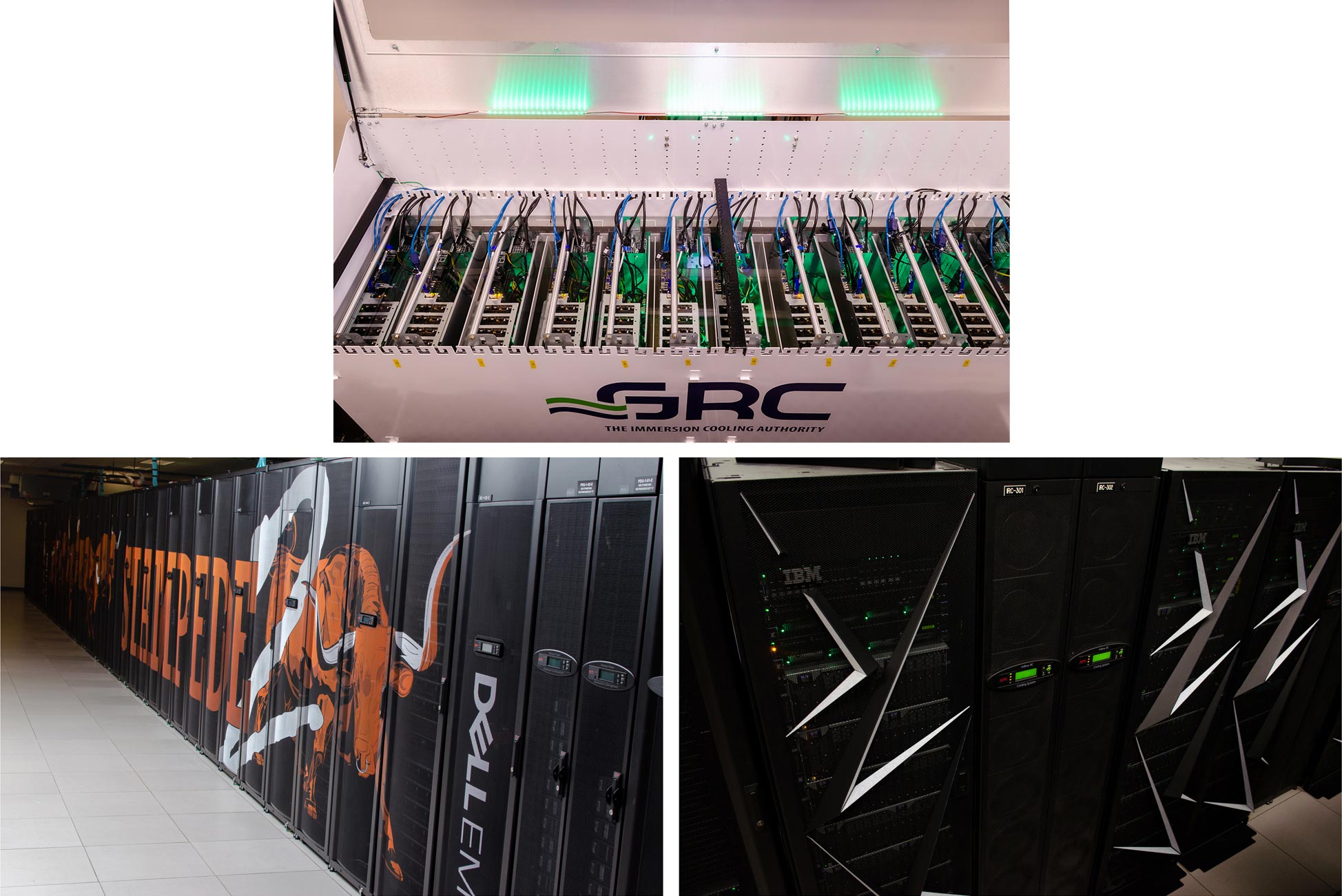
HETDEX used the Maverick and Stampede2 supercomputers of the Texas Advanced Computing Center, a leading academic supercomputing center at UT Austin. Stampede2 is funded by the National Science Foundation as a shared resource for thousands of scientists across the US. They helped process and analyze about 60 terabytes of image data on TACC’s Corral system.
Expanding Access to Astronomical Data
What’s more, Cooper and colleagues have worked with TACC to create JupyterHub public access to the data.
“Anyone with any academic credentials can get a TACC account and go on through a web browser to access our data. We’re going to let them access all of our data. This is just the catalog right now. But, the future is going to offer a legacy potential of the science from HETDEX. TACC is helping setting that up,” Cooper said.
One interesting highlight from the catalog is the identification of an active galactic nuclei (AGN) with strong Lyman-alpha light emission. Gebhadt co-authored a study led by UT Austin astronomy post-doctoral researcher Chenxu Liu, published in November 2022 in The Astrophysical Journal. It presents intriguing evidence of a black hole without a surrounding host galaxy.
“This is what I call ‘naked black holes,'” Gebhardt said. “Nothing confirmed yet, but we suspect these could be out there. Only a survey like HETDEX will be able to find these.”
The Holy Grail: Understanding Universe Expansion
The science generated from HETDEX adds to the bigger picture of understanding the expansion of the entire universe, unexpectedly growing much faster than expected based on precise observations from the Hubble Space Telescope in 2019 of supernovae that act like a cosmic yardstick.
The Holy Grail for HETDEX is an accurate measure of the Universe expansion rate 10 billion years ago that will reveal the physical model for dark energy.
Astronomers are at odds over how to explain the measure of the current expansion rate. Understanding it could require a modification in the theory of gravity, or a change in the fundamental Big Bang theory. It might be the handiwork of an undiscovered particle.
A precise value of the expansion rate early in the Universe can be compared to the expansion rate today. This comparison can determine if the Universe will continue to expand forever, or will someday collapse on itself many billions of years from now.
“The whole point of the HETDEX project is to measure the expansion of the universe,” Gebhardt said.
“This new catalog adds valuable data in finally answering the ‘million galaxy’ question, which is something the HETDEX Collaboration is working very hard on in the coming year. But there’s a bigger picture here, and that’s what we give back to the community, not just to the scientists around the world but the general community. We wouldn’t be able to do this work without the supercomputing resources and experts at TACC, through allowing us the computing power to run many analyses of the data and continue to improve the process.”
To find out how you can help identify galaxies for HETDEX, read about the Dark Energy Explorers project.
Reference: “HETDEX Public Source Catalog 1: 220 K Sources Including Over 50 K Lyα Emitters from an Untargeted Wide-area Spectroscopic Survey” by Erin Mentuch Cooper, Karl Gebhardt, Dustin Davis, Daniel J. Farrow, Chenxu Liu, Gregory Zeimann, Robin Ciardullo, John J. Feldmeier, Niv Drory, Donghui Jeong, Barbara Benda, William P. Bowman, Michael Boylan-Kolchin, Óscar A. Chávez Ortiz, Maya H. Debski, Mona Dentler, Maximilian Fabricius, Rameen Farooq, Steven L. Finkelstein, Eric Gawiser, Caryl Gronwall, Gary J. Hill, Ulrich Hopp, Lindsay R. House, Steven Janowiecki, Hasti Khoraminezhad, Wolfram Kollatschny, Eiichiro Komatsu, Martin Landriau, Maja Lujan Niemeyer, Hanshin Lee, Phillip MacQueen, Ken Mawatari, Brianna McKay, Masami Ouchi, Jennifer Poppe, Shun Saito, Donald P. Schneider, Jan Snigula, Benjamin P. Thomas, Sarah Tuttle, Tanya Urrutia, Laurel Weiss, Lutz Wisotzki, Yechi Zhang and The HETDEX collaboration, 7 February 2023, The Astrophysical Journal.
DOI: 10.3847/1538-4357/aca962
Never miss a breakthrough: Join the SciTechDaily newsletter.
Follow us on Google and Google News.
1 Comment
In my model of the universe with locally induced coherent pulsing lines of gravity force, photons accelerate on dense lines of gravity force when leaving their deep space sources only to decelerated when arriving to earth in our locally dense field of solar/planetary lines of gravity force. Sounds like ‘fool’s gold’ to me.