
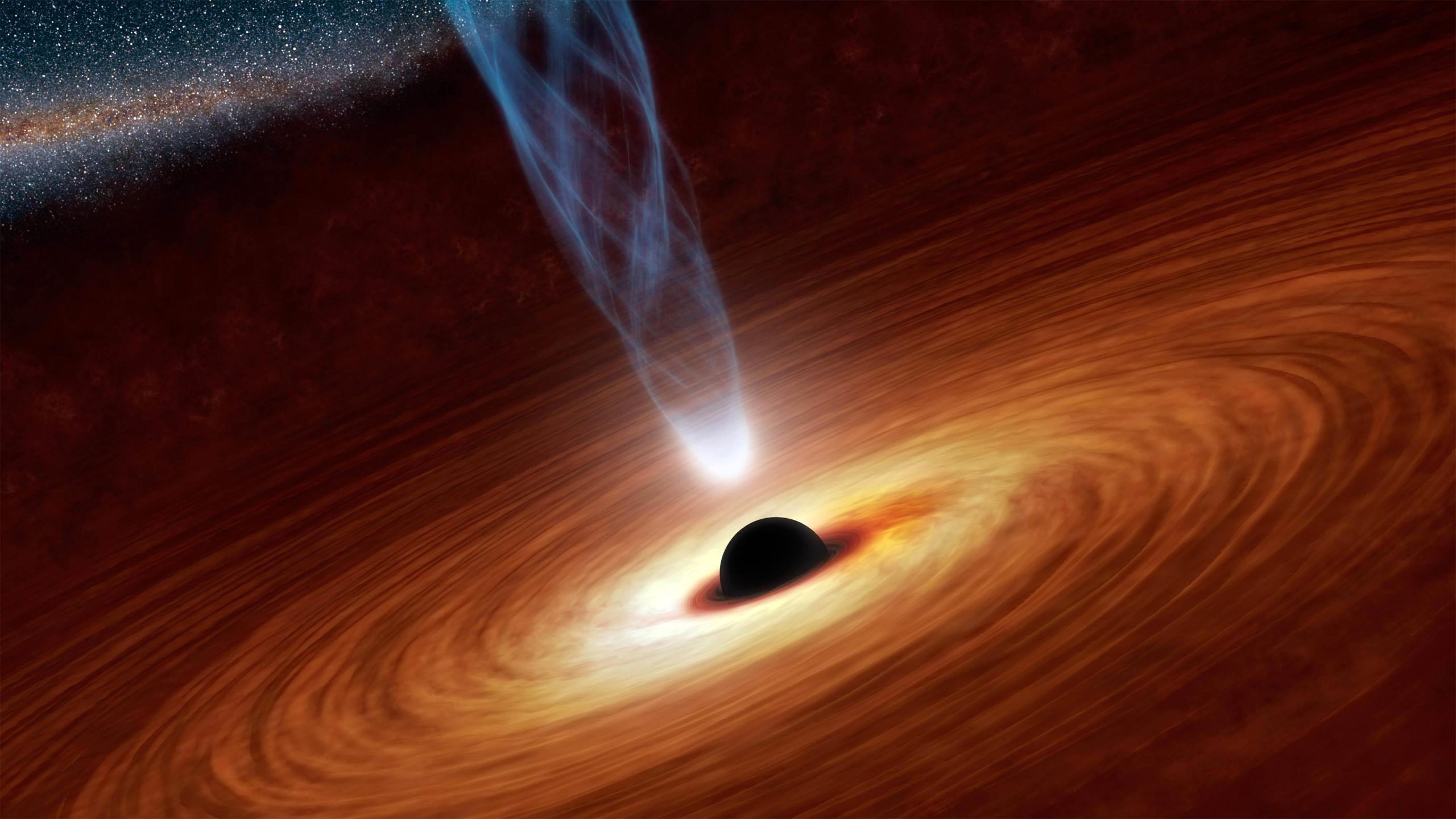
The impossibility of the kugelblitz: quantum effects forbid the formation of black holes from high concentrations of intense light.
Researchers have concluded that kugelblitze, black holes formed from light, are theoretically impossible. This finding was derived from a mathematical model incorporating quantum effects, revealing that the light intensity required far exceeds that found in the universe. While disappointing for theoretical physics, this discovery has profound implications for understanding quantum mechanics and general relativity.
For the last seven decades, astrophysicists have theorized the existence of “kugelblitz,” black holes caused by extremely high concentrations of light.
These special black holes, they speculated, might be linked to astronomical phenomena such as dark matter, and have even been suggested as the power source of hypothetical spaceship engines in the far future.
Debunking Kugelblitze: A New Study
However, new theoretical physics research by a team of researchers at the University of Waterloo and Universidad Complutense de Madrid demonstrates that kugelblitze are impossible in our current universe.
“The most commonly known black holes are those caused by enormous concentrations of regular matter collapsing under its own gravity,” said Eduardo Martín-Martínez, who is a professor of applied mathematics and mathematical physics and affiliate of the Perimeter Institute for Theoretical Physics. “Because, in Einstein’s theory of general relativity, any kind of energy curves space-time, it has been long speculated that an enormous concentration of energy in the form of light might lead to a similar collapse. However, this prediction was made without considering quantum effects.”
Quantum Limitations on Light-Induced Black Holes
The team built a mathematical model, taking into account quantum effects, that demonstrated that the concentration of light required to create kugelblitze would be tens of orders of magnitude greater than that observed in quasars, the brightest objects in our universe.
“Long before you could reach that intensity of light, certain quantum effects would occur first,” said José Polo-Gómez, a PhD candidate in applied mathematics and quantum information. “That strong of a concentration of light would lead to the spontaneous creation of particles like electron-positron pairs, which would move very quickly away from the area.”
Though the conditions necessary to achieve such an effect are impossible to test on earth using current technology, the team can be confident in the accuracy of their predictions because they rely on the same mathematical and scientific principles that power positron emission tomography (PET) scans.
“A way to understand this phenomenon is to think of the annihilation of matter and antimatter, like what happens during PET scans. Electrons, and their antiparticles (positrons) can annihilate each other and disintegrate into pairs of photons, or light ‘particles’,” Martín-Martínez said. “Our results are a consequence of the phenomenon called ‘vacuum polarization’ and the Schwinger effect, and while explaining them in a few words can be challenging, a helpful way of thinking about it is this: the phenomenon we’ve predicted that would prevent the creation of black holes from light is in many ways like the opposite of the matter-antimatter disintegration phenomenon that happens in a PET scan: when there is a large concentration of photons they can disintegrate into electron-positron pairs, which are quickly scattered away taking the energy with them and preventing the gravitational collapse”
Implications for Physics and Future Technologies
While the impossibility of kugelblitze may be disappointing for astrophysicists, the discovery is an important achievement in the kind of fundamental physics research enabled by the partnership between applied mathematics, the Perimeter Institute, and the Institute for Quantum Computing at Waterloo.
“While these discoveries may not have known applications right now, we are laying the groundwork for our descendants’ technological innovations,” said Polo-Gómez. “The science behind PET scan machines was once just as theoretical, and now there’s one in every hospital.”
The research, “No black holes from light,” was published in Physical Review Letters.
Reference: “No Black Holes from Light” by Álvaro Álvarez-Domínguez, Luis J. Garay, Eduardo Martín-Martínez and José Polo-Gómez, 26 July 2024, Physical Review Letters.
DOI: 10.1103/PhysRevLett.133.041401
Never miss a breakthrough: Join the SciTechDaily newsletter.
Follow us on Google and Google News.