
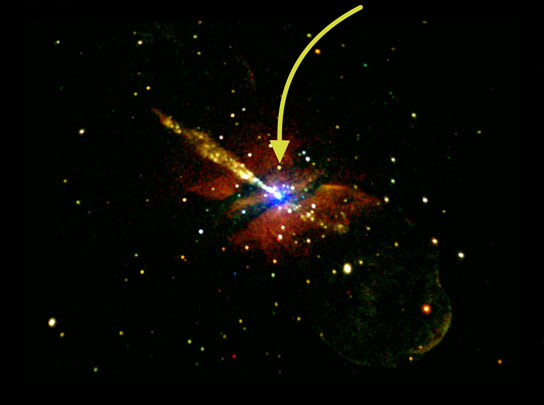
A newly published study describes the findings of a black hole located 12 million light-years away in galaxy Centaurus A. Although black holes are believed to be everywhere, this is the first time a normal-size black hole has been detected away from the immediate vicinity of our own galaxy.
An international team of scientists have discovered an ‘ordinary’ black hole in the 12 million light-year-distant galaxy Centaurus A. This is the first time that a normal-size black hole has been detected away from the immediate vicinity of our own Galaxy. PhD student Mark Burke will present the discovery at the National Astronomy Meeting in Manchester.
Although exotic by everyday standards, black holes are everywhere. The lowest-mass black holes are formed when very massive stars reach the end of their lives, ejecting most of their material into space in a supernova explosion and leaving behind a compact core that collapses into a black hole. There are thought to be millions of these low-mass black holes distributed throughout every galaxy. Despite their ubiquity, they can be hard to detect as they do not emit light so are normally seen through their action on the objects around them, for example by dragging in material that then heats up in the process and emits X-rays. But despite this, the overwhelming majority of black holes have remained undetected.
In recent years, researchers have made some progress in finding ordinary black holes in binary systems, by looking for the X-ray emission produced when they suck in material from their companion stars. So far these objects have been relatively close by, either in our own Milky Way Galaxy or in nearby galaxies in the so-called Local Group (a cluster of galaxies relatively near the Milky Way that includes Andromeda).
Mr. Burke works under the supervision of Birmingham University astronomer Dr. Somak Raychaudhury and is part of an international team led by Ralph Kraft of the Harvard-Smithsonian Center for Astrophysics. The team used the orbiting Chandra X-ray observatory to make six 100,000-second-long exposures of Centaurus A, detecting an object with 50,000 times the X-ray brightness of our Sun. A month later, it had dimmed by more than a factor of 10 and then later by a factor of more than 100, so became undetectable.
This behavior is characteristic of a low-mass black hole in a binary system during the final stages of an outburst and is typical of similar black holes in the Milky Way. It implies that the team made the first detection of a normal black hole so far away, for the first time opening up the opportunity to characterize the black hole population of other galaxies.
Mr. Burke comments: “So far we’ve struggled to find many ordinary black holes in other galaxies, even though we know they are there. To confirm (or refute) our understanding of the evolution of stars we need to search for these objects, despite the difficulty of detecting them at large distances. If it turns out that black holes are either much rarer or much more common in other galaxies than in our own it would be a big challenge to some of the basic ideas that underpin astronomy.”
The group now plan to look at the more than 50 other bright X-ray sources that reside within Centaurus A, identifying them as black holes or other exotic objects, and gain at least an inkling of the nature of a further 50 less luminous sources.
Reference: “A Transient Sub-Eddington Black Hole X-ray Binary Candidate in the Dust Lanes of Centaurus A” by Mark J. Burke, Somak Raychaudhury, Ralph P. Kraft, Nicola J. Brassington, Martin J. Hardcastle, Joanna L. Goodger, Gregory R. Sivakoff, William R. Forman, Christine Jones, Kristin A. Woodley, Stephen S. Murray, Jouni Kainulainen, Mark Birkinshaw, Judith H. Croston, Daniel A. Evans, Marat Gilfanov, Andrés Jordán, Craig L. Sarazin, Rasmus Voss, Diana M. Worrall and Zhongli Zhang, 28 March 2012, The Astrophysical Journal.
DOI: 10.1088/0004-637X/749/2/112
Never miss a breakthrough: Join the SciTechDaily newsletter.
Follow us on Google and Google News.