
Close Menu
    Facebook X (Twitter) Instagram
    SciTechDaily
    • Biology
    • Chemistry
    • Earth
    • Health
    • Physics
    • Science
    • Space
    • Technology
    Facebook X (Twitter) Pinterest YouTube RSS
    SciTechDaily
    Home»Physics»Deciphering the Mystery of Neutrino Mass – A New Approach Uses Random Matrix Theory
    Physics

    Deciphering the Mystery of Neutrino Mass – A New Approach Uses Random Matrix Theory

    By Osaka Metropolitan UniversityJuly 4, 20233 Comments3 Mins Read
    Facebook Twitter Pinterest Telegram LinkedIn WhatsApp Email Reddit
    Share
    Facebook Twitter LinkedIn Pinterest Telegram Email Reddit
    Neutrino Concept
    Scientists have used random matrix theory to theoretically show that neutrino mass hierarchy can be mathematically explained.

    Random matrix theory helps explain neutrino mass differences, supporting the seesaw model.

    When any substance is fragmented into increasingly smaller segments, ultimately, you reach a point where division is no longer possible. At this point, you’re left with an elementary particle. As of now, 12 distinct elementary particles have been identified, composed of a blend of quarks and leptons, each available in six unique variations.

    These variants are categorized into three generations. Each generation contains a lepton that carries a charge and one that is neutral, forming various particles such as electrons, muons, and tau neutrinos. In the Standard Model, the masses of the three generations of neutrinos are represented by a three-by-three matrix.

    A research team led by Professor Naoyuki Haba from the Osaka Metropolitan University Graduate School of Science, analyzed the collection of leptons that make up the neutrino mass matrix. Neutrinos are known to have less difference in mass between generations than other elementary particles, so the research team considered that neutrinos are roughly equal in mass between generations. They analyzed the neutrino mass matrix by randomly assigning each element of the matrix. They showed theoretically, using the random mass matrix model that the lepton flavor mixings are large.
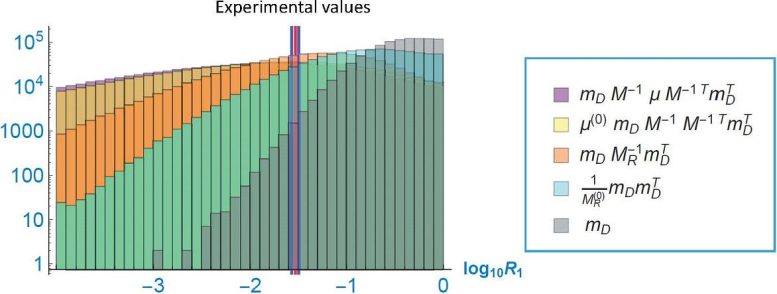
    Probability Distributions of Different Neutrino Mass Models
    The horizontal axis shows the ordinary logarithm of the neutrino mass squared difference ratio, while the vertical axis shows their probability distribution. Each histogram represents the probability distributions for the seesaw mechanisms of the corresponding color. The vertical red and blue lines represent the experimental values (1σ and 3σ errors) of the ordinary logarithm of the neutrino mass squared difference ratio. The probability distribution for the seesaw model with the random Dirac and Majorana matrices in orange has the highest probability of reproducing the experimental value. Credit: Naoyuki Haba, Osaka Metropolitan University

    “Clarifying the properties of elementary particles leads to the exploration of the universe and ultimately to the grand theme of where we came from!” Professor Haba explained. “Beyond the remaining mysteries of the Standard Model, there is a whole new world of physics.”

    After studying the neutrino mass anarchy in the Dirac neutrino, seesaw, double seesaw models, the researchers found that the anarchy approach requires that the measure of the matrix should obey the Gaussian distribution. Having considered several models of light neutrino mass where the matrix is composed of the product of several random matrices, the research team was able to prove, as best they could at this stage, why the calculation of the squared difference of the neutrino masses are closest with the experimental results in the case of the seesaw model with the random Dirac and Majorana matrices.

    “In this study, we showed that the neutrino mass hierarchy can be mathematically explained using random matrix theory. However, this proof is not mathematically complete and is expected to be rigorously proven as random matrix theory continues to develop,” said Professor Haba. “In the future, we will continue with our challenge of elucidating the three-generation copy structure of elementary particles, the essential nature of which is still completely unknown both theoretically and experimentally.”

    Reference: “Neutrino mass square ratio and neutrinoless double-beta decay in random neutrino mass matrices ” by Naoyuki Haba, Yasuhiro Shimizu and Toshifumi Yamada, 19 January 2023, Progress of Theoretical and Experimental Physics.
    DOI: 10.1093/ptep/ptad010

    The study was funded by the Ministry of Education, Culture, Sports, Science and Technology of Japan.

    Never miss a breakthrough: Join the SciTechDaily newsletter.
    Follow us on Google and Google News.

    Neutrinos Osaka Metropolitan University Particle Physics
    Share. Facebook Twitter Pinterest LinkedIn Email Reddit

    Related Articles

    Matter Without Antimatter? Closing In on Elusive Particles.

    Physicists at MIT Shave Estimate of Mass of Neutrino “Ghost Particle” in Half

    New Tabletop Detector Identifies Single Electrons

    GERDA Experiment Phase I Results – No New Evidence That Neutrinos Are Their Own Antiparticles

    Fermilab Narrows the Gap Between the Masses of Neutrinos and Antineutrinos

    MAJORANA, the Underground Experiment that Could Rewrite the Standard Model

    ICARUS Experiment Claims Neutrinos Aren’t Faster Than Light

    New Type of Neutrino Oscillation Discovered at Daya Bay

    Possible Mistakes Found in Faster Than Light Neutrino Measurement

    3 Comments

    1. Bao-hua ZHANG on July 4, 2023 6:06 pm

      When any substance is fragmented into increasingly smaller segments, ultimately, you reach a point where division is no longer possible. At this point, you’re left with an elementary particle. As of now, 12 distinct elementary particles have been identified, composed of a blend of quarks and leptons, each available in six unique variations.
      This paragraph is contradictory and full of loopholes. Please tell the public what is the basis for the 12 distinct elementary particles you described where division is no longer possible. According to the topological vortex gravitational field theory, this speech may be suspected of Pseudoscience.

      Reply
      • Bao-hua ZHANG on July 5, 2023 11:40 pm

        How to explain that the elementary particle is composed of a blend of quarks and leptons, and where division is no longer possible.

        Reply
        • Bao-hua ZHANG on July 6, 2023 1:44 am

          The physical phenomena observed in scientific research are often not comprehensive, let alone essential.

          Reply
    Leave A Reply Cancel Reply

    • Facebook
    • Twitter
    • Pinterest
    • YouTube

    Don't Miss a Discovery

    Subscribe for the Latest in Science & Tech!

    Trending News

    Breakthrough Parkinson’s Drug Targets Disease at Its Genetic Roots

    Just 4 Weeks of Simple Diet Changes Reversed Signs of Aging in Older Adults

    Scientists May Have Finally Solved Why Humans Are Right-Handed

    NASA’s Hubble Accidentally Witnesses a Comet Shattering in Space

    Researchers Discover the Body’s Hidden “Off Switch” for Inflammation

    Scientists Discover Metformin Doesn’t Work the Way We Thought

    Tea or Coffee? Your Daily Choice Could Affect Osteoporosis Risk

    Vitamin C May Fight Cancer in a Surprising Way

    Follow SciTechDaily
    • Facebook
    • Twitter
    • YouTube
    • Pinterest
    • Newsletter
    • RSS
    SciTech News
    • Biology News
    • Chemistry News
    • Earth News
    • Health News
    • Physics News
    • Science News
    • Space News
    • Technology News
    Recent Posts
    • Scientists Discover the Secret Bacteria Behind Artisan Cheeses – and They May Be Good for Your Health
    • Banned Antibiotic Discovered in Fish Raises Food Safety Concerns
    • Common Asthma Drug May Reverse Dangerous Fatty Liver Disease
    • Scientists Develop Experimental Eye Drop That Could Transform Dry Eye Treatment
    • Extra Weight Could Age Your Brain Faster, Study Warns
    Copyright © 1998 - 2026 SciTechDaily. All Rights Reserved.
    • Science News
    • About
    • Contact
    • Editorial Board
    • Privacy Policy
    • Terms of Use

    Type above and press Enter to search. Press Esc to cancel.