
Close Menu
    Facebook X (Twitter) Instagram
    SciTechDaily
    • Biology
    • Chemistry
    • Earth
    • Health
    • Physics
    • Science
    • Space
    • Technology
    Facebook X (Twitter) Pinterest YouTube RSS
    SciTechDaily
    Home»Health»Decoding Alzheimer’s: The Arctic Mutation’s Role in Unusual Brain Structures
    Health

    Decoding Alzheimer’s: The Arctic Mutation’s Role in Unusual Brain Structures

    By RIKENNovember 25, 2024No Comments4 Mins Read
    Facebook Twitter Pinterest Telegram LinkedIn WhatsApp Email Reddit
    Share
    Facebook Twitter LinkedIn Pinterest Telegram Email Reddit
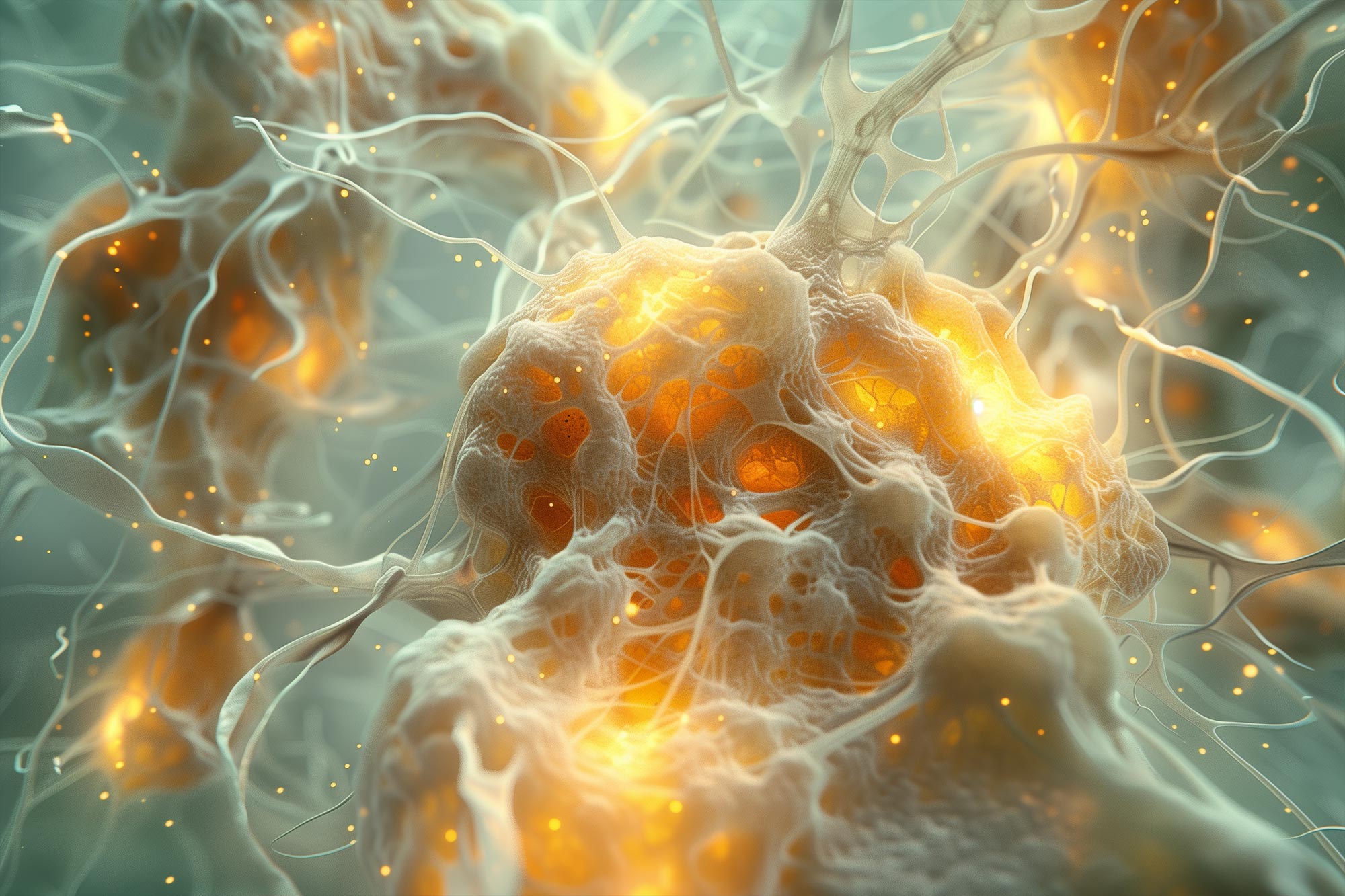
    Alzheimers Disease Cotton Wool Brain Plaques Concept
    A study reveals that mutations linked to familial Alzheimer’s cause unique brain structures, providing potential new targets for treatment. Credit: SciTechDaily.com

    Researchers have uncovered how certain genetic mutations lead to unique spherical amyloid plaques in inherited forms of Alzheimer’s, offering insights that could advance our understanding of the disease and improve therapeutic strategies.

    An international collaboration led by RIKEN researchers has discovered how unusual spherical structures form in the brains of people with a mutation that causes a form of inherited Alzheimer’s disease. This discovery could help better understand the mechanics of the debilitating neurodegenerative disease.

    Why Alzheimer’s disease strikes some people but not others is still largely mysterious. But in about one percent of cases that reason is clear—the person has inherited one of a handful of mutations that cause familial Alzheimer’s.

    “The inherited form of Alzheimer’s disease can be caused by mutations to the gene that encodes for the amyloid precursor protein,” explains Yoshitaka Ishii of the RIKEN Center for Biosystems Dynamics Research.

    Amyloid Fibrils and Alzheimer’s Research

    Some of these mutations promote misfolding of the amyloid beta peptides into fibrillar aggregates, which are amyloid beta molecules clumped together in strings. Such amyloid beta fibrils are one of the hallmarks of all forms of Alzheimer’s disease, although their structures vary according to the disease variety.

    Discovering the structures of amyloid fibrils of amyloid-beta peptides could shed light on how the disease develops. It could help with developing ways to prevent or treat the condition.

    “Amyloid fibrils are key drug targets for antibody therapies for Alzheimer’s,” says Ishii. “It’s thus important to determine their structures.”

    E22G 40-Residue Beta-Amyloid Fibrils
    A new W-shaped structural model of E22G 40-residue beta-amyloid fibrils. RIKEN researchers have shown how the unique structure of amyloid fibrils produced by the Arctic mutation can trigger the production of cotton wool plaques in familial Alzheimer’s disease. Credit: © 2024 RIKEN Center for Biosystems Dynamics Research

    Structural Insights From Arctic Mutation Analysis

    Now, Ishii and co-workers have prepared samples of amyloid beta fibrils produced by the Arctic mutation—so called because it was first found in Scandinavia. They then used cryo-electron microscopy and solid-state nuclear magnetic resonance (NMR) to determine its structure.

    “While Alzheimer’s patients with the Arctic mutation exhibit similar symptoms as people with regular Alzheimer’s, the pathological features are unique,” says Ishii. “For example, a distinctive type of amyloid plaque called cotton wool plaque is often observed.”

    Cotton wool plaques are large, spherical plaques. “In Alzheimer’s patients with the Arctic mutation, cotton wool plaques can be 200 micrometers in diameter, which is ten times larger than a typical plaque,” explains Ishii. “But no one knew how these unique features were produced.”

    Potential Impact on Alzheimer’s Therapy

    Ishii’s team’s structural analysis has now revealed how cotton wool plaques may be formed by the mutation. “We’ve demonstrated that the unique W-shaped structure of amyloid fibrils produced by the Arctic mutation reproduces the major features of cotton wool plaques,” says Ishii.

    Ishii and his team hope this kind of structural analysis will help Alzheimer’s research on two fronts.

    “We believe that experimentally creating amyloid fibrils, which mimic the fibrils in various subtypes of Alzheimer’s disease, will reveal the complex mechanisms of Alzheimer’s,” says Ishii. “This direction should also provide good potential targets for antibody or other therapies for the disorder.”

    Reference: “E22G Aβ40 fibril structure and kinetics illuminate how Aβ40 rather than Aβ42 triggers familial Alzheimer’s” by Mohammad Jafar Tehrani, Isamu Matsuda, Atsushi Yamagata, Yu Kodama, Tatsuya Matsunaga, Mayuko Sato, Kiminori Toyooka, Dan McElheny, Naohiro Kobayashi, Mikako Shirouzu and Yoshitaka Ishii, 15 August 2024, Nature Communications.
    DOI: 10.1038/s41467-024-51294-w

    Never miss a breakthrough: Join the SciTechDaily newsletter.
    Follow us on Google and Google News.

    Alzheimer's Disease Brain Neuroscience Popular RIKEN
    Share. Facebook Twitter Pinterest LinkedIn Email Reddit

    Related Articles

    Melting Away Alzheimer’s: How Dopamine Dissolves Harmful Brain Plaques

    Neurologist Explores Link Between COVID and “Brain Fog,” Memory Loss and Dementia

    COVID-19 Associated With Long-Term Cognitive Dysfunction, Acceleration of Alzheimer’s Symptoms

    Brain Cells Snap Open Their DNA To Make Memories – Extent of DNA Double-Strand Breaks Is “Surprising and Concerning”

    Are We Wrong About Alzheimer’s? Researchers Question Prevailing Theory After New Discovery

    Statins Used to Lower Cholesterol Linked to Doubled Risk of Developing Dementia

    Identifying “The Terrorist Inside My Husband’s Brain” – Living Brain Imaging Can Clearly Differentiate Between Types of Dementia

    Neuroscientists Discover Promising Way to Restore Cognitive Function Impaired by Alzheimer’s Disease

    Century of Data Shows COVID-19 Likely to Impact the Brain Long-Term

    Leave A Reply Cancel Reply

    • Facebook
    • Twitter
    • Pinterest
    • YouTube

    Don't Miss a Discovery

    Subscribe for the Latest in Science & Tech!

    Trending News

    One of the Universe’s Largest Stars May Be Getting Ready To Explode

    Scientists Discover Enzyme That Could Supercharge Ozempic-Like Weight Loss Drugs

    Popular Sweetener Linked to DNA Damage – “It’s Something You Should Not Be Eating”

    Ancient “Rock” Microbes May Reveal How Complex Life Began

    Researchers Capture Quantum Interference in One of Nature’s Rarest Atoms

    “A Plague Is Upon Us”: The Mass Death That Changed an Ancient City Forever

    Scientists Discover Game-Changing New Way To Treat High Cholesterol

    This Small Change to Your Exercise Routine Could Be the Secret to Living Longer

    Follow SciTechDaily
    • Facebook
    • Twitter
    • YouTube
    • Pinterest
    • Newsletter
    • RSS
    SciTech News
    • Biology News
    • Chemistry News
    • Earth News
    • Health News
    • Physics News
    • Science News
    • Space News
    • Technology News
    Recent Posts
    • Revolutionary Imaging Technique Unlocks Secrets of Matter at Extreme Speeds
    • Where Does Mass Come From? Scientists Find Evidence of a New Exotic Nuclear State
    • Quantum Breakthrough: Unhackable Keys Sent Over 120 km Using Quantum Dots
    • Researchers Discover Unknown Beetle Species Just Steps From Their Lab
    • Jellyfish Caught Feasting on Exploding Sea Worms for the First Time
    Copyright © 1998 - 2026 SciTechDaily. All Rights Reserved.
    • Science News
    • About
    • Contact
    • Editorial Board
    • Privacy Policy
    • Terms of Use

    Type above and press Enter to search. Press Esc to cancel.