
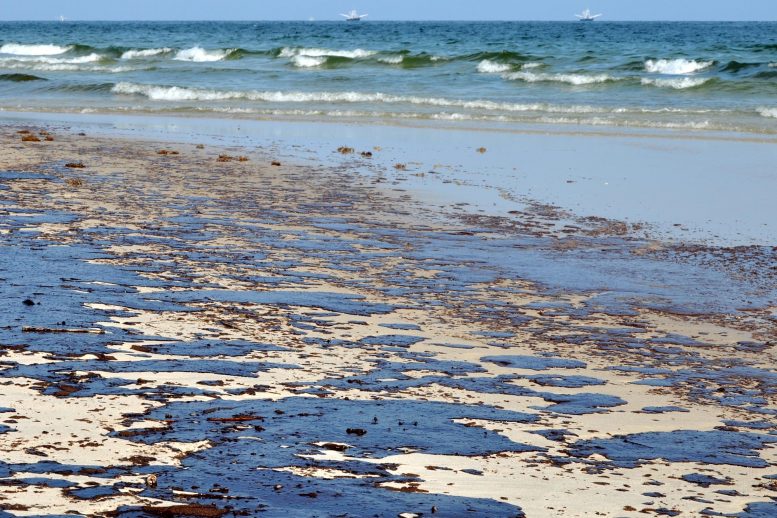
Golf ball-size clods of weathered crude oil originating from the 2010 Deepwater Horizon catastrophe could remain buried in sandy Gulf Coast beaches for decades, according to a new study by ecologists at Florida State University.
In a paper published in the journal Scientific Reports, FSU Professor of Oceanography Markus Huettel and graduate student Ioana Bociu revealed that these large clumps of oil and sand — called sediment-oil-agglomerates — take at least 30 years to decompose.
“This oil contains substances that are harmful to the environment and to humans,” Huettel said. “Understanding the fate of this buried oil is critical, as it can persist for long periods of time.”
Oil from the Deepwater Horizon spill contaminated an estimated 965 kilometers (600 miles) of sandy beaches along the Gulf of Mexico coastline. Portions of that oil were quickly removed: Past research conducted by Huettel and his colleague Joel Kostka from the Georgia Institute of Technology found that smaller Deepwater Horizon-derived oil droplets were degraded by sand-dwelling microbes, or pervasive microscopic organisms, within just one year of washing ashore.
In addition to the rapid degradation of smaller droplets, significant amounts of larger oil particles were extracted by sweeping mechanical excavation efforts. But these muscular cleanup operations were not able to unearth all of the harmful oil, some of which was buried as deep as 70 centimeters in the sand.
In order to investigate what could become of the remaining oil contaminants, Huettel and his team conducted a three-year experiment of sediment-oil-agglomerates buried in the white sands of Northwest Florida’s Pensacola Beach.
They found that these buried clumps of oil and sediment, usually measuring less than 10 centimeters in diameter, take roughly three decades to fully decompose — a result of their smaller surface area to volume ratios and the limited oxygen, moisture, and nutrients available to their live-in microbes.
While golf-ball size clumps were the most common agglomerates buried along the Gulf Coast beaches, other, more extreme contaminants discovered by the researchers would require even longer periods to completely degrade.
“After the Deepwater Horizon spill, we found sediment-oil-agglomerates at Pensacola Beach that were the size of an office printer, and even larger,” Huettel said. “After burial, these would persist in the beach much longer than our golf ball-size agglomerates.”
Thirty years from burial to full decomposition may seem like a dangerously prolonged period of decay, but Huettel’s study showed that without the unique ecological properties of a sandy beach, the same golf ball-size agglomerates would take more than 100 years to break down.
That, Huettel said, underscores the pivotal biocatalytic filter role of beach sands, which he compared to sand filters used for water purification, swimming pools, or aquariums.
“The microbe-colonized beach sands that are flushed by the waves washing onto the shore function in a similar way and thus can clean very large volumes of water,” he said.
Farther up the beach, beyond the reach of breaking waves, regular tidal groundwater oscillations play a similarly important role. When groundwater levels fall, warm, oxygen-rich air is drawn into the sands, nourishing oil-degrading microbes and stimulating their biodegradation activity. When groundwater rises, moisture, which is essential for biodegradation, is transported to the microbes, and carbon dioxide resulting from that biodegradation is expelled.
“The beach, breathing in tidal rhythm, thus can be compared to a large organism that aerobically ‘digests’ the organic matter — including oil — by inhaling oxygen and exhaling carbon dioxide,” Huettel said. “The apparent cleanness of the sand that we all enjoy when going to the beach is a reflection of the effective beach biocatalytic decomposition process that removes degradable material in a relatively short time.”
Without this natural “breathing” process, oil agglomerates and other toxic material would accumulate on the beach, compromising the area’s ecology and putrefying coastal waters.
However, the biocatalytic sand filter is not infallible.
If the load of organic and inorganic particles grows unsustainably, once-pristine beach and coastal sands can become a muddy mess, impenetrable to oxygen and therefore inhospitable to aerobic degraders. This ecological deterioration can result in hypoxic zones — areas deprived of oxygen — which are becoming increasingly common around the world.
“Protecting the beaches, therefore, is critical to maintaining a healthy shore environment,” Huettel said.
###
This study was funded by the Gulf of Mexico Research Initiative, the National Science Foundation, the Florida Institute of Oceanography and the Northern Gulf Institute.
Reference: “Decomposition of sediment-oil-agglomerates in a Gulf of Mexico sandy beach” by Ioana Bociu, Boryoung Shin, Wm. Brian Wells, Joel E. Kostka, Konstantinos T. Konstantinidis and Markus Huettel, 11 July 2019, Scientific Reports.
DOI: 10.1038/s41598-019-46301-w
Never miss a breakthrough: Join the SciTechDaily newsletter.
Follow us on Google and Google News.