
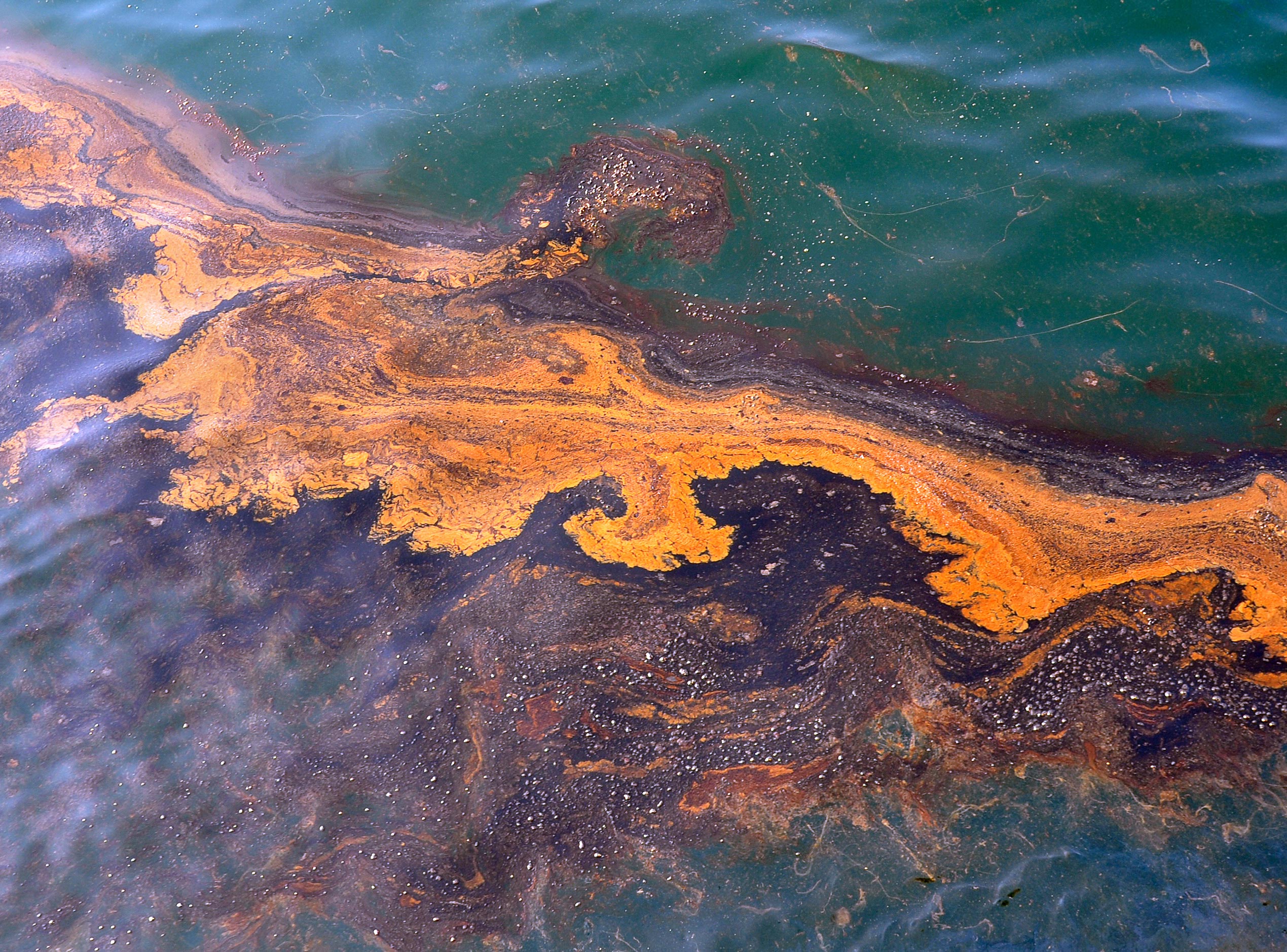
Dissolving Oil in a Sunlit Sea
The 2010 Deepwater Horizon oil spill was the largest marine oil spill in United States history. The disaster was caused by an explosion on the Deepwater Horizon oil rig, taking 11 lives and releasing nearly 210 million gallons (795 million liters) of crude oil into the Gulf of Mexico. Twelve years and hundreds of millions of dollars later, scientists are still working to understand where all this oil ended up, a concept known as environmental fate.
The most commonly discussed fates of oil spilled at sea are biodegradation (microorganisms consuming and breaking down the oil), evaporation (liquid oil becoming a gas), and oil stranding on shorelines.
Discovery of Photo-Dissolution as a Major Oil Fate
A team of Woods Hole Oceanographic Institution (WHOI) researchers discovered that nearly 10 percent of the oil floating on the Gulf after the Deepwater Horizon disaster was dissolved into seawater by sunlight — a process called “photo-dissolution.” The findings were published today in the paper “Sunlight-driven dissolution is a major fate of oil at sea” in Science Advances.
“The amount of oil that was transformed by sunlight into compounds that dissolved in seawater during the 2010 Deepwater Horizon spill rivals that of commonly accepted oil fates, like biodegradation and stranding on shorelines,” said co-author Collin Ward, assistant scientist in WHOI’s Marine Chemistry and Geochemistry Department.
“One of the most fascinating aspects of this finding is that it might impact our understanding of where else the oil is going, and whether the result is good or bad,” said lead author Danielle Haas Freeman, Massachusetts Institute of Technology/WHOI Joint Program student. “If this sizable fraction of oil is being transformed by sunlight and is dissolving into seawater, that might mean that less oil is ending up in other places, like sensitive coastal ecosystems. On the other hand, we have to consider the impacts of the compounds on marine organisms before we can decide if the net result is positive or negative.”
To arrive at this important finding, Freeman and Ward used custom-built light-emitting diode (LED) reactors to measure how the rate of this oil fate varies for different types of light, such as ultraviolet and visible light.
“The process of oil photo-dissolution has actually been known for over fifty years,” said Ward. “But what’s new here is our understanding how this process varies with light wavelength, which we determined using the LED reactors. This is the key piece of information that allowed us to estimate the importance of this process during a spill.”
New Understanding of Spill Scenarios and Conditions
The novel measurements using the LEDs also provided an opportunity to determine which conditions were most important in controlling this process. The team created hypothetical spill scenarios with varying oil slick thicknesses, times of the year, locations around the world, and types of light. What they noticed was that some of these changing conditions mattered more than others.
“The importance of this process changes dramatically if you are looking at thin versus thick oil slicks,” said Freeman. “We also found, contrary to popular belief, that this process is relevant in Arctic waters, a particularly important finding given the expected increase in cargo ship traffic and heightened risk of spills in that region. This kind of modeling is critical when forecasting spills and considering the impacts on marine ecosystems.”
Future Research and Environmental Considerations
The notion that ocean surface oil could have a new fate is monumental for framing the future of oil spill studies and spill response tactics. It is currently unknown what the fate and potential toxicity of these sunlight-produced compounds are, posing a challenge in assessing the impacts of this oil fate. Freeman and Ward encourage the field to gravitate towards these gaps in knowledge.
“While our findings suggest that a substantial fraction of surface oil can dissolve into the ocean after sunlight exposure, a logical next step is to evaluate its persistence and potential harm to aquatic animals,” Ward said.
Reference: “Sunlight-driven dissolution is a major fate of oil at sea” by Danielle Haas Freeman and Collin P. Ward, 16 February 2022, Science Advances.
DOI: 10.1126/sciadv.abl7605
Never miss a breakthrough: Join the SciTechDaily newsletter.
Follow us on Google and Google News.