
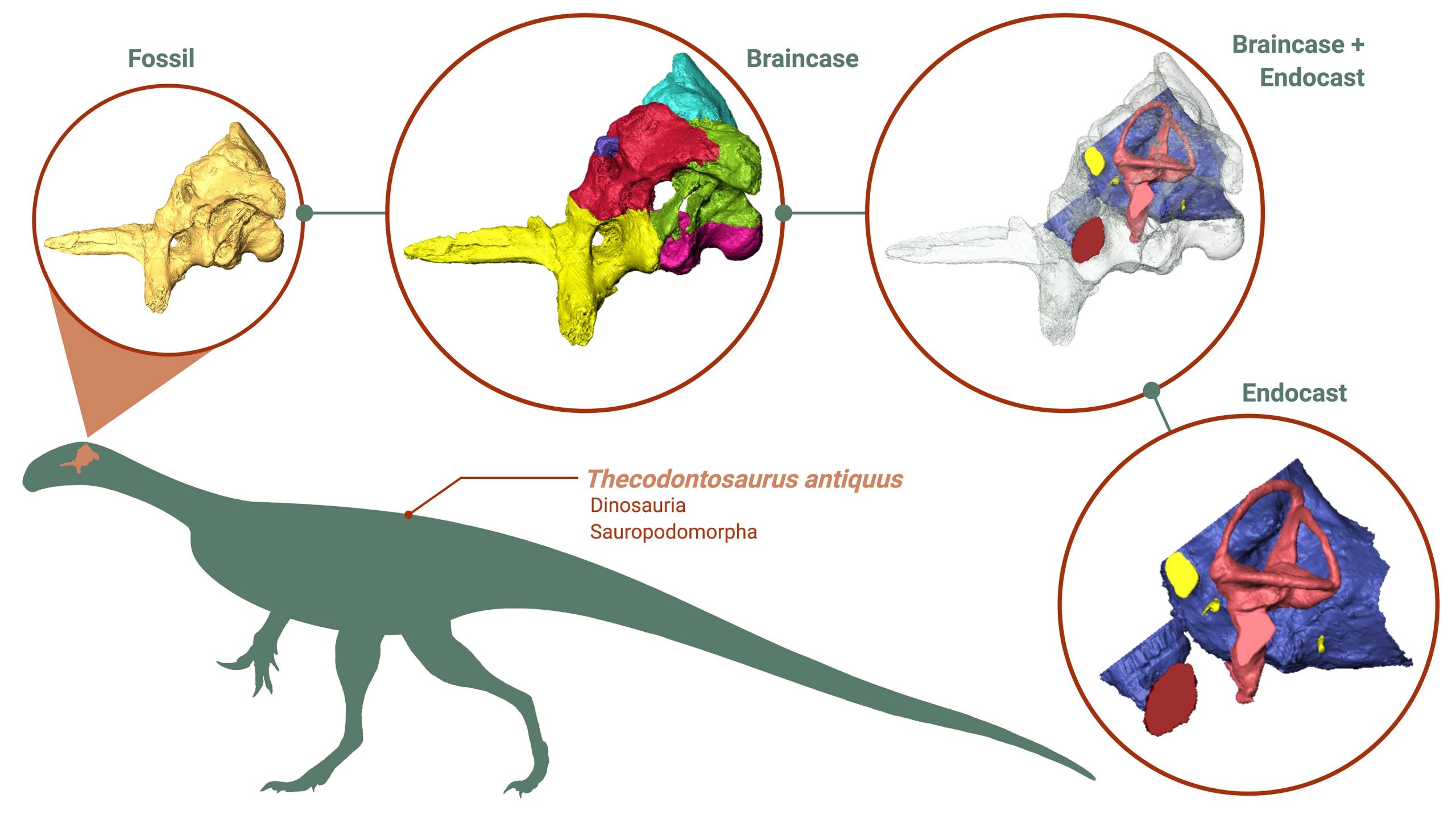
A pioneering reconstruction of the brain belonging to one of the earliest dinosaurs to roam the Earth has shed new light on its possible diet and ability to move fast.
Research, led by the University of Bristol, used advanced imaging and 3-D modeling techniques to digitally rebuild the brain of Thecodontosaurus, better known as the Bristol dinosaur due to its origins in the UK city. The paleontologists found Thecodontosaurus may have eaten meat, unlike its giant long-necked later relatives including Diplodocus and Brontosaurus, which only fed on plants.
Antonio Ballell, lead author of the study published today in Zoological Journal of the Linnean Society, said: “Our analysis of Thecodontosaurus’ brain uncovered many fascinating features, some of which were quite surprising. Whereas its later relatives moved around ponderously on all fours, our findings suggest this species may have walked on two legs and been occasionally carnivorous.”
Thecodontosaurus lived in the late Triassic age some 205 million years ago and was the size of a large dog. Although its fossils were discovered in the 1800s, many of which are carefully preserved at the University of Bristol, scientists have only very recently been able to deploy imaging software to extract new information without destroying them. 3-D models were generated from CT scans by digitally extracting the bone from the rock, identifying anatomical details about its brain and inner ear previously unseen in the fossil.
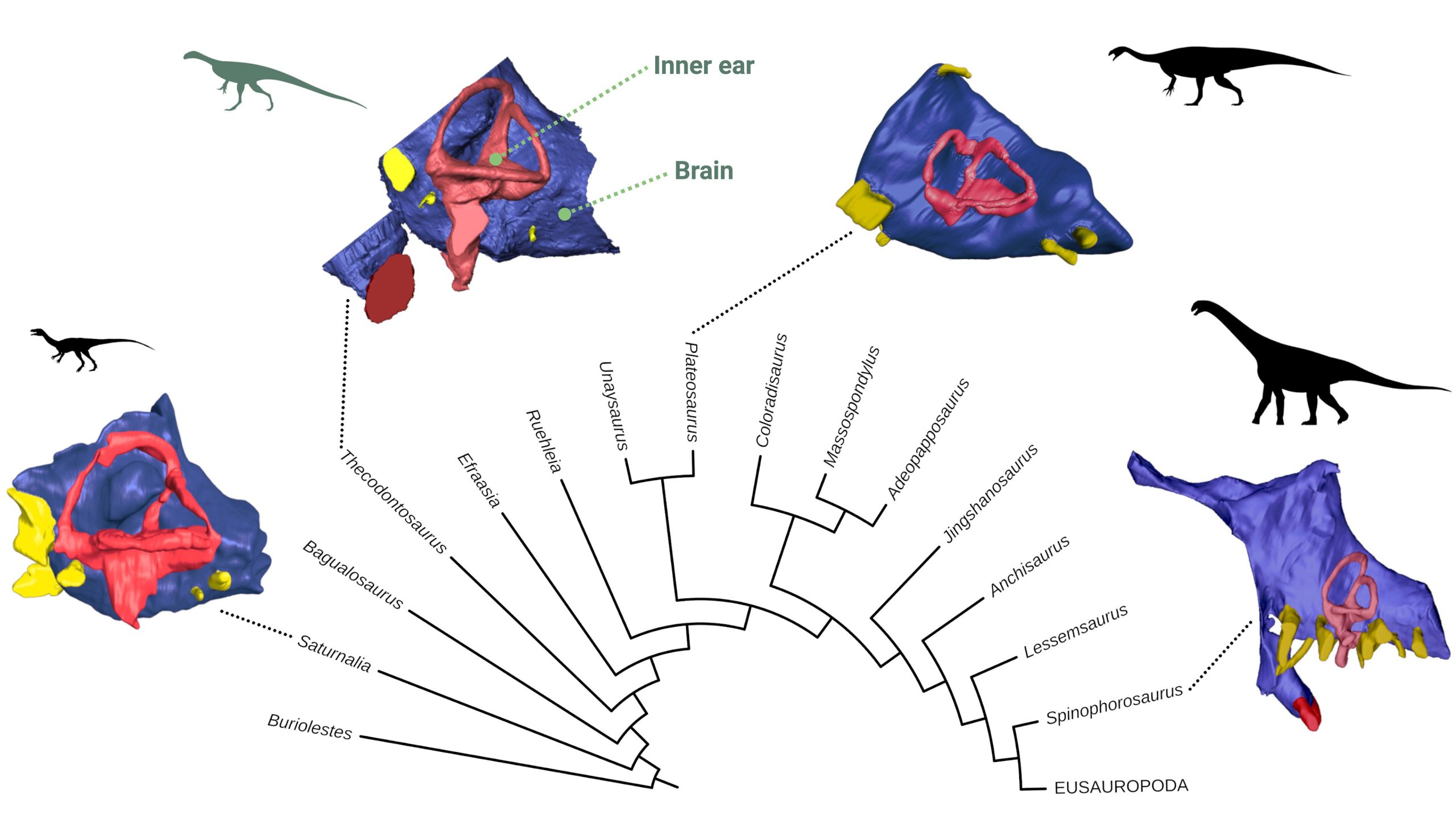
“Even though the actual brain is long gone, the software allows us to recreate brain and inner ear shape via the dimensions of the cavities left behind. The braincase of Thecodontosaurus is beautifully preserved so we compared it to other dinosaurs, identifying common features and some that are specific to Thecodontosaurus,” Antonio said. “Its brain cast even showed the detail of the floccular lobes, located at the back of the brain, which are important for balance. Their large size indicates it was bipedal. This structure is also associated with the control of balance and eye and neck movements, suggesting Thecodontosaurus was relatively agile and could keep a stable gaze while moving fast.”
Although Thecodontosaurus is known for being relatively small and agile, its diet has been debated.
Antonio, a PhD student at the University of Bristol’s School of Earth Sciences, said: “Our analysis showed parts of the brain associated with keeping the head stable and eyes and gaze steady during movement were well-developed. This could also mean Thecodontosaurus could occasionally catch prey, although its tooth morphology suggests plants were the main component of its diet. It’s possible it adopted omnivorous habits.”
The researchers were also able to reconstruct the inner ears, allowing them to estimate how well it could hear compared to other dinosaurs. Its hearing frequency was relatively high, pointing towards some sort of social complexity – an ability to recognize varied squeaks and honks from different animals.
Professor Mike Benton, study co-author, said: “It’s great to see how new technologies are allowing us to find out even more about how this little dinosaur lived more than 200 million years ago.
“We began working on Thecodontosaurus in 1990, and it is the emblem of the Bristol Dinosaur Project, an educational outreach scheme where students go to speak about science in local schools. We’re very fortunate to have so many well-preserved fossils of such an important dinosaur here in Bristol. This has helped us understand many aspects of the biology of Thecodontosaurus, but there are still many questions about this species yet to be explored.”
Reference: “The braincase, brain and palaeobiology of the basal sauropodomorph dinosaur Thecodontosaurus antiquus” by Antonio Ballell, J Logan King, James M Neenan, Emily J Rayfield and Michael J Benton, 14 December 2020, Zoological Journal of the Linnean Society.
DOI: 10.1093/zoolinnean/zlaa157
This research was funded by the Natural Environment Research Council (NERC), the Leverhulme Trust and the Royal Society.
Never miss a breakthrough: Join the SciTechDaily newsletter.
Follow us on Google and Google News.
2 Comments
Even chimps eat a little meat. Years ago scientists did not know why the poor deprived chimps of roadside exhibits lived longer than those in zoos with healthy, clean fresh fruits, etc. Once they realized that insects were part of the roadside diets they realized that a little meat did the primates a lot of good. Perhaps these guys incidentally ate meat or it took longer to digest or perhaps mama bear showed up and retaliated for their catch of the day. Or not. Just a consideration. Chimps have the teeth for it, perhaps these guys don’t.
Raw meat contains about the same stuff that your own body, so any mineral deficiency could be circumvented that way. Meat diets have other problems (parasites, liver and kidney damage if purely meat, et cetera).
What can be observed is that herbivores are not too particular with pure herbivory – you can see videos showing deer snatching chicks that has fallen out of nests and hide in grass – or predators being not too particular with pure predation – you can see dogs and cats snatching leaves and grass. It is their digestive systems (starting with teeth) that have evolved to specialize in one or other direction.
Omnivore evolution explain how lineages in clades can transit from one or the other as you move out the branches of the evolutionary tree.