
Sea-Ice-Free Arctic Makes Permafrost Vulnerable to Thawing
Permafrost is ground that remains frozen throughout the year; it covers nearly a quarter of Northern Hemisphere land. The frozen state of permafrost enables it to store large amounts of carbon; about twice as much as in the atmosphere. The rate and extent of future thawing of permafrost, and the consequent release of its carbon, are hard to predict from modern observations alone.
However, a crucial past relationship between summer sea ice in the Arctic and permafrost, discovered in this study, is now understood, with significant implications for the future.
Professor Gideon Henderson, an author of the study based at the Department of Earth Sciences, University of Oxford, said: ‘We were surprised to find that times when permafrost melted in the past did not simply match up with times when the Earth was at its warmest, but were much more likely when the Arctic was free of ice in the summer. This discovery about the past behavior of permafrost suggests that the expected loss of Arctic sea ice in the future will accelerate the melting of the permafrost presently found across much of Siberia.’
Significant decreases of Arctic sea ice have been observed in recent years, and the Arctic is expected to be free of summer sea ice in the coming decades. Such loss of sea ice is likely to lead to an acceleration of thawing of permafrost in Siberia and to the consequent release of carbon.
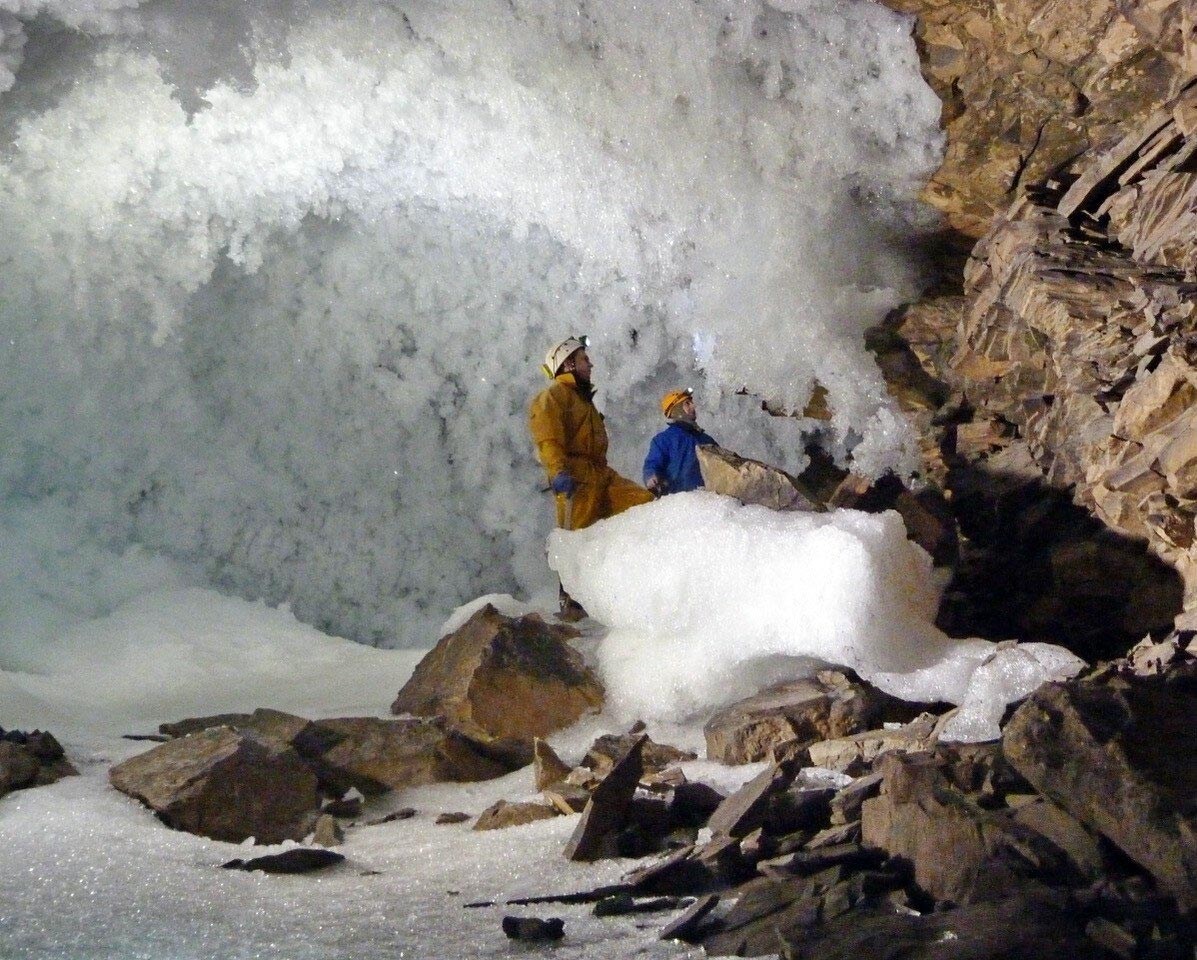
The new research relies on challenging field work to discover and explore Siberian caves. Caves are powerful recorders of periods when permafrost was absent in the past. Stalagmites, stalactites, and flowstones can only form when there is liquid water, and therefore not when overlying land is permanently frozen. The presence of stalagmites in caves under present permafrost thus demonstrates periods when permafrost was absent in the past.
Development of new approaches to date stalagmites using measurements of natural uranium and lead, allow dating of the recovered stalagmites — and therefore of periods of permafrost absence — for the last one and a half million years. Stalagmites grew intermittently from 1,500,000 to 400,000 years ago, and have not grown for the last 400,000 years. The timing of stalagmite formation, and therefore absence of permafrost, do not relate simply to global temperatures in the past but are notably more common when the Arctic Ocean was free of summer sea ice.
This study shows that several processes may lead to the relationship between Arctic sea ice and permafrost. The absence of sea ice leads to an increase in heat and moisture transfer from ocean to atmosphere and therefore to warmer air transported far overland into Siberia. Moisture transport also increases snowfall over Siberia during the autumn months. This blanket of snow insulates the ground from the extreme cold of winters leading to an increase in average annual ground temperatures, destabilizing the permafrost. Consequently, in regions with increased snow cover and insulation, permafrost will start to thaw, releasing carbon dioxide that was trapped for millennia.
Reference: “Palaeoclimate evidence of vulnerable permafrost during times of low sea ice” by A. Vaks, A. J. Mason, S. F. M. Breitenbach, A. M. Kononov, A. V. Osinzev, M. Rosensaft, A. Borshevsky, O. S. Gutareva and G. M. Henderson, 8 January 2020, Nature.
DOI: 10.1038/s41586-019-1880-1
The international team involved in the study consists of scientists from the Geological Survey of Israel, The University of Oxford, UK, Northumbria University, UK, The Institute of Earth’s Crust of the Russian Academy of Sciences (Irkutsk, Russia), and the Speleoclub Arabica (Irkutsk, Russia).
Never miss a breakthrough: Join the SciTechDaily newsletter.
Follow us on Google and Google News.
8 Comments
Weren’t we told the Arctic would be free of sea ice already?
Yes, some climatologists did predict that. Most predictions were for 2040, 2050, and even later. Weather and climate are both complex and chaotic systems.
Making precise predictions is difficult, if not impossible.
However, we do know the direction that the climate is going. We know the oceans and atmosphere are warming — we have hundreds of measurements showing that.
We don’t know the details of how global warming climate change will play out.
When will the Arctic ocean by ice free in summer? in winter?
How fast will the permafrost melt, and how much CO2 will it release??
How will sea currents change? (the Gulf Stream is slowing down, for instance.)
How will air currents change? (the Jet Stream is slowing down, and meandering more, causing odd weather abnormalities.)
And so many other questions we don’t yet know the answers to.
We were told the Arctic was going to be free of sea ice by now. Why should we believe it now?
Amazing how suddenly some folks are time keepers of when the sea ice melts. Moments before, the same peanut gallery , was watching the flat Earth channel……
This is to be expected. With a warm ocean to the North, the permafrost regions will be inundated with warm air, even hot air. The permafrost is already melting, an ice free Arctic Ocean will accelerate the melting.
To the doubters:
Permafrost is already melting.
Atmospheric CO2 is going up by 3ppm, approximately.
Current levels of CO2 existed last 3.5mya, during the Pliocene, when oceans were 70ft deeper.
CO2 levels are directly correlated with past climate temperatures.
The high CO2 levels of the Cretaceous had no ice at the poles, for instance.
BTW…whether an ice free Arctic ocean happens in 2020 or 2030 or 2040, makes little difference. The Earth works on larger time scales than we use. What is certain is the trend — we are losing Arctic sea ice and permafrost.
To clarify:
CO2 is going up about 3ppm — ANNUALLY!!
It is now at 410ppm, and will be at 500ppm by 2050.
500ppm CO2, has not been seen since the Cretaceous, Age of the Dinosaurs.
Magnetic polar shift, polar reversal, Sun’s behavior and strength of the magnetic atmosphere are also unknown factors that add to the unknowns of global warming.