
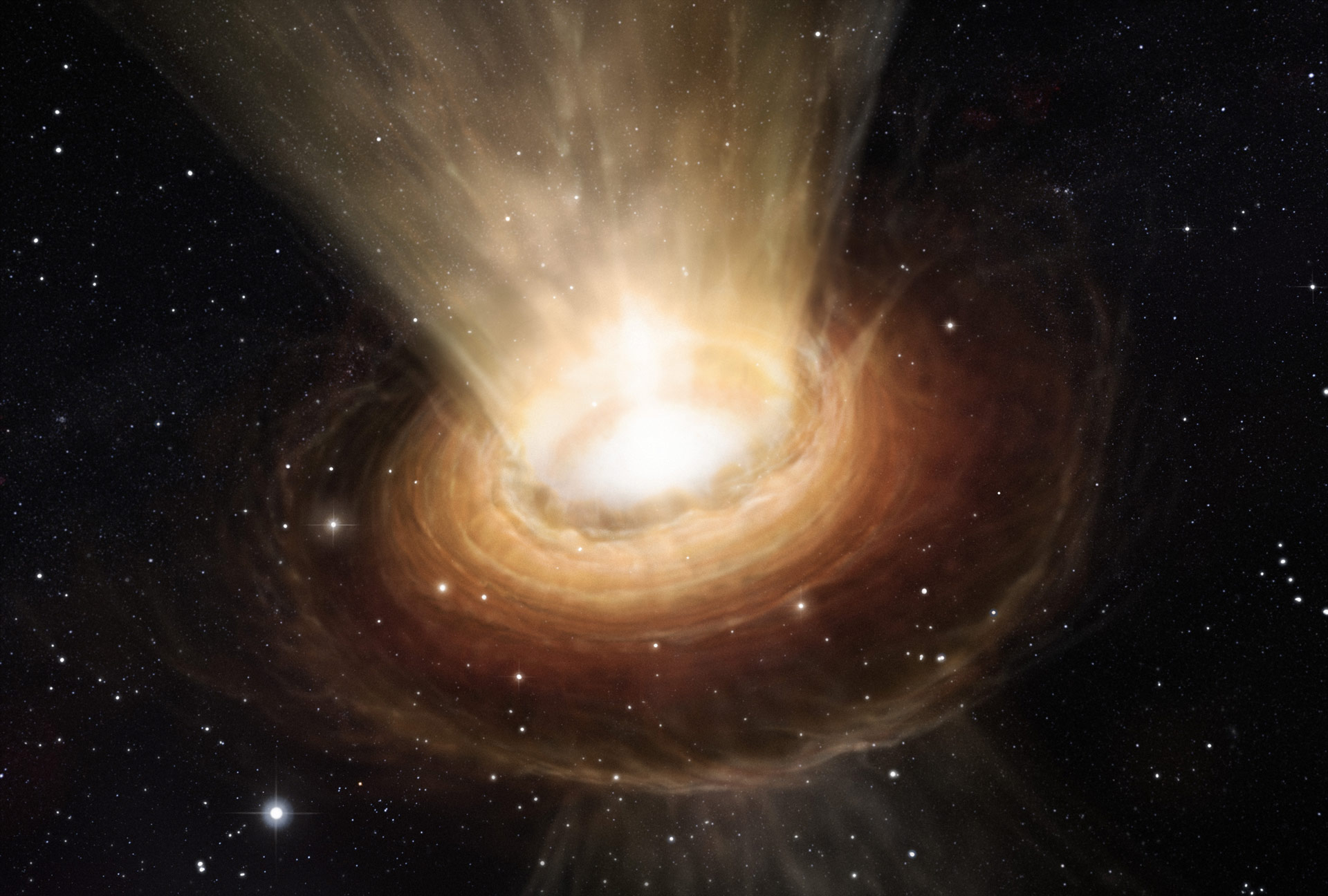
Using the combined power of the Unit Telescopes of ESO’s Very Large Telescope, astronomers have gathered new data on dust around the black hole at the center of active galaxy NGC 3783, revealing for the first time the combined detailed mid-infrared observations of the cool, room-temperature dust around an AGN with similarly detailed observations of the very hot dust.
ESO’s Very Large Telescope Interferometer has gathered the most detailed observations ever of the dust around the huge black hole at the center of an active galaxy. Rather than finding all of the glowing dust in a doughnut-shaped torus around the black hole, as expected, the astronomers find that much of it is located above and below the torus. These observations show that dust is being pushed away from the black hole as a cool wind — a surprising finding that challenges current theories and tells us how supermassive black holes evolve and interact with their surroundings.
Over the last twenty years, astronomers have found that almost all galaxies have a huge black hole at their center. Some of these black holes are growing by drawing in matter from their surroundings, creating in the process the most energetic objects in the Universe: active galactic nuclei (AGN). The central regions of these brilliant powerhouses are ringed by doughnuts of cosmic dust [1] dragged from the surrounding space, similar to how water forms a small whirlpool around the plughole of a sink. It was thought that most of the strong infrared radiation coming from AGN originated in these doughnuts.
But new observations of a nearby active galaxy called NGC 3783, harnessing the power of the Very Large Telescope Interferometer (VLTI) at ESO’s Paranal Observatory in Chile [2], have given a team of astronomers a surprise. Although the hot dust — at some 700 to 1000 degrees Celsius — is indeed in a torus as expected, they found huge amounts of cooler dust above and below this main torus [3].
This video shows an artist’s impression of the dusty wind emanating from the black hole at the center of galaxy NGC 3783. Astronomers knew that dust surrounded such supermassive black holes in a doughnut-shaped torus, but new observations using ESO’s Very Large Telescope Interferometer now show that dust also lies in the polar regions. This material is pushed outwards by the black hole’s radiation, forming a cool, dusty wind. Credit: ESO/M. Kornmesser Music: Andrey Avkhimovich
As Sebastian Hönig (University of California Santa Barbara, USA and Christian-Albrechts-Universität zu Kiel, Germany), lead author of the paper presenting the new results, explains, “This is the first time we’ve been able to combine detailed mid-infrared observations of the cool, room-temperature dust around an AGN with similarly detailed observations of the very hot dust. This also represents the largest set of infrared interferometry for an AGN published yet.”
The newly-discovered dust forms a cool wind streaming outwards from the black hole. This wind must play an important role in the complex relationship between the black hole and its environment. The black hole feeds its insatiable appetite from the surrounding material, but the intense radiation this produces also seems to be blowing the material away. It is still unclear how these two processes work together and allow supermassive black holes to grow and evolve within galaxies, but the presence of a dusty wind adds a new piece to this picture.
In order to investigate the central regions of NGC 3783, the astronomers needed to use the combined power of the Unit Telescopes of ESO’s Very Large Telescope. Using these units together forms an interferometer that can obtain a resolution equivalent to that of a 130-meter telescope.
Another team member, Gerd Weigelt (Max-Planck-Institut für Radioastronomie, Bonn, Germany), explains, “By combining the world-class sensitivity of the large mirrors of the VLT with interferometry we are able to collect enough light to observe faint objects. This lets us study a region as small as the distance from our Sun to its closest neighboring star, in a galaxy tens of millions of light-years away. No other optical or infrared system in the world is currently capable of this.”
These new observations may lead to a paradigm shift in the understanding of AGN. They are direct evidence that dust is being pushed out by the intense radiation. Models of how the dust is distributed and how supermassive black holes grow and evolve must now take into account this newly discovered effect.
Hönig concludes, “I am now really looking forward to MATISSE, which will allow us to combine all four VLT Unit Telescopes at once and observe simultaneously in the near- and mid-infrared — giving us much more detailed data.” MATISSE, a second-generation instrument for the VLTI, is currently under construction.
Notes
[1] Cosmic dust consists of silicate and graphite grains — minerals also abundant on Earth. The soot from a candle is very similar to cosmic graphite dust, although the size of the grains in the soot are ten or more times bigger than typical grain sizes of cosmic graphite grains.
[2] The VLTI is formed from a combination of the four 8.2-meter VLT Unit Telescopes, or the four moveable 1.8-meter VLT Auxiliary Telescopes. It makes use of a technique known as interferometry, in which sophisticated instrumentation combines the light from several telescopes into one observation. Although it usually does not produce actual images, this technique dramatically increases the level of detail that can be measured in the resulting observations, comparable to what a space telescope with a diameter of over 100 meters would measure.
[3] The hotter dust was mapped using the AMBER VLTI instrument at near-infrared wavelengths and the newer observations reported here used the MIDI instrument at wavelengths between 8 and 13 microns in the mid-infrared.
Reference: “Dust in the polar region as a major contributor to the IR emission of AGN” by S. F. Hönig, M. Kishimoto, K. R. W. Tristram, M. A. Prieto, P. Gandhi, D. Asmus, R. Antonucci, L. Burtscher, W. J. Duschl and G. Weigelt, 20 June 2013, The Astrophysical Journal.
DOI: 10.1088/0004-637X/771/2/87
arXiv:1306.4312
Never miss a breakthrough: Join the SciTechDaily newsletter.
Follow us on Google and Google News.