
Close Menu
    Facebook X (Twitter) Instagram
    SciTechDaily
    • Biology
    • Chemistry
    • Earth
    • Health
    • Physics
    • Science
    • Space
    • Technology
    Facebook X (Twitter) Pinterest YouTube RSS
    SciTechDaily
    Home»Physics»Discovery Reveals Tractionless Self-Propulsion Is Possible
    Physics

    Discovery Reveals Tractionless Self-Propulsion Is Possible

    By University of BristolDecember 17, 2019No Comments4 Mins Read
    Facebook Twitter Pinterest Telegram LinkedIn WhatsApp Email Reddit
    Share
    Facebook Twitter LinkedIn Pinterest Telegram Email Reddit
    Tractionless Self Propulsion
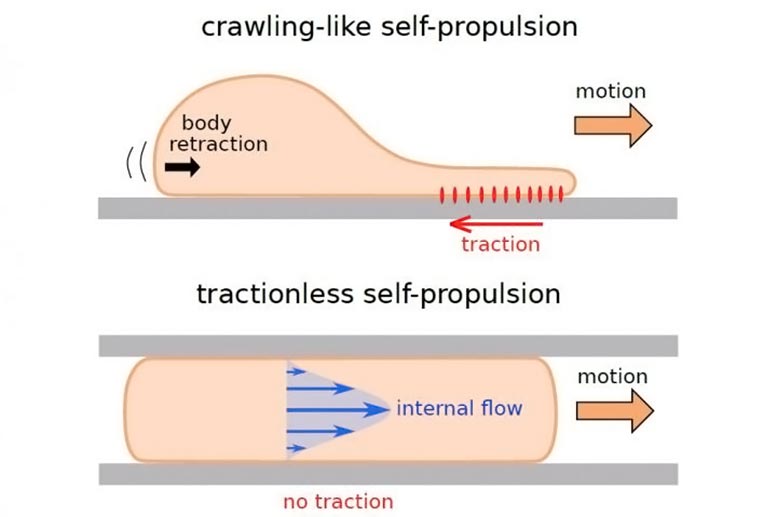
    Crawling is a well-known mechanism for motion on surfaces, but it is ineffective for fast migration in tissues, where cells have to squeeze through tiny gaps. In contrast, tractionless self-propulsion is very suited for that purpose. Credit: A. Loisy, J. Eggers, and T. Liverpool, University of Bristol

    In an article published in Physical Review Letters on December 13, 2019, Bristol scientists have answered the fundamental question: “Is it possible to move without exerting force on the environment?” by describing the tractionless self-propulsion of active matter.

    Understanding how cells move autonomously is a fundamental question for both biologists and physicists.

    Experiments on cell motility are commonly done by looking at the motion of a cell on a glass slide under a microscope.

    In those conditions, cells are observed to “crawl” on the surface. Crawling is well-understood: cells attach themselves to the surface and use these anchor points to push themselves forward (like crawling on the ground). However, crawling is very inefficient in vivo, where cells move through complex 3D environments.

    Scientists from the School of Mathematics at Bristol have identified a different propulsion mechanism particularly suited for cell motion in tissues – one that doesn’t rely on force transmission through anchor points.
    Tractionless Motion
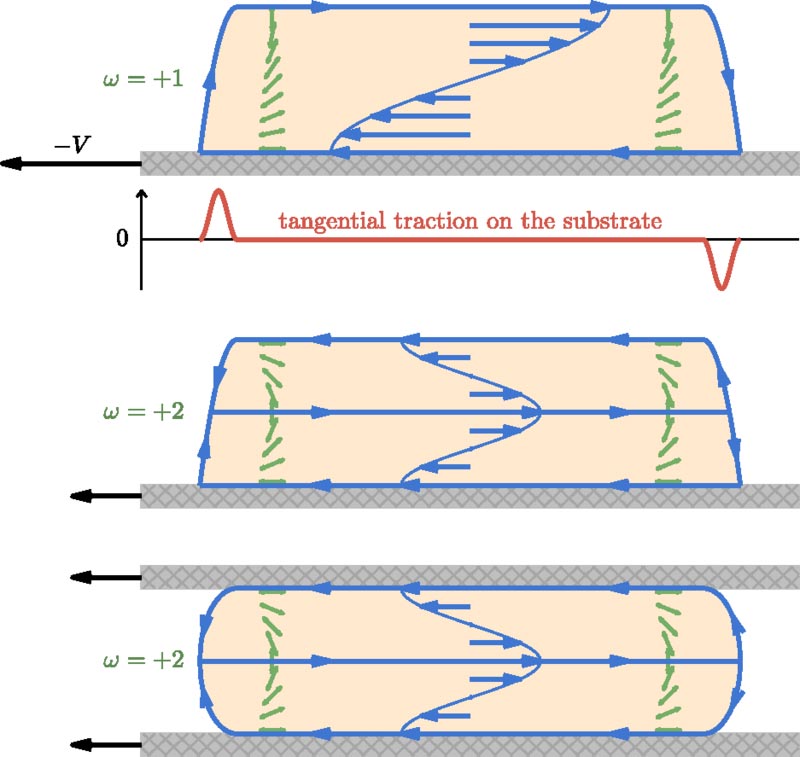
    Tractionless self-propulsion of an active drop. A drop with active stresses σaij=−αninj propels itself (here rightward) at velocity V, given by Eq. (1), without exerting any tangential traction on the substrate (except locally at its edges: this local traction is solely due to surface tension acting to maintain the drop shape). The winding number ω, defined as the number of quarter turns of the director n (green rods) across the drop height, controls the number of fluid circulation cells inside the drop. The internal velocity profile (blue arrows) in the comoving frame of reference is ux=−Vcos(ωπz/H), with z being the distance to the substrate, and yields a tank-treading type of motion. The solution obtained for |ω|=2 also allows propulsion in a confined geometry. Credit: American Physical Society, A. Loisy, J. Eggers, and T. Liverpool, University of Bristol

    They found that self-propulsion without traction (local force on the surrounding environment) is possible if you are made of “active” matter, as cells are. They describe how a drop of active matter can move itself forward in a narrow channel without exerting any force on the walls around it.

    Lead author, Dr. Aurore Loisy, said: “Tractionless motion is very counterintuitive. We became really excited when we realized that not only it is possible, but also that it provides a plausible explanation to a problem as important as cell motility in tissues.

    “Besides, part of the beauty of this tractionless self-propulsion lies in the fact that it is described by an analytical solution of remarkable and unusual simplicity. Due to the complexity (nonlinearity) of the equations that describe active matter, we did not expect to end up with something so simple!”

    Active matter is a special kind of matter, ubiquitous in biology, in which metabolic energy is constantly converted into mechanical energy. This ability to generate mechanical forces internally, in the bulk, is what allows the drop to move without exerting forces at its boundaries (the walls).

    Dr. Loisy added: “A drop of active matter moving through tiny gaps is a minimal model to understand cell motility in tissues, which are crowded environments with intricate geometries.

    “The mechanism we discovered provides a possible explanation to the open question of how cells move in those environments. Such motility is crucial to a multitude of physiological processes in living organisms, including immune response and wound healing, and its deregulation is key to cancer dissemination (metastasis).”

    The next step is to observe this phenomenon experimentally, using a drop of cell extracts in a specifically engineered microchannel.

    Reference: “Tractionless Self-Propulsion of Active Drops” by Aurore Loisy, Jens Eggers and Tanniemola B. Liverpool, 13 December 2019, Physical Review Letters.
    DOI: 10.1103/PhysRevLett.123.248006

    Never miss a breakthrough: Join the SciTechDaily newsletter.
    Follow us on Google and Google News.

    Mathematics University of Bristol
    Share. Facebook Twitter Pinterest LinkedIn Email Reddit

    Related Articles

    Quantum Tunneling Explained With 40-Year-Old Mathematical Discovery

    Ingenious New Method Measures the 3D Position of Individual Atoms

    The Limits of Math: Study Shows Forests Are More Complex Than Thought

    Revolutionizing Physics With a Game-Changing Topological Approach

    Breaking Physics: The Unlikely Twist in Feynman’s Sprinkler Problem

    Scientists Use Machine Learning To Unravel Mysteries of Atomic Shapes

    Hopfions Unveiled: The 3D Spin Structures Set to Spin Up Future Tech

    Bridging the Chasm Between Quantum Physics and the Theory of Gravity – “We Have Found a Surprisingly Simple Solution”

    Physicists Predict Properties of Prime Numbers from Freezing Liquids

    Leave A Reply Cancel Reply

    • Facebook
    • Twitter
    • Pinterest
    • YouTube

    Don't Miss a Discovery

    Subscribe for the Latest in Science & Tech!

    Trending News

    Popular Sugar-Free Sweetener Linked to Liver Disease, Study Warns

    What Is Hantavirus? The Deadly Disease Raising Alarm Worldwide

    Scientists Just Discovered How the Universe Builds Monster Black Holes

    Scientists Unveil New Treatment Strategy That Could Outsmart Cancer

    A Simple Vitamin May Hold the Key to Treating Rare Genetic Diseases

    Scientists Think the Real Fountain of Youth May Be Hiding in Your Gut

    Ravens Don’t Follow Wolves, They Predict Them

    This Common Knee Surgery May Be Doing More Harm Than Good

    Follow SciTechDaily
    • Facebook
    • Twitter
    • YouTube
    • Pinterest
    • Newsletter
    • RSS
    SciTech News
    • Biology News
    • Chemistry News
    • Earth News
    • Health News
    • Physics News
    • Science News
    • Space News
    • Technology News
    Recent Posts
    • Why Are So Many New Fathers Dying? Scientists Say the U.S. Has a Dangerous Blind Spot
    • Scientists Identify Simple Supplement That Greatly Reduces Alzheimer’s Damage
    • You May Have a Dangerous Type of Cholesterol Even if Your Tests Look Normal
    • Study Reveals Dangerous Flaw in AI Symptom Checkers
    • New MRI Breakthrough Captures Stunningly Clear Images of the Eye and Brain
    Copyright © 1998 - 2026 SciTechDaily. All Rights Reserved.
    • Science News
    • About
    • Contact
    • Editorial Board
    • Privacy Policy
    • Terms of Use

    Type above and press Enter to search. Press Esc to cancel.