

Close Menu
    Facebook X (Twitter) Instagram
    SciTechDaily
    • Biology
    • Chemistry
    • Earth
    • Health
    • Physics
    • Science
    • Space
    • Technology
    Facebook X (Twitter) Pinterest YouTube RSS
    SciTechDaily
    Home»Technology»DNA Origami Enables Fabricating Superconducting Nanowires for Nanoelectronic Circuits of the Future
    Technology

    DNA Origami Enables Fabricating Superconducting Nanowires for Nanoelectronic Circuits of the Future

    By American Institute of PhysicsFebruary 20, 2021No Comments4 Mins Read
    Facebook Twitter Pinterest Telegram LinkedIn WhatsApp Email Reddit
    Share
    Facebook Twitter LinkedIn Pinterest Telegram Email Reddit
    Futuristic Circuits Concept
    Researchers utilize DNA origami as a platform for constructing superconducting nanoarchitectures.

    Fabricating nanoelectronic circuits of the future just got a lot more interesting, thanks to DNA origami.

    The quest for ever-smaller electronic components led an international group of researchers to explore using molecular building blocks to create them. DNA is able to self-assemble into arbitrary structures, but the challenge with using these structures for nanoelectronic circuits is the DNA strands must be converted into highly conductive wires.

    Inspired by previous works using the DNA molecule as a template for superconducting nanowires, the group took advantage of a recent bioengineering advance known as DNA origami to fold DNA into arbitrary shapes.

    In AIP Advances, from AIP Publishing, researchers from Bar-Ilan University, Ludwig-Maximilians-Universität München, Columbia University, and Brookhaven National Laboratory describe how to exploit DNA origami as a platform to build superconducting nanoarchitectures. The structures they built are addressable with nanometric precision that can be used as a template for 3D architectures that are not possible today via conventional fabrication techniques.
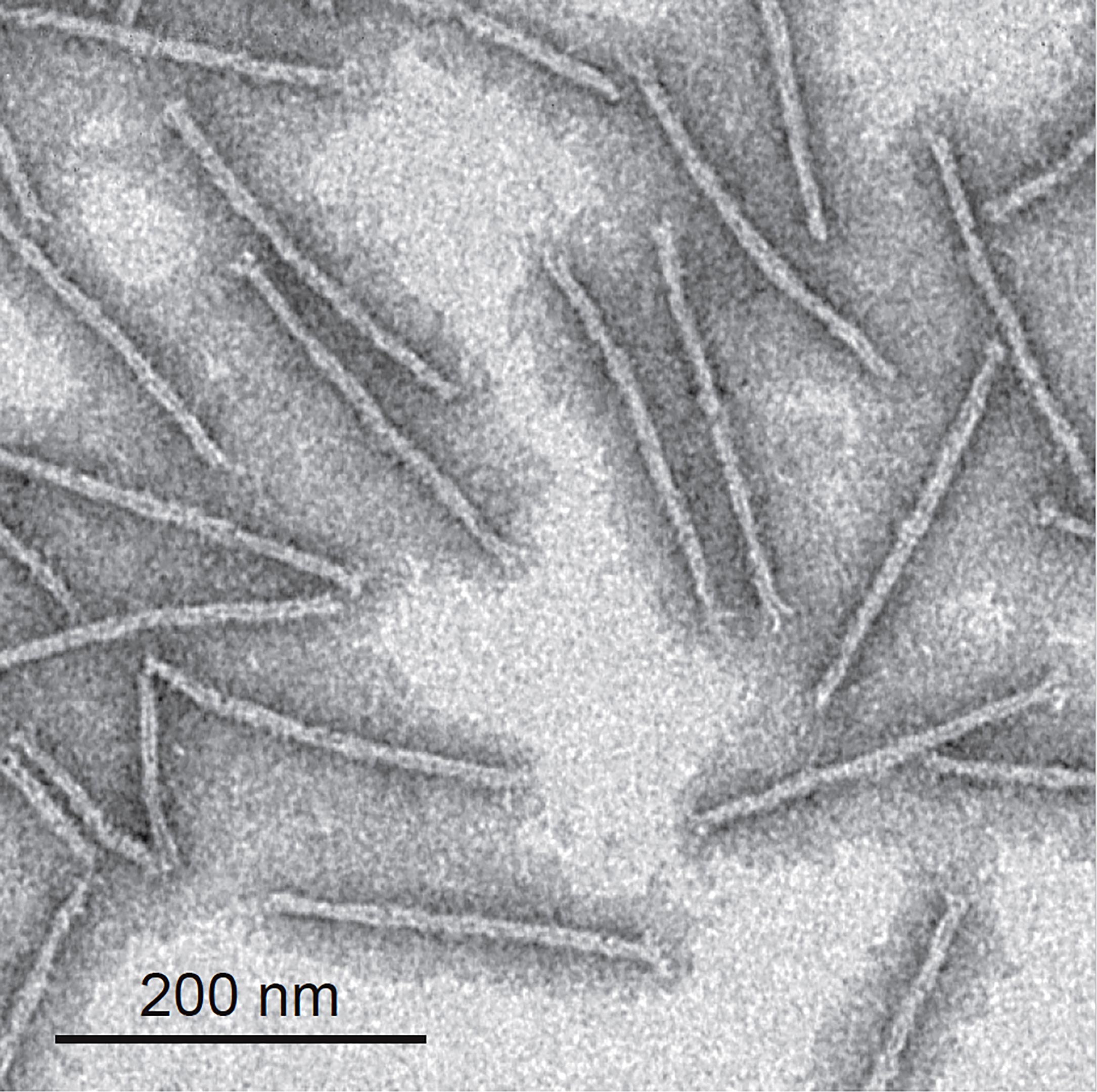
    DNA Origami Wires
    Using DNA origami as a platform to build superconducting nanoarchitectures. Transmission electron microscopy (TEM) image of DNA origami wires before the coating. Credit: Lior Shani, Philip Tinnefeld, Yafit Fleger, Amos Sharoni, Boris Shapiro, Avner Shaulov, Oleg Gang, and Yosef Yeshurun

    Multidisciplinary Fabrication Approach

    The group’s fabrication process involves a multidisciplinary approach, namely the conversion of the DNA origami nanostructures into superconducting components. And the preparation process of DNA origami nanostructures involves two major components: a circular single-strand DNA as the scaffold, and a mix of complementary short strands acting as staples that determine the shape of the structure.

    “In our case, the structure is an approximately 220-nanometer-long and 15-nanometer-wide DNA origami wire,” said Lior Shani, of Bar-Ilan University in Israel. “We dropcast the DNA nanowires onto a substrate with a channel and coat them with superconducting niobium nitride. Then we suspend the nanowires over the channel to isolate them from the substrate during the electrical measurements.”

    Creating Superconducting Nanoarchitectures

    The group’s work shows how to exploit the DNA origami technique to fabricate superconducting components that can be incorporated into a wide range of architectures.

    Niobium Nitrate-Coated DNA Nanowire
    Using DNA origami as a platform to build superconducting nanoarchitectures. (left) Schematic illustration of a niobium nitrate-coated DNA nanowire suspended above a silicon nitride/silicon oxide channel. (right) High-resolution scanning electron microscope (HR-SEM) image of the channel (black in image) on which the DNA nanowire is suspended. In the image, the channel appears discontinuous, reflecting the DNA suspended across it (marked by dashed orange rectangle). The distance between the two sides of the channel is ~50 nanometers, and the width of the niobium nitrate-coated nanowire at its narrowest point is ~25 nanometers. Credit: Lior Shani, Philip Tinnefeld, Yafit Fleger, Amos Sharoni, Boris Shapiro, Avner Shaulov, Oleg Gang, and Yosef Yeshurun

    “Superconductors are known for running an electric current flow without dissipations,” said Shani. “But superconducting wires with nanometric dimensions give rise to quantum fluctuations that destroy the superconducting state, which results in the appearance of resistance at low temperatures.”

    By using a high magnetic field, the group suppressed these fluctuations and reduced about 90% of the resistance.

    “This means that our work can be used in applications like interconnects for nanoelectronics and novel devices based on exploitation of the flexibility of DNA origami in fabrication of 3D superconducting architectures, such as 3D magnetometers,” said Shani.

    Reference: “DNA origami based superconducting nanowires” by Lior Shani, Philip Tinnefeld, Yafit Fleger, Amos Sharoni, Boris Ya. Shapiro, Avner Shaulov, Oleg Gang and Yosef Yeshurun, 19 January 2021, AIP Advances.
    DOI: 10.1063/5.0029781

    Never miss a breakthrough: Join the SciTechDaily newsletter.
    Follow us on Google and Google News.

    American Institute of Physics Biophysics DNA Electrical Engineering Nanotechnology Superconductivity
    Share. Facebook Twitter Pinterest LinkedIn Email Reddit

    Related Articles

    The Next Frontier: DNA Emerges as a Powerhouse for Data Storage and Computing

    Quantum Transformation: TiS3 Nanoribbons Become Superconductors Under Pressure

    Improving Lithium-Ion Battery Performance, Cell Lifetime for Renewable Energy Applications

    Making 3D Superconducting Nanostructures With DNA

    Powerful Photon-Based Processing Units Enable Complex Artificial Intelligence

    First Electron Microscope Image of DNA Double Helix

    Cancer-Fighting DNA Nanorobots Could Target Specific Cells for Repair

    Amplifier Chip Measures Nanopores With High Speed Precision

    Researchers Develop DNA Nanorobot to Seek Specific Cell Targets

    Leave A Reply Cancel Reply

    • Facebook
    • Twitter
    • Pinterest
    • YouTube

    Don't Miss a Discovery

    Subscribe for the Latest in Science & Tech!

    Trending News

    Scientists Discover Game-Changing New Way To Treat High Cholesterol

    This Small Change to Your Exercise Routine Could Be the Secret to Living Longer

    Scientists Discover 430,000-Year-Old Wooden Tools, Rewriting Human History

    AI Could Detect Early Signs of Alzheimer’s in Under a Minute – Far Before Traditional Tests

    What if Dark Matter Has Two Forms? Bold New Hypothesis Could Explain a Cosmic Mystery

    This Metal Melts in Your Hand – and Scientists Just Discovered Something Strange

    Beef vs. Chicken: Surprising Results From New Prediabetes Study

    Alzheimer’s Breakthrough: Scientists Discover Key Protein May Prevent Toxic Protein Clumps in the Brain

    Follow SciTechDaily
    • Facebook
    • Twitter
    • YouTube
    • Pinterest
    • Newsletter
    • RSS
    SciTech News
    • Biology News
    • Chemistry News
    • Earth News
    • Health News
    • Physics News
    • Science News
    • Space News
    • Technology News
    Recent Posts
    • Revolutionary Imaging Technique Unlocks Secrets of Matter at Extreme Speeds
    • Where Does Mass Come From? Scientists Find Evidence of a New Exotic Nuclear State
    • Quantum Breakthrough: Unhackable Keys Sent Over 120 km Using Quantum Dots
    • Researchers Discover Unknown Beetle Species Just Steps From Their Lab
    • Jellyfish Caught Feasting on Exploding Sea Worms for the First Time
    Copyright © 1998 - 2026 SciTechDaily. All Rights Reserved.
    • Science News
    • About
    • Contact
    • Editorial Board
    • Privacy Policy
    • Terms of Use

    Type above and press Enter to search. Press Esc to cancel.