
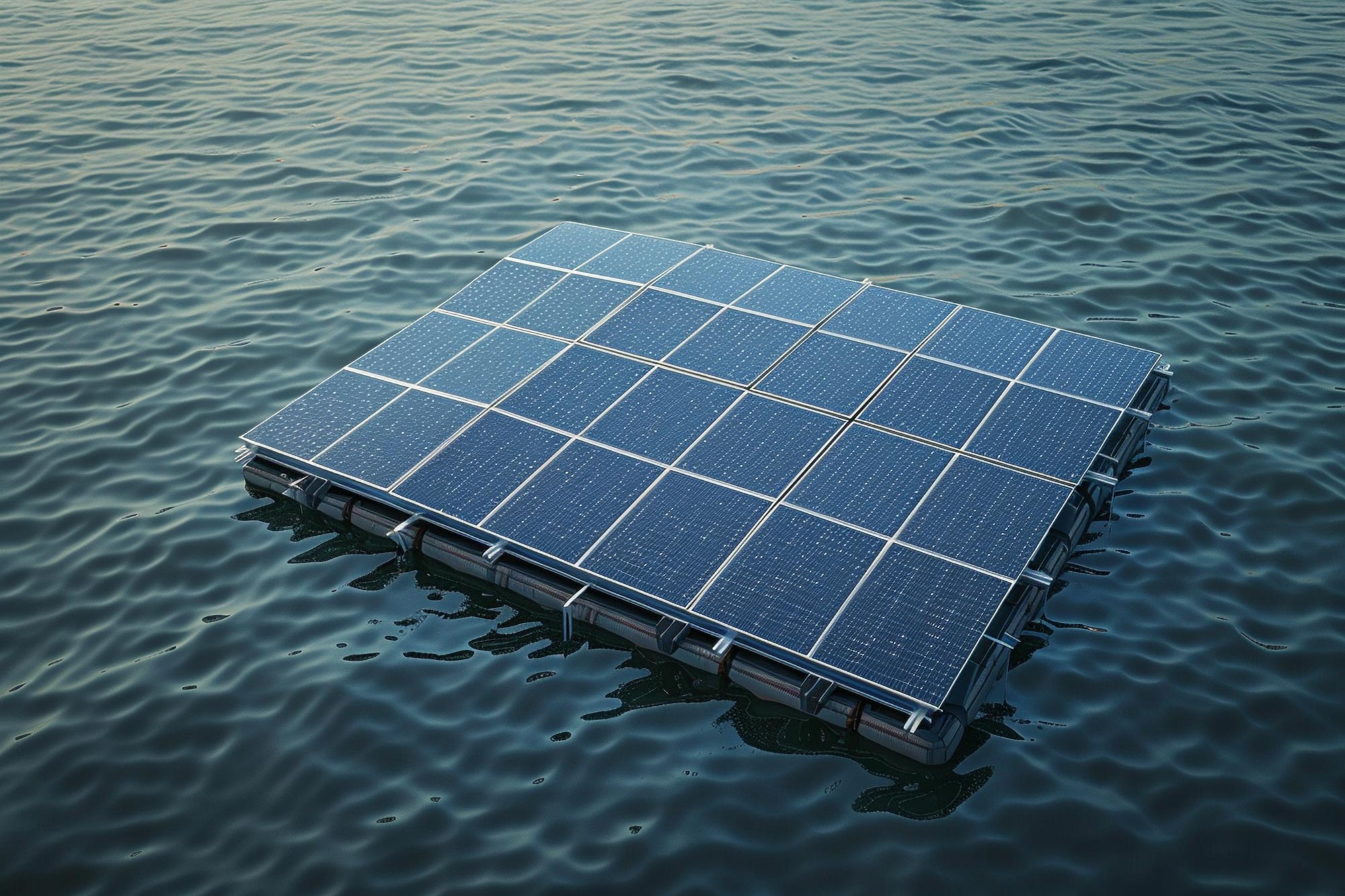
A new study reveals that federally managed reservoirs have the potential to generate enough energy to supply power to around 100 million U.S. homes annually.
Federal reservoirs have significant potential to support the nation’s solar energy needs, according to a new study published in Solar Energy.
Researchers Evan Rosenlieb and Marie Rivers, geospatial scientists at the U.S. Department of Energy’s National Renewable Energy Laboratory (NREL), along with Aaron Levine, a senior legal and regulatory analyst at NREL, conducted the first detailed assessment of how much energy could be produced by installing floating solar panel systems on federally owned or regulated reservoirs. Developers can access specific information about each reservoir on the AquaPV website.
The findings reveal a remarkable opportunity: these reservoirs could accommodate enough floating solar panels to generate up to 1,476 terawatt-hours of electricity annually—enough to power roughly 100 million homes each year.
“That’s a technical potential,” Rosenlieb said, meaning the maximum amount of energy that could be generated if each reservoir held as many floating solar panels as possible. “We know we’re not going to be able to develop all of this. But even if you could develop 10% of what we identified, that would go a long way.”
Challenges and Future Considerations
Levine and Rosenlieb have yet to consider how human and wildlife activities might impact floating solar energy development on specific reservoirs. But they plan to address this limitation in future work.
This study provides far more accurate data on floating solar power’s potential in the United States. And that accuracy could help developers more easily plan projects on U.S. reservoirs and help researchers better assess how these technologies fit into the country’s broader energy goals.
Floating solar panels, also known as floating PV, come with many benefits: Not only do these buoyed power plants generate electricity, but they do so without competing for limited land. They also shade and cool bodies of water, which helps prevent evaporation and conserves valuable water supplies.
“But we haven’t seen any large-scale installations, like at a large reservoir,” Levine said. “In the United States, we don’t have a single project over 10 megawatts.”
Assessing Reservoir Suitability for Floating Solar
Previous studies have tried to quantify how much energy the country could generate from floating solar panels. But Levine and Rosenlieb are the first to consider which water sources have the right conditions to support these kinds of power plants.
In some reservoirs, for example, shipping traffic causes wakes that could damage the mooring lines or impact the float infrastructure. Others get too cold, are too shallow, or have sloping bottoms that are too steep to secure solar panels in place.
And yet, some hydropower reservoirs could be ideal locations for floating solar power plants. A hybrid energy system that relies on both solar energy and hydropower could provide more reliable and resilient energy to the power grid. If, for example, a drought depletes a hydropower facility’s reservoir, solar panels could generate energy while the facility pauses to allow the water to replenish.
And, to build new pumped storage hydropower projects—which pump water from one reservoir to another at a higher elevation to store and generate energy as needed—some developers create entirely new bodies of water. These new reservoirs are disconnected from naturally flowing rivers, and no human or animal depends on them for recreation, habitat, or food (at least not yet).
In the future, the researchers plan to review which locations are close to transmission lines or electricity demand, how much development might cost at specific sites, whether a site should be avoided to protect the local environment, and how developers can navigate state and federal regulations. The team would also like to evaluate even more potential locations, including other, smaller reservoirs, estuaries, and even ocean sites.
Reference: “Floating photovoltaic technical potential: A novel geospatial approach on federally controlled reservoirs in the United States” by Evan Rosenlieb, Marie Rivers and Aaron Levine, 22 December 2024, Solar Energy.
DOI: 10.1016/j.solener.2024.113177
The research was funded by the Solar Energy Technologies Office and the Water Power Technologies Office in DOE’s Office of Energy Efficiency and Renewable Energy (EERE).
Access the study to learn more about the immense potential for floating solar plants in the United States, or visit AquaPV to dig into the data on specific reservoirs.
Never miss a breakthrough: Join the SciTechDaily newsletter.
Follow us on Google and Google News.
9 Comments
See, you lost me at “federally managed.”
Very interesting- way behind where do I go to begin understanding?
You mean like they did in Gaza? https://amp.cnn.com/cnn/2024/05/28/politics/us-gaza-pier-broken-apart
It would be great is there was any form of critical thinking left in this world.
Been advocating for this for over 2 decades for enhancing/value adding inland freshwater open floating pen fisheries that would use Minute amount of the energy to run hopper feeders as well solar bug zappers to teach game fish resilancy and survivorship, lessen feed dependency! As well manage effluent for additional value added product (fish emulsion) by filtering water from bottom to surface to additionally provide support for cold water loving fish is critical component that the solar shade supports!! Healthier and tastier fish that would take well to beyond sustainable aquaculturing for stocking programs and fishfarm to table next level whos ready?!?!
Gaza? You mean out on an unprotected ocean coast line, not a reservoir? Do your homework, you don’t know what you are talking about!
So on average you get sunlight 9-11 hrs a day that could generate electricity with about 60% of that being optimum. Not really solving the problem of needing power around the clock.
Yes, when all is said and done, it is still intermittent power.
I suspect that migrating birds will like the floating islands. Who gets the job of cleaning off all the white ‘residue?’
How about using batteries there Jimbo? Wow
How about using batteries there Jimbo? Wow