
Close Menu
    Facebook X (Twitter) Instagram
    SciTechDaily
    • Biology
    • Chemistry
    • Earth
    • Health
    • Physics
    • Science
    • Space
    • Technology
    Facebook X (Twitter) Pinterest YouTube RSS
    SciTechDaily
    Home»Technology»Predicting Semiconductor Solar Cell Performance From Terahertz and Microwave Spectroscopy
    Technology

    Predicting Semiconductor Solar Cell Performance From Terahertz and Microwave Spectroscopy

    By Helmholtz-Zentrum BerlinMarch 4, 2022No Comments3 Mins Read
    Facebook Twitter Pinterest Telegram LinkedIn WhatsApp Email Reddit
    Share
    Facebook Twitter LinkedIn Pinterest Telegram Email Reddit
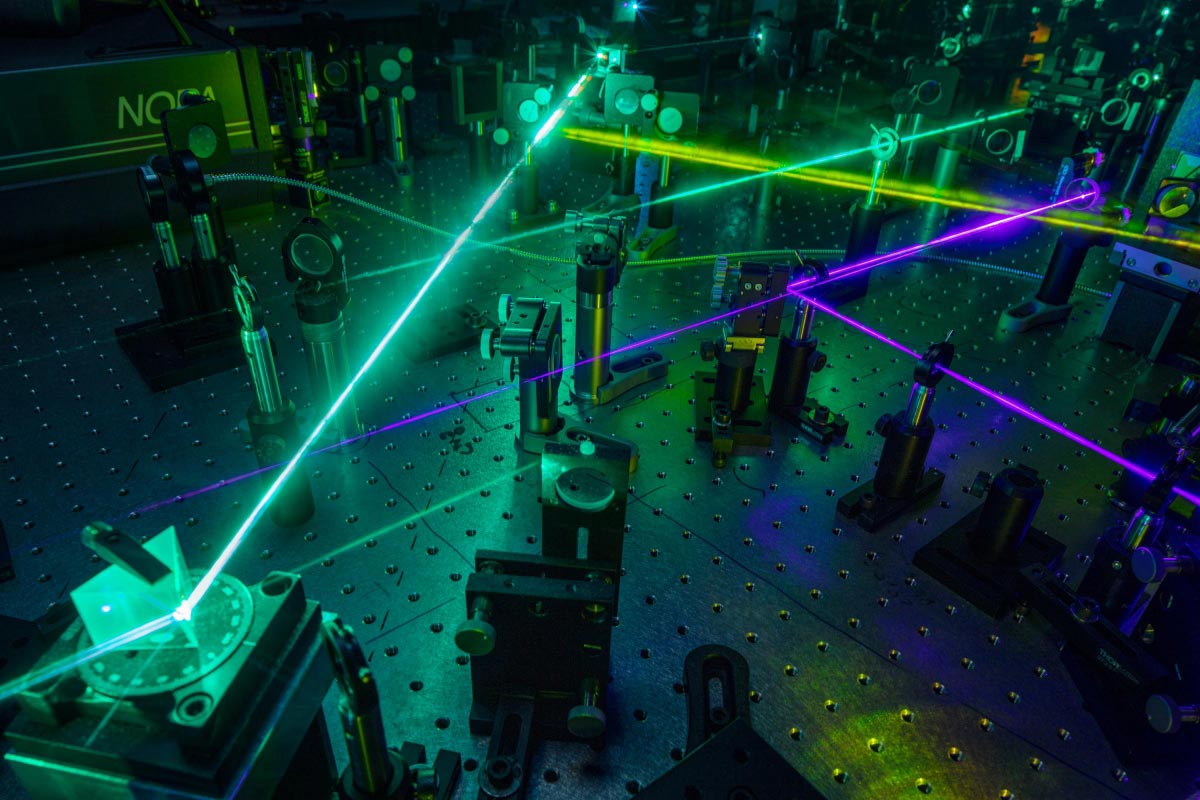
    Femtosecond Laser Laboratory
    In the femtosecond laser laboratory of Dr. Dennis Friedrich at HZB, the transport properties of semiconductors can be determined using terahertz or microwave spectroscopy. For this purpose, a laser light pulse first excites the charge carriers in the material, which are then irradiated with electromagnetic waves (either THz or Microwave) and absorb some of them. Credit: HZB

    Improved measurement techniques for semiconductors allow for better solar cell efficiency predictions and faster evaluation of new materials.

    Many semiconducting materials are possible candidates for solar cells. In recent years, perovskite semiconductors in particular have attracted attention, as they are both inexpensive and easy to process and enable high efficiencies. Now a study with 15 participating research institutions shows how terahertz (TRTS) and microwave spectroscopy (TRMC) can be used to reliably determine the mobility and lifetime of the charge carriers in new semiconducting materials. Using these measurement data it is possible to predict the potential efficiency of the solar cell in advance and to classify the losses in the finished cell.

    The most important properties of a semiconductor to be used as a solar cell include the mobility and lifetime of electrons and “holes.” Both quantities can be measured without contacts with spectroscopic methods using terahertz or microwave radiation. However, measurement data found in literature often differ by order of magnitude. This has made it difficult to use them for reliable assessments of material quality.

    Reference Samples Measured

    “We wanted to get to the bottom of these differences, and contacted experts from a total of 15 international laboratories to analyze typical sources of error and problems with the measurements,” says Dr. Hannes Hempel from the HZB team led by Dr. Thomas Unold. The HZB physicists sent reference samples produced by the team of Dr. Martin Stolterfoht at University Potsdam to each laboratory with the perovskite semiconductor compound (Cs,FA,MA)Pb(I,Br)3) optimized for stability.

    Better Data for Better Prediction

    One result of the joint work is the significantly more precise determination of the transport properties with terahertz or microwave spectroscopy. “We could identify some neuralgic points that have to be considered before the actual measurements take place, which allows us to arrive at a significantly better agreement of the results,” Hempel emphasizes.

    Another result of the study: With reliable measurement data and a more advanced analysis, the characteristics of the solar cell can also be calculated more precisely. “We believe that this analysis is of great interest for photovoltaic research, because it predicts the maximum possible efficiency of the material in a solar cell and reveals the influence of various loss mechanisms, such as transport barriers,” says Unold. This applies not only to the material class of perovskite semiconductors, but also to other new semiconducting materials, which can thus be tested more quickly for their potential suitability.

    Reference: “Predicting Solar Cell Performance from Terahertz and Microwave Spectroscopy” by Hannes Hempel, Tom J. Savenjie, Martin Stolterfoht, Jens Neu, Michele Failla, Vaisakh C. Paingad, Petr Kužel, Edwin J. Heilweil, Jacob A. Spies, Markus Schleuning, Jiashang Zhao, Dennis Friedrich, Klaus Schwarzburg, Laurens D.A. Siebbeles, Patrick Dörflinger, Vladimir Dyakonov, Ryuzi Katoh, Min Ji Hong, John G. Labram, Maurizio Monti, Edward Butler-Caddle, James Lloyd-Hughes, Mohammad M. Taheri, Jason B. Baxter, Timothy J. Magnanelli, Simon Luo, Joseph M. Cardon, Shane Ardo and Thomas Unold, 26 February 2022, Advanced Energy Materials.
    DOI: 10.1002/aenm.202102776

    Never miss a breakthrough: Join the SciTechDaily newsletter.
    Follow us on Google and Google News.

    Energy Helmholtz-Zentrum Berlin Perovskite Solar Cell Photovoltaics Semiconductors Solar Cells Solar Energy
    Share. Facebook Twitter Pinterest LinkedIn Email Reddit

    Related Articles

    Innovative Technology Offers Big Performance Boost to Perovskite–Silicon Tandem Solar Cells

    New Materials Enable Cheaper Solar Cells That Are Easier To Make

    Researchers Set New World Record for Solar Cell Efficiency

    Solar Modules With a Marble Look for House Facades

    Templating Approach Stabilizes “Ideal” Perovskite Material for Cheap, Efficient Solar Cells

    Solar Energy Breakthrough: Ultrathin Solar Cells Using 2D Perovskites Get a Boost

    Mystery of High Performing Novel Solar Cells Revealed in Stunning Clarity

    A Sunny Outlook for Solar: New Research Demonstrates Great Promise for Improving Solar Cell Efficiency

    World Record: Perovskite/Silicon Tandem Solar Cells on the Magic Threshold of 30% Efficiency

    Leave A Reply Cancel Reply

    • Facebook
    • Twitter
    • Pinterest
    • YouTube

    Don't Miss a Discovery

    Subscribe for the Latest in Science & Tech!

    Trending News

    Even Occasional Binge Drinking May Triple Liver Damage Risk

    Liftoff! NASA’s Artemis II Launch Sends Astronauts Around the Moon for First Time in 50 Years

    Scientists Discover New Way To Eliminate “Zombie Cells” Driving Aging

    This New Quantum Theory Could Change Everything We Know About the Big Bang

    This One Vitamin May Help Protect Your Brain From Dementia Years Later

    Stopping Weight-Loss Drugs Like Ozempic Can Quickly Erase Heart Benefits

    A 500-Million-Year-Old Surprise Is Forcing Scientists to Rethink Spider Evolution

    Coffee and Blood Pressure: What You Need To Know Before Your Next Cup

    Follow SciTechDaily
    • Facebook
    • Twitter
    • YouTube
    • Pinterest
    • Newsletter
    • RSS
    SciTech News
    • Biology News
    • Chemistry News
    • Earth News
    • Health News
    • Physics News
    • Science News
    • Space News
    • Technology News
    Recent Posts
    • NASA’s Artemis II: Humans Just Left Earth Orbit for the First Time Since 1972
    • What Causes Chronic Pain? Scientists Identify Key Culprit in the Brain
    • Semaglutide Shows Surprising Mental Health Benefits in Massive 100,000-Person Study
    • This Little-Known Japanese Fruit Could Help Stop Lung Cancer Before It Starts
    • Scientists Uncover Giant Lava Fields From an Active Underwater Volcano
    Copyright © 1998 - 2026 SciTechDaily. All Rights Reserved.
    • Science News
    • About
    • Contact
    • Editorial Board
    • Privacy Policy
    • Terms of Use

    Type above and press Enter to search. Press Esc to cancel.