
Close Menu
    Facebook X (Twitter) Instagram
    SciTechDaily
    • Biology
    • Chemistry
    • Earth
    • Health
    • Physics
    • Science
    • Space
    • Technology
    Facebook X (Twitter) Pinterest YouTube RSS
    SciTechDaily
    Home»Physics»Does a Quantum State Collapse Instantly During a Measurement? Scientists “Film” It to Find Out.
    Physics

    Does a Quantum State Collapse Instantly During a Measurement? Scientists “Film” It to Find Out.

    By Stockholm UniversityFebruary 28, 20201 Comment3 Mins Read
    Facebook Twitter Pinterest Telegram LinkedIn WhatsApp Email Reddit
    Share
    Facebook Twitter LinkedIn Pinterest Telegram Email Reddit
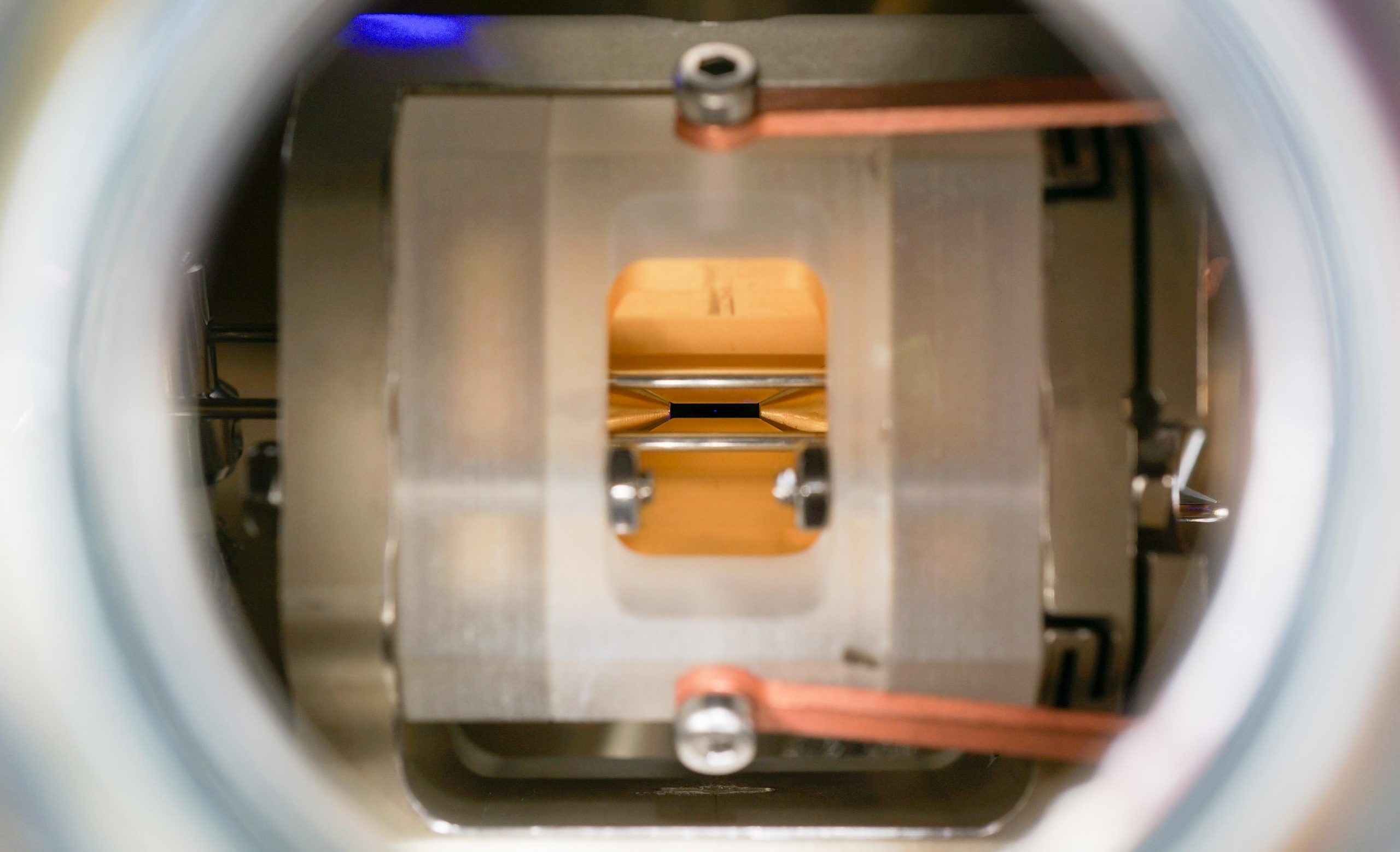
    Strontium Ion Trap
    Strontium ion trapped in an electric field. The measurement on the ion lasts only a millionth of a second. Credit: F. Pokorny et al.

    Quantum physics describes the inner world of individual atoms, a world very different from our everyday experience. One of the many strange yet fundamental aspects of quantum mechanics is the role of the observer — measuring the state of a quantum system causes it to change. Despite the importance of the measurement process within the theory, it still holds unanswered questions: Does a quantum state collapse instantly during a measurement? If not, how much time does the measurement process take and what is the quantum state of the system at any intermediate step?

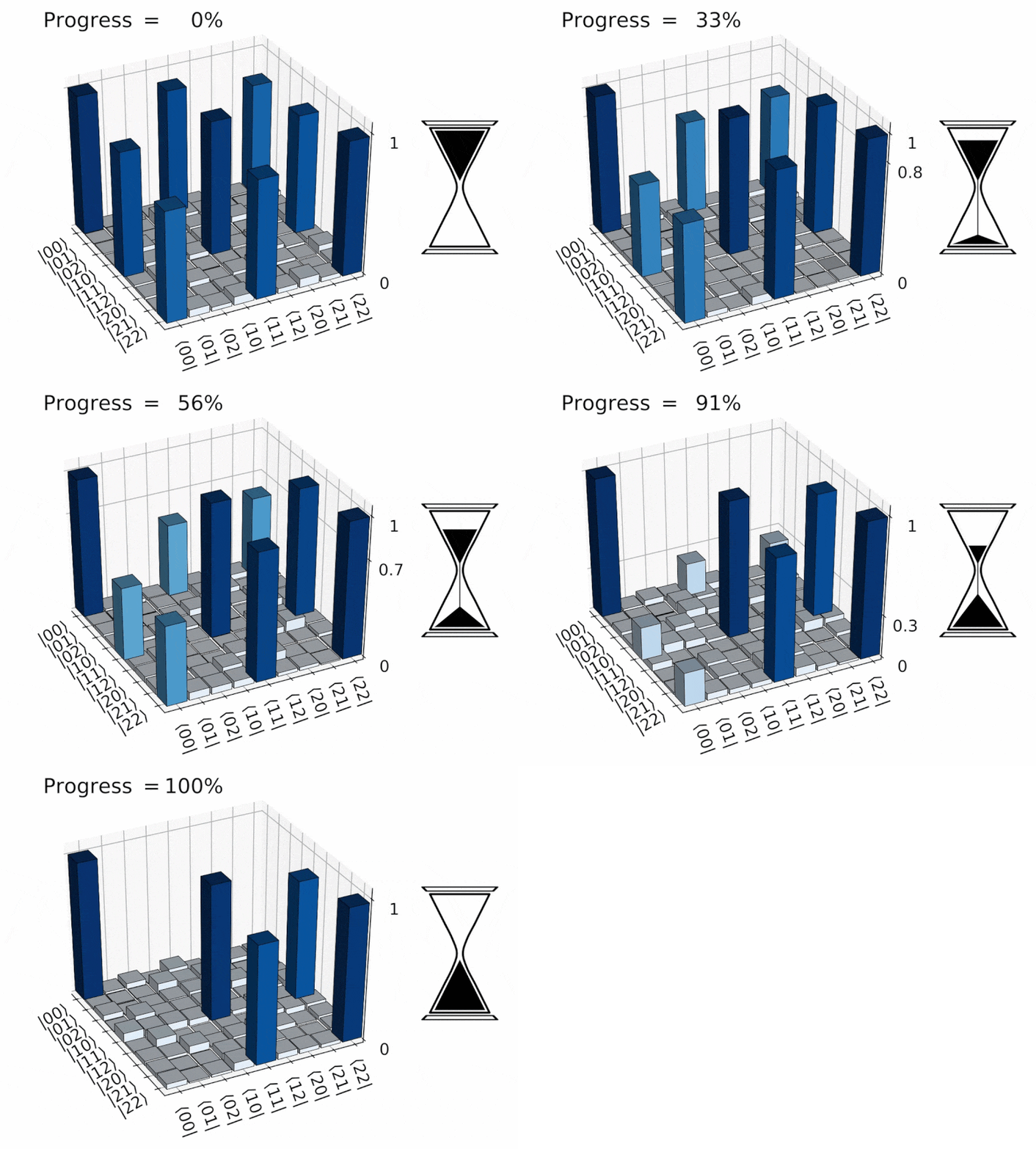
    A collaboration of researchers from Sweden, Germany, and Spain has answered these questions using a single atom — a strontium ion trapped in an electric field. The measurement on the ion lasts only a millionth of a second. By producing a “film” consisting of pictures taken at different times of the measurement they showed that the change of the state happens gradually under the measurement influence.
    Quantum Measurement
    The result of the experiment can be summarized in an animated GIF that shows what happens to the quantum state of the ion during that millionth of a second. The state can be visualized using a three-dimensional board. The heights of the bars indicate the degree of superposition of the possible quantum states. The film shows how during the measurement some of the superpositions are lost — and how this loss is gradual — while others are preserved as they should be in an ideal quantum measurement. Credit: F. Pokorny et al.,

    Atoms follow the laws of quantum mechanics which often contradict our normal expectations. The internal quantum state of an atom is formed by the state of the electrons circling around the atomic core. The electron can circle around the core in an orbit close or further away. Quantum mechanics, however, also allows so-called superposition states, where the electron occupies both orbits at once, but each orbit only with some probability.

    “Every time when we measure the orbit of the electron, the answer of the measurement will be that the electron was either in a lower or higher orbit, never something in between. This is true even when the initial quantum state was a superposition of both possibilities. The measurement in a sense forces the electron to decide in which of the two states it is,” says Fabian Pokorny, researcher at the Department of Physics, Stockholm University.

    The “film” displays the evolution during the measurement process. The individual pictures show tomography data where the height of the bars reveal the degree of superposition that is still preserved. During the measurement some of the superpositions are lost — and this loss happens gradually — while others are preserved as they should be for an ideal quantum measurement.

    “These findings shed new light onto the inner workings of nature and are consistent with the predictions of modern quantum physics,” says Markus Hennrich, group leader of the team in Stockholm.

    These results are also important beyond fundamental quantum theory. Quantum measurement are an essential part of quantum computers. The group at Stockholm University is working on computers based on trapped ions, where the measurements are used to read out the result at the end of a quantum calculation.

    Reference: “Tracking the Dynamics of an Ideal Quantum Measurement” by Fabian Pokorny, Chi Zhang, Gerard Higgins, Adán Cabello, Matthias Kleinmann and Markus Hennrich, 25 February 2020, Physical Review Letters.
    DOI: 10.1103/PhysRevLett.124.080401

    Never miss a breakthrough: Join the SciTechDaily newsletter.
    Follow us on Google and Google News.

    Particle Physics Popular Quantum Physics Stockholm University
    Share. Facebook Twitter Pinterest LinkedIn Email Reddit

    Related Articles

    Physicists Chart the ‘Secret’ Movement of Quantum Particles

    Physicists Make First Ever Measurement of Antiproton Interactions

    New CERN Study Suggests Subatomic Particles Could Defy the Standard Model

    Experiment Using Photons Could Detect Quantum-Scale Black Holes

    Photons Traverse Optical Obstacles as Both a Wave and Particle Simultaneously

    Physicists Use Cheap Colliders to Probe for Heavy Photons

    Quantum Interference Shown Experimentally in Larger Molecules

    Evidence of Elusive Majorana Fermions Raises Possibilities for Quantum Computing

    Higgs Boson Signals Gain Strength at Large Hadron Collider

    1 Comment

    1. Prof. David A. Edwards on February 29, 2020 4:33 am

      Nietzsche introduced the idea of perspectivism: in the final analysis, all we really have is a manifold of interlocking perspectives. For example, consider the following toy model. If humans are small finite, represent each possible human perspective by a small non-empty subset of {1,…,n} where n is a large natural number. Then, there are minimal perspectives, but no maximal human perspective. Still, there is an ideal finite perspective which sees everything! If n=infinity, then there is still an ideal infinite perspective which sees everything! (God’s eye-view!) If one accepts the standard quantum logic, then one has a manifold of perspectives which cannot-by Gleason’s Theorem-be embedded into any single perspective! There are now maximal perspectives, but no universal perspective!

      http://alpha.math.uga.edu/~davide/

      Reply
    Leave A Reply Cancel Reply

    • Facebook
    • Twitter
    • Pinterest
    • YouTube

    Don't Miss a Discovery

    Subscribe for the Latest in Science & Tech!

    Trending News

    Popular Sugar-Free Sweetener Linked to Liver Disease, Study Warns

    What Is Hantavirus? The Deadly Disease Raising Alarm Worldwide

    Scientists Just Discovered How the Universe Builds Monster Black Holes

    Scientists Unveil New Treatment Strategy That Could Outsmart Cancer

    A Simple Vitamin May Hold the Key to Treating Rare Genetic Diseases

    Scientists Think the Real Fountain of Youth May Be Hiding in Your Gut

    Ravens Don’t Follow Wolves, They Predict Them

    This Common Knee Surgery May Be Doing More Harm Than Good

    Follow SciTechDaily
    • Facebook
    • Twitter
    • YouTube
    • Pinterest
    • Newsletter
    • RSS
    SciTech News
    • Biology News
    • Chemistry News
    • Earth News
    • Health News
    • Physics News
    • Science News
    • Space News
    • Technology News
    Recent Posts
    • Why Are So Many New Fathers Dying? Scientists Say the U.S. Has a Dangerous Blind Spot
    • Scientists Identify Simple Supplement That Greatly Reduces Alzheimer’s Damage
    • You May Have a Dangerous Type of Cholesterol Even if Your Tests Look Normal
    • Study Reveals Dangerous Flaw in AI Symptom Checkers
    • New MRI Breakthrough Captures Stunningly Clear Images of the Eye and Brain
    Copyright © 1998 - 2026 SciTechDaily. All Rights Reserved.
    • Science News
    • About
    • Contact
    • Editorial Board
    • Privacy Policy
    • Terms of Use

    Type above and press Enter to search. Press Esc to cancel.