
Close Menu
    Facebook X (Twitter) Instagram
    SciTechDaily
    • Biology
    • Chemistry
    • Earth
    • Health
    • Physics
    • Science
    • Space
    • Technology
    Facebook X (Twitter) Pinterest YouTube RSS
    SciTechDaily
    Home»Biology»Drepanosaurus – A Small Reptile with a Rearsome Finger
    Biology

    Drepanosaurus – A Small Reptile with a Rearsome Finger

    By Jim Shelton, Yale UniversityOctober 3, 20161 Comment3 Mins Read
    Facebook Twitter Pinterest Telegram LinkedIn WhatsApp Email Reddit
    Share
    Facebook Twitter LinkedIn Pinterest Telegram Email Reddit
    Drepanosaurus a Cross between a Chameleon and an Anteater
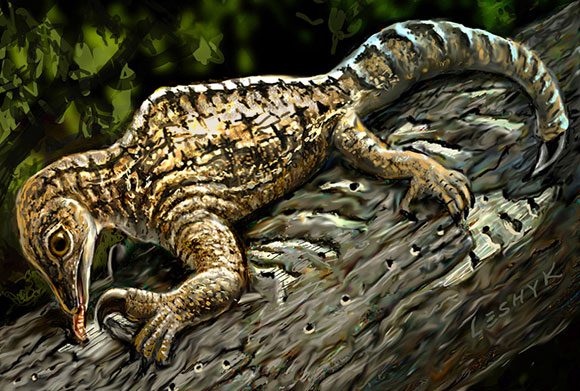
    In this illustration set 212 million years ago in what is today New Mexico, a Drepanosaurus rips away tree bark with its massive claw and powerful arm. (Painting by Victor Leshyk)

    A newly published study confirms that Drepanosaurus, a prehistoric cross between a chameleon and an anteater, was a small reptile with a fearsome finger. The second digit of its forelimb sported a massive claw.

    Scientists analyzed 212-million-year-old Drepanosaurus arm fossils that were discovered at the Hayden Quarry in Ghost Ranch, New Mexico. The researchers describe their findings in a paper in the September 29 edition of the journal Current Biology.

    Drepanosaurus is neither a dinosaur nor a lizard. It is a one- to two-foot-long (30 to 60-centimeter-long) reptile from an extinct group of animals called drepanosaurs, and shares a common ancestry with lizards, crocodiles, and dinosaurs. The only other known Drepanosaurus fossil was a badly crushed skeleton found in northern Italy more than 30 years ago.

    “This animal stretches the bounds of what we think can evolve in the limbs of four-footed animals,” said Adam Pritchard, a postdoctoral researcher at Yale and first author of the study. “Ecologically, Drepanosaurus seems to be a sort of chameleon-anteater hybrid, which is really bizarre for the time. It possesses a totally unique forelimb.”

    Four-limbed animals with a backbone are called tetrapods. In nearly all tetrapods, the forearm is made up of two, elongate and parallel bones — the radius and the ulna. These bones connect to a series of much shorter, wrist bones at the base of the hand.

    Drepanosaurus, however, has radius and ulna bones that are not parallel. Instead, the ulna is a flat, crescent-shaped bone. Also, the two wrist bones that meet the end of the ulna are long rather than short. They are longer than the radius, in fact.

    “The bone contacts suggest that the enlarged claw of Drepanosaurus could have been hooked into insect nests,” Pritchard said. “The entire arm could then have been powerfully retracted to tear open the nest. This motion is very similar to the hook-and-pull digging of living anteaters, which also eat insects.”

    Drepanosaurus also had grasping feet and a claw-like structure at the tip of its tail. The finding suggests that tetrapods developed specialized, modern ecological roles more than 200 million years ago.

    Pritchard is a postdoctoral fellow in the lab of Bhart-Anjan Bhullar in the Department of Geology and Geophysics at Yale. Co-authors of the study were Alan Turner of Stony Brook University, Randall Irmis of the University of Utah, Sterling Nesbitt of Virginia Polytechnic Institute and State University, and Nathan Smith of the Dinosaur Institute at the Natural History Museum of Los Angeles County.

    The research was funded by grants from the National Science Foundation. Other funding was provided by the National Geographic Society Committee for Research & Exploration. Fieldwork was conducted with the permission and support of the Ghost Ranch Conference Center.

    Reference: “Extreme Modification of the Tetrapod Forelimb in a Triassic Diapsid Reptile” by Adam C. Pritchard, Alan H. Turner, Randall B. Irmis, Sterling J. Nesbitt and Nathan D. Smith, 29 September 2016, Current Biology.
    DOI: 10.1016/j.cub.2016.07.084

    Never miss a breakthrough: Join the SciTechDaily newsletter.
    Follow us on Google and Google News.

    Archaeology Fossils Paleontology Yale University
    Share. Facebook Twitter Pinterest LinkedIn Email Reddit

    Related Articles

    Burnt Toast and Dinosaur Bones Have a Common Trait

    Finding the ‘Breath of Life’ in a Silurian Ostracod

    Fossils Reveal New Insight on Mesozoic Pollinating Insects

    Scientists Reveal the First Bird Beak, 3D Skull of Ichthyornis Dispar

    Paleontologists Identify a New Species of Prehistoric Reptile, Colobops Noviportensis

    ‘Bloat-and-Float’ Explains Dinosaur Fossil Mystery

    Tiny Jurassic Dinosaur Featured Rainbow Ruff and a Bony Crest

    Habelia Optata – A 508-Million-Year-Old Sea Creature

    Pentecopterus – A Giant Sea Scorpion from the Prehistoric Seas

    1 Comment

    1. Stoney Markham on September 7, 2021 9:24 am

      Title says “rearsome” instead of “fearsome”; could’ve been a whole different article. Dino-erotica anyone?

      Reply
    Leave A Reply Cancel Reply

    • Facebook
    • Twitter
    • Pinterest
    • YouTube

    Don't Miss a Discovery

    Subscribe for the Latest in Science & Tech!

    Trending News

    289-Million-Year-Old Reptile Mummy Reveals Origin of Human Breathing System

    New Brain Discovery Challenges Long-Held Theory of Teenage Brain Development

    Scientists Discover Plants “Scream” – We Just Couldn’t Hear Them Until Now

    Scientists Discover a Surprising Reason Intermittent Fasting Extends Life

    This Simple Fruit Wash Could Make Produce Safer and Last Days Longer

    Scientists Say Adding This Unusual Seafood to Your Diet Could Reverse Signs of Aging

    Scientists Say a Hidden Structure May Exist Inside Earth’s Core

    Doctors Surprised by the Power of a Simple Drug Against Colon Cancer

    Follow SciTechDaily
    • Facebook
    • Twitter
    • YouTube
    • Pinterest
    • Newsletter
    • RSS
    SciTech News
    • Biology News
    • Chemistry News
    • Earth News
    • Health News
    • Physics News
    • Science News
    • Space News
    • Technology News
    Recent Posts
    • Scientists Propose Radical New Way To Detect Alien Life – Without Traditional Biosignatures
    • Scientists Just Discovered Light Can Actually Slow Plant Growth
    • Scientists Finally Solved One of Water’s Biggest Mysteries
    • 7,000-Year-Old DNA Rewrites the Story of the “Neolithic Revolution”
    • Missing Medieval Relic of Legendary English King Found After Being Missing for 40 Years
    Copyright © 1998 - 2026 SciTechDaily. All Rights Reserved.
    • Science News
    • About
    • Contact
    • Editorial Board
    • Privacy Policy
    • Terms of Use

    Type above and press Enter to search. Press Esc to cancel.