
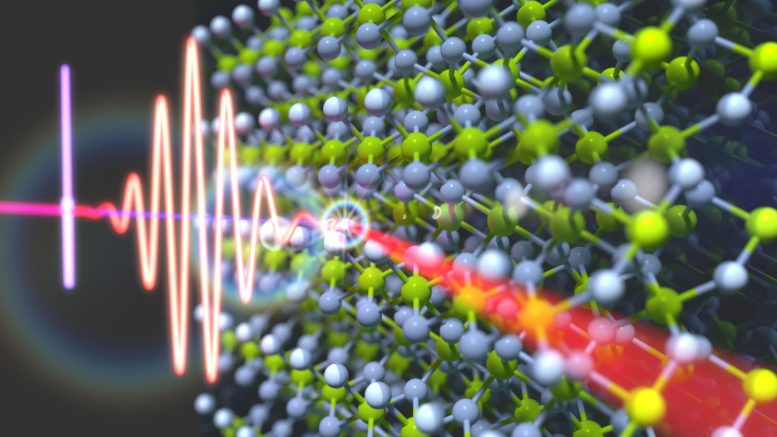
Excitons exhibit both atomic-like and solid-like behaviors when stimulated by light, revealing a new dual nature critical for future optoelectronic technologies.
Excitons are quasiparticles that can transport energy through solid substances. This makes them important for the development of future materials and devices — but more research is needed to understand their fundamental behavior and how to manipulate it. Researchers at Politecnico di Milano in collaboration with the Institute of Photonics and Nanotechnologies IFN-CNR and a theory group from the Tsukuba University (Japan) and the Max Plank Institute for the Structure and Dynamics of matter (Hamburg, Germany), have discovered that an exciton can simultaneously adopt two radically different characters when it is stimulated by light. Their work, published recently in Nature Communications, yields crucial new insights for current and future excitonics research.
Complexity of Many-Body Effects in Ultrafast Dynamics
Excitons consist of a negatively charged electron and a positively charged hole in solids. They are a so-called many-body-effect, produced by the interaction of many particles, especially when a strong light pulse hits the solid material. In the past decade, researchers have observed many-body-effects down to the unimaginably short attosecond time scale, in other words, billionths of a billionth of a second.
However, scientists have still not reached a fundamental understanding of excitons and other many-body effects due to the complexity of the ultrafast electron dynamics when many particles interact. The research team from Politecnico di Milano, the University of Tsukuba, and the Max Planck Institute for the Structure and Dynamics (MPSD) wanted to explore the light-induced ultrafast exciton dynamics in MgF2 single crystals by employing state-of-the-art attosecond transient reflection spectroscopy and microscopic theoretical simulations.
By combining these methods, the team discovered an entirely new property of excitons: The fact that they can simultaneously show atomic-like and solid-like characteristics. In excitons displaying an atomic character, the electrons and holes are tightly bound together by their Coulomb attraction — just like the electrons in atoms are bound by the nucleus. In excitons with a solid-like character, on the other hand, the electrons move more freely in solids, not unlike waves in the ocean.
“These are significant findings — says lead author Matteo Lucchini from the Politecnico di Milano — because understanding how excitons interact with light on these extreme time scales allows us to envision how to exploit their unique characteristics, fostering the establishment of a new class of electro-optical devices.”
Attosecond Experiment Reveals New Dynamics
During their attosecond experiment performed at the Attosecond Research Center (ARC) within the ERC project AuDACE (“Attosecond Dynamics in AdvanCed matErials”), the researchers managed to observe the sub-femtosecond dynamics of excitons for the first time, with signals consisting of slow and fast components. This phenomenon was explained with advanced theoretical simulations, adds co-author Shunsuke Sato from the MPSD and the University of Tsukuba: “Our calculations clarified that the slower component of the signal originates from the atomic-like character of the exciton while the faster component originates from the solid-like character — a ground-breaking discovery, which demonstrates the co-existence of the dual characters of excitons!”
This work opens up an important new avenue for the manipulation of excitonic as well as materials’ properties by light. It represents a major step towards the deep understanding of non-equilibrium electron dynamics in matter and provides the fundamental knowledge for the development of future ultrafast optoelectronic devices, electronics, optics, spintronics, and excitonics.
Reference: “Unravelling the intertwined atomic and bulk nature of localised excitons by attosecond spectroscopy” by Matteo Lucchini, Shunsuke A. Sato, Giacinto D. Lucarelli, Bruno Moio, Giacomo Inzani, Rocío Borrego-Varillas, Fabio Frassetto, Luca Poletto, Hannes Hübener, Umberto De Giovannini, Angel Rubio and Mauro Nisoli, 15 February 2021, Nature Communications.
DOI: 10.1038/s41467-021-21345-7
Never miss a breakthrough: Join the SciTechDaily newsletter.
Follow us on Google and Google News.