
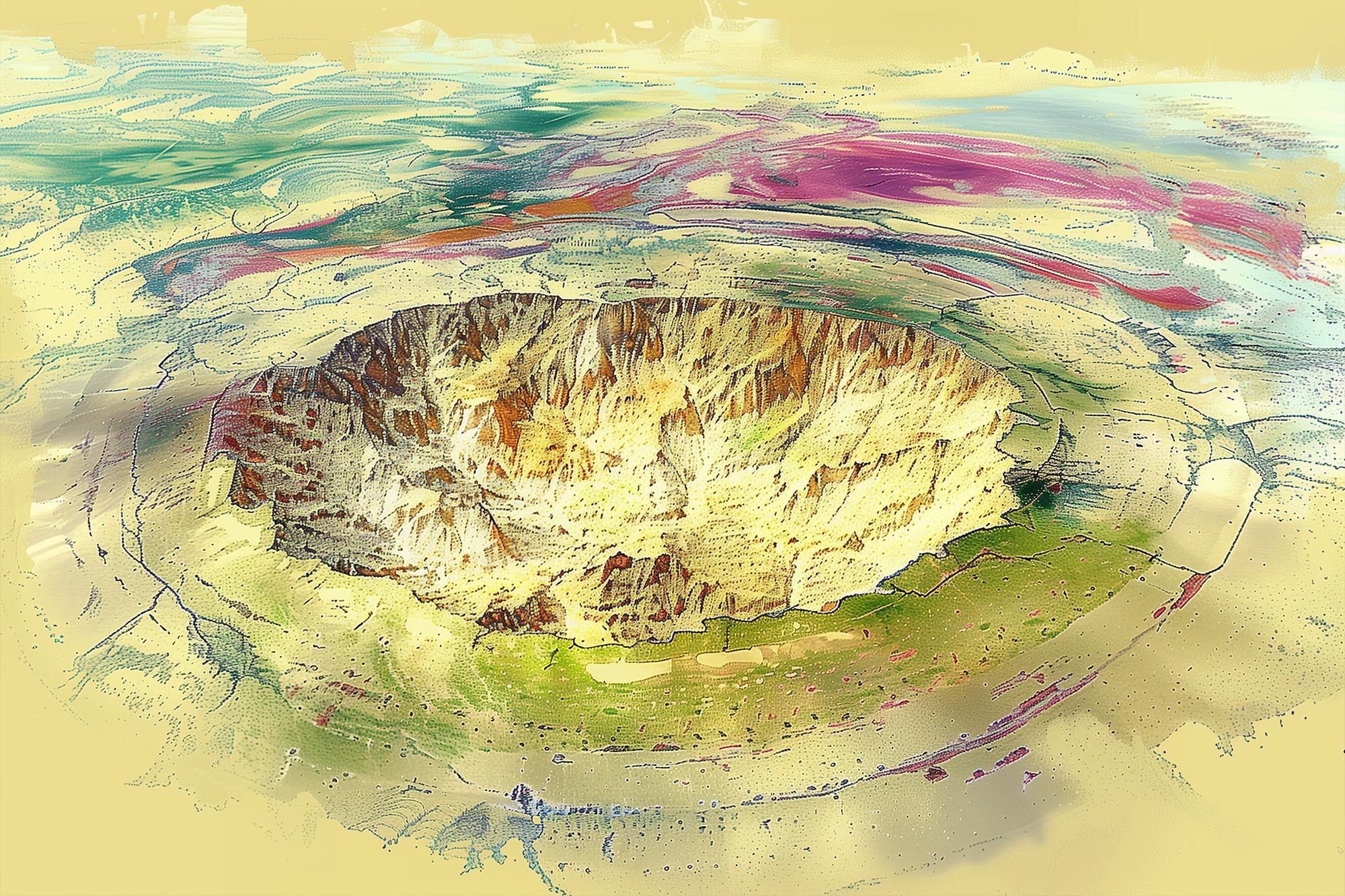
Research team is delving into history, exploring events that occurred hundreds of millions of years ago.
A potential crater over 370 miles (600 kilometers) wide in central Australia may transform our knowledge of Earth’s geological past.
Researcher Daniel Connelly and Virginia Commonwealth University’s Arif Sikder, Ph.D., believe they have found evidence to support the existence of MAPCIS – the Massive Australian Precambrian-Cambrian Impact Structure – which is a nonconcentric complex crater that could provide new insights into the geological and biological evolution of our planet.
“Working on the MAPCIS project has been an incredible journey,” said Sikder, an associate professor in the Center for Environmental Studies, a unit of VCU Life Sciences. “The data we’ve gathered offers a unique glimpse into the forces that have shaped our planet, and I’m excited about the future research this discovery will inspire.”
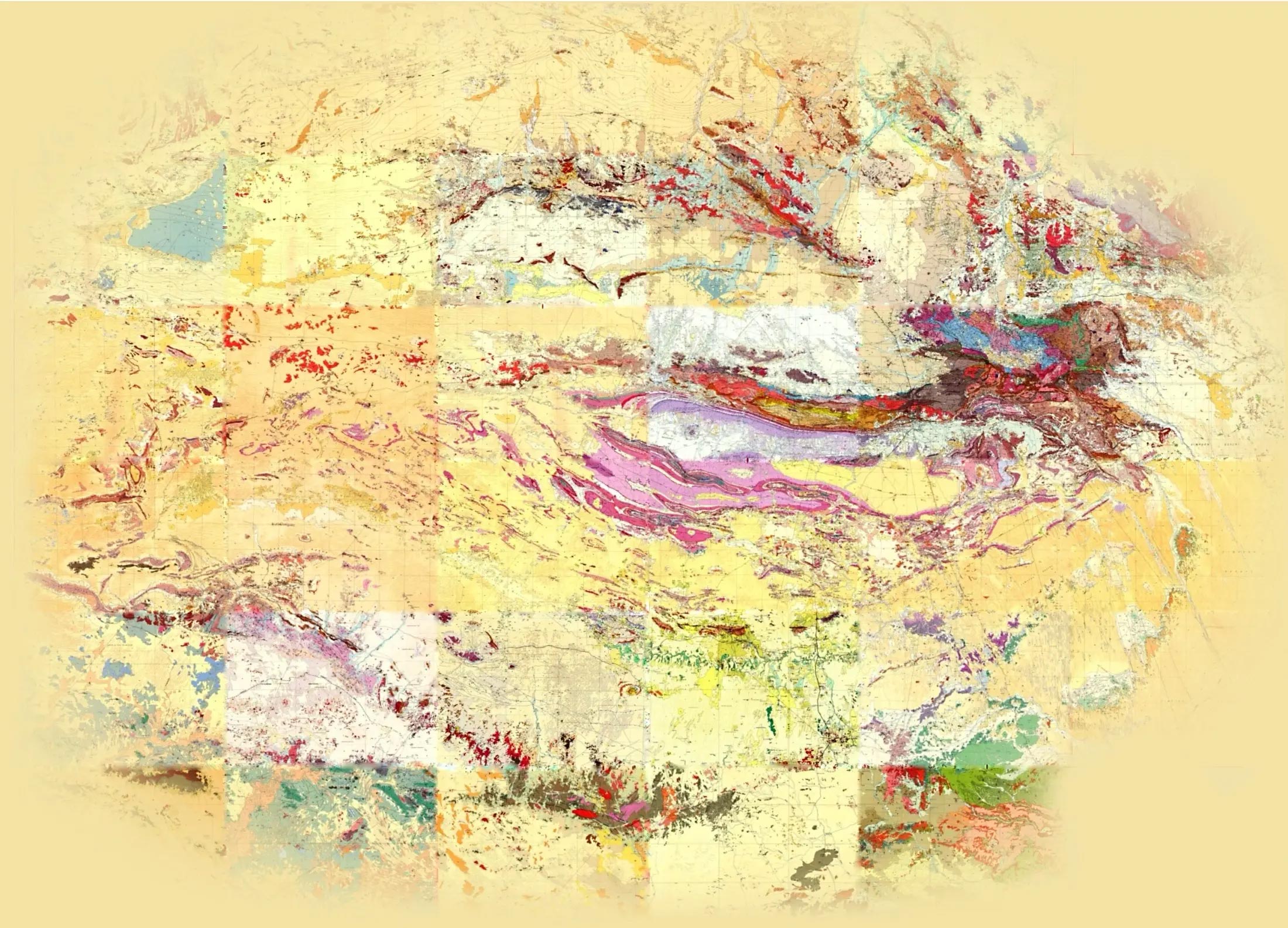
This September, Connelly will make a presentation in Anaheim, California, at Connects 2024, the Geological Society of America’s annual meeting. In August, he presented at the 37th International Geological Congress 2024 in Busan, South Korea. According to researchers, the impact occurred at the end of the Ediacaran period, within the Neoproterozoic Era, which spans from 1 billion to 538.8 million years ago.
Geological Evidence of the Impact
Among the geological evidence they have uncovered to support the age, size, and location of the impact are massive deposits of pseudotachylite breccia, or melt rock, near the crater center. The researchers found shocked minerals, including lonsdaleite, or shocked diamond, in the deposits, along with impact level amounts of iridium.
“The discovery of MAPCIS is a testament to the power of collaborative research,” Connelly said. “Our findings not only highlight the significance of this impact structure but also open new avenues for understanding Earth’s geological past.”
Meeting: Connects 2024
Never miss a breakthrough: Join the SciTechDaily newsletter.
Follow us on Google and Google News.
10 Comments
there are bigger ones, coming sometime?
Probably not. The more time goes on, the fewer there are to impact us, and the largest ones likely already have, or hit the moon, or Jupiter, or some other celestial body in our solar system. Our solar system is 4 Billion years old. And if you look at all the large impacts that we know about, the further back in time you look, the more frequent and large they become.
Not to say it’s impossible, but almost certainly not in the lifetime of anyone alive today.
Agreed. Large asteroid impacts, like the one that Earth experienced 65 million years ago, are extremely rare events. For example, the large impact sites visible on the Moon (the lunar maria) are all estimated to be at least 3 billion years old. As Alice pointed out, the larger planets (particularly Jupiter) sweep up a lot of the debris that might otherwise be crossing Earth’s orbit, such as Comet Shoemaker-Levy 9 in 1994. I would only add that, while I would not be too concerned about large asteroids, the number of large comets that could come into the inner solar system is still a potential threat, as the large outer planets won’t catch all of them.
Or you can just believe that god has your back and protects us all. God created all this and would not leave us unprotected. Hence the reason we are all thriving on planet earth.
Millions of years ago?
Uniformitarian ancient age theories unprovable pushed as fact.
Any big ones would likely come in from the Oort cloud or even from outside the system and be exceedingly rare. There appears to be a cycle of disturbances that send rocks our way every time our system passes through the center of the galactic planar disc where there’s a greater density of material that can gravitationally disturb our outer system, sending Oort objects towards the inner solar system where they can hit us, but we’re very unlikely to have anything massive hit us even then. The big concern is if the inner planets’ orbits destabilize slightly in a way that causes a cascade that ultimately pulls Mercury into a slingshot elliptical orbit that could cause it to hit any of the inner planets, including Earth and Luna.
Obviously a direct hit would be a Theia-level event and would reset Earth’s evolutionary clock to zero pretty immediately, so that would be bad; but hitting absolutely any of the other larger inner worlds like Mars, Venus, or even Ceres and Vesta, the two largest transjovian asteroids, or, provided Mercury fell towards the sun just the right way, any of the big jovian moons–you get big melty-hot chunks of Mercury and whatever it hit sent your way special delivery via curcumsolar shotgun gallery. The post-impact debris would fly out in all directions and get smeared out across the orbits of the inner planets all the way inward to the sun and as some would get flung out as far out as Uranus and Neptune’s orbits. That means in roughly the first 3-6 months after the collision, no matter where in the solar system it occurs, Earth’s sky would start to fill with small meteoric debris, which at first will look pretty, but when they start falling at a rate of 2 or more a minute per 25 square kilometers, the sky begins to heat up and fill with the pulverized debris of fast-approaching lava blobs that break apart and burn up just before impact, making it like breathing glass shards in a sauna within a month to six weeks. Then while most life dies out and goes extinct, the Big Chunks make it here of whatever world got smacked and smack us with likely far more force then the asteroid impact that killed the dinosaurs. Most or all of the crust of the planet, the atmosphere, the oceans, all vaporized and blasted into space. The only good news if it’s Venus, it will take longer, up to a year or more, for most of the horrible stuff to reach Earth because most of it will fall towards the sun first, some of it will fall directly into it, but easily more than half will get slingshotted around and thrown right at us, so we’ll have mainly pretty meteor showers for 18 months or so then a week of rapidly increasing frequency of meteors hitting the atmosphere and exploding before impact, then a bunch of much bigger very hot rocks that are still molten inside will start hitting the surface of the Earth and the Moon as well, sending more big hot pieces of Moon our way in addition to the chunks of molten Venus, basically causing a near total wipeout of all life. Near total, but likely not entirely total, so the restart begins with mostly a few microscopic species with a billion years of junk retroviral DNA and chunks of other evolved multicellular species in their genome that would often come along for the ride and a bunch of viruses and extremophiles that can survive being flung into space on a chunk of debris flung into orbit and then impacting back on whatever left of Earth later on to reseed it with life. But again the chances of Mercury destabilizing in the next 200 million years is small. So unless something makes that happen sooner, we’re probably safe from planet killers for a while.
Or the theory that as we travel thru space our solar system might just come thru an area of ancient debris or areas of supernova explosion and surely some kind of giant ore type asteroids are laying in wait for us to cross thru and be pulled in thru gravity and next thing ya know WHAM!!!!
We suddenly become irrelevant in the grand universal scheme and the scientists outside of their mega hydron collider are wondering what happened inside of their experiment did we just find a big bang theory? Get it yet folks?
You don’t get a lot of dates, do you? 😂😂😂😂
Ignorant response
Our solar system has completed some 20 orbits around the galactic center since its formation over 4 billion years ago. It passes through the denser parts of the galactic plane several times during each orbit (the oscillation period is around 30 to 40 million years). Anything that is encountered during these interactions is most likely to affect the outermost objects in the Oort Cloud and perhaps even the outer parts of the Kuiper Belt. Short of colliding with some interstellar flotsam (as mentioned by Jay B Fairweather above), it would require a very close pass by of another star to perturb the orbits of any of the planets. Given the number of interactions with the denser parts of the galactic plane over the past 4 billion years, I’d say that the orbits of the planets in our system have remained pretty stable, including Mercury. And while the possibility of a large impact from something lurking in the outer realms of our solar system has greatly lessened over time, it’s still the more likely threat, relatively speaking.