
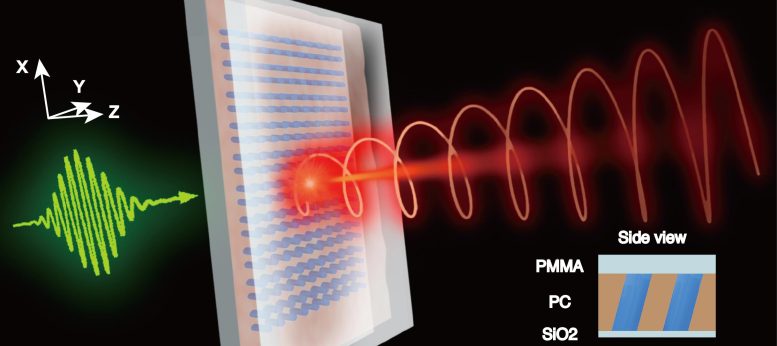
Chiral Quasi Bound States in the Continuum for High-Purity Circularly Polarized Light Source
Scientists demonstrate high-purity, highly directional, and high-Q circularly polarized light source from spontaneous emission to laser.
An ultra-compact circularly polarized light source is a crucial component for the applications of classical and quantum optics information processing. The development of this field relies on the advances of two technologies, quantum materials and chiral optical cavities.
Disadvantages of conventional approaches for circularly polarized photoluminescence include incoherent broadband emission, limited DOP, and large radiating angles. Their practical applications are restricted by low efficiency and energy waste as well as undesired handedness and emission directions. Chiral microlasers can have large DOPs and directional output, but only in specific power ranges. Most importantly, their subthreshold performances drop significantly. Thus far, the strategy for simultaneous control of chiral spontaneous emission and chiral lasing is still absent.
Chiral Quasi-Bound States in the Continuum (BICs)
In a new paper published today (September 8) in the journal Science, researchers from Harbin Institute of Technology and Australian National University employ the physics of chiral quasi bound states in the continuum (BICs) and demonstrate the efficient and controllable emission of circularly polarized light from resonant metasurfaces.
BICs with integer topological charge in momentum space and theoretically infinity Q factor have been investigated for many applications including nonlinear optics and lasing. By introducing in-plane asymmetry, BICs turn to be quasi-BICs with finite but still high Q factors. Interestingly, the integer topological charge of BICs mode would split into two half integer charges, which symmetrically distribute in momentum space and correspond to left- and right-handed circular polarization states, also known as C points.
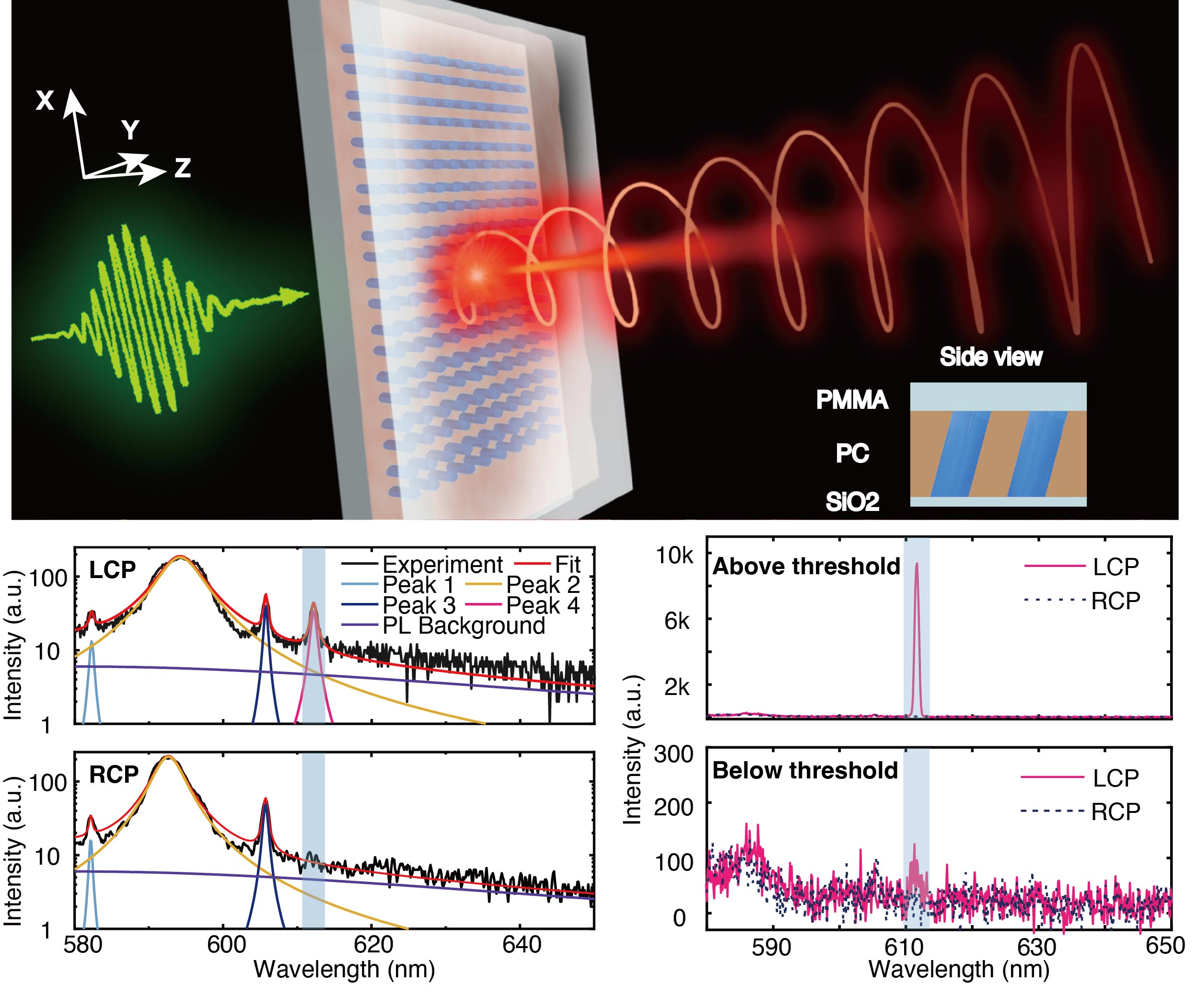
At the C points, incident light with one circular polarization state can be coupled into the nanostructures and produce dramatically enhanced local electromagnetic fields. The other polarization state is decoupled and almost perfectly transmit. Such characteristics are well known but rarely applied to light emissions. “This is mainly because the C points usually deviate from the bottom of band. They have relatively low Q factor and cannot be excited for lasing actions,” says Zhang.
Achieving High-Purity, Directional Chiral Light Emission
To realize the chiral light emission, a key step is to combine the local density of states with the intrinsic chirality at C points. If one C point is shifted to the bottom of the band, the Q factor of the corresponding chiral quasi-BIC can be maximal. According to Fermi’s golden rule, the radiation rate of one circularly polarized spontaneous emission is enhanced, whereas the other polarization is inhibited. Both the Q factor and the radiation rate reduce dramatically with the emission angle. As a result, high-purity and highly directional light emission can be expected near the G point.
“Of course, the other C point can support similar high chirality with opposite handedness. However, that point also deviates from the maximal Q factor and less be enhanced. Therefore, our metasurface only produces one near-unity circular polarization with high directionality around the normal direction,” says Zhang.
The control of C points in momentum space closely relates to the maximization of chirality in the normal direction. In principle, the realization of chirality relates to the simultaneous breaking of in-plane and out-of-plane mirror reflection symmetries. In this research, the scientists have introduced an out-of-plane asymmetry, the tilt of nanostructures. For an in-plane asymmetry, there is one out-of-plane asymmetry that can move one C point to G point. “We find two types of asymmetries are linearly dependent on one another. This makes the optimization of chirality in normal direction very easy,” says Zhang.
In the experiment, the researchers fabricated the metasurfaces with one-step slanted reactive ion etching process and characterized the emissions. Under the excitation of a nanosecond laser, they have successfully demonstrated the chiral emissions with a DOP of 0.98 and a far-field divergent angle of 1.06 degrees. “Our circularly light source is realized with the control of C point in momentum space and local density of state. It is independent of the excitation power,” said Zhang, “this is the reason that we can achieve the high Q, high directionality, and high purity circular polarization emission from spontaneous emission to lasing.”
Compared with conventional approaches, the chiral quasi-BIC provides a way to simultaneously modify and control radiation patterns, spectra, and spin angular momentum of photoluminescence and lasing without any spin injection. This approach may improve the design of current sources of chiral light and boost their practical applications in photonic and quantum systems.
Reference: “Chiral emission from resonant metasurfaces” by Xudong Zhang, Yilin Liu, Jiecai Han, Yuri Kivshar and Qinghai Song, 8 September 2022, Science.
DOI: 10.1126/science.abq7870
Never miss a breakthrough: Join the SciTechDaily newsletter.
Follow us on Google and Google News.
1 Comment
The motion of space-times is the interaction of countless topological vortex fields, and each vortex fields is the same body of clockwise and counterclockwise rotation. The spin period of the topological vortex-antivortex field pairs can provided with the fundamental nature of time. The absolute of time is that each vortex field has its own spin period. At the same time, the relative of time is different vortex fields may have different spin period.